Parekh Mohit, Romano Vito, Franch Antonella, Leon Pia, Birattari Federica, Borroni Davide, Kaye Stephen B, Ponzin Diego, Ahmad Sajjad, Ferrari Stefano
Institute of Ophthalmology, University College London, London, United Kingdom.
International Center for Ocular Physiopathology, The Veneto Eye Bank Foundation, Venice, Italy.
Am J Ophthalmol Case Rep. 2020 May 8;19:100737. doi: 10.1016/j.ajoc.2020.100737. eCollection 2020 Sep.
To investigate if shotgun-sequencing method could be useful in detailed diagnosis of herpes simplex virus (HSV) infection and compare it with the conventional diagnostic method.
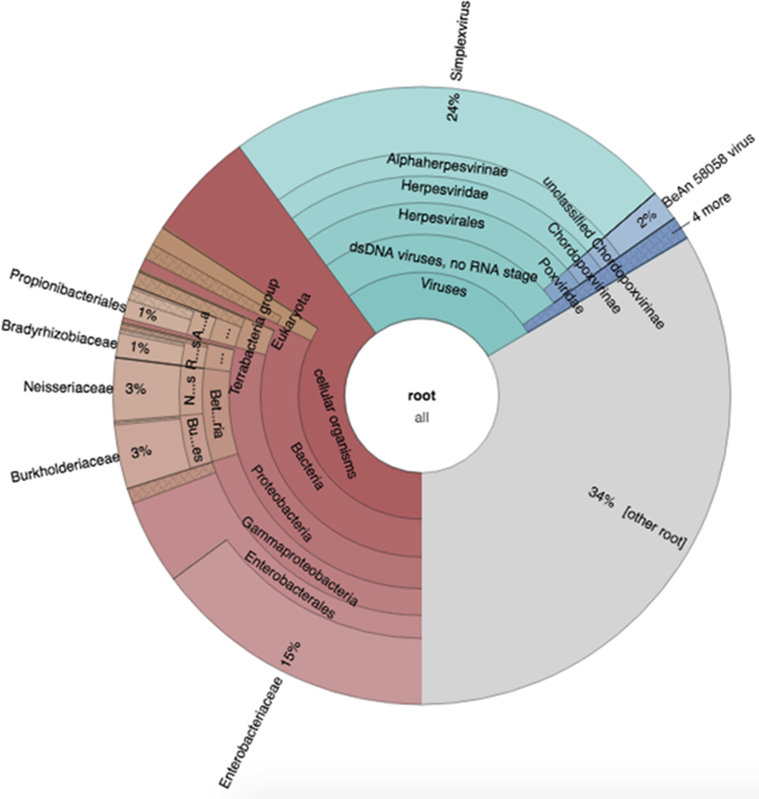
Using a sterile scraper, the infectious part of the ocular surface was scraped gently and placed on a glass slide for conventional diagnosis using PCR and histology and in RNA stabilizing reagent for shotgun sequencing respectively. Concentration of the DNA was determined using a sensitive fluorescence dye-based Qubit dsDNA HS Assay Kit. Shotgun-sequencing libraries were generated using the NEBNext DNA ultra II protocol. The samples were sequenced on the Illumina NextSeq 500 in high output mode with 2X150 bp paired-end sequencing. Taxonomic and functional profiles were generated.Conventional diagnostic method suspected herpetic keratitis. The results indicated presence of an amplified product of 92 bp positive HSV-DNA. Conventional diagnostic method detected the presence of Herpes Simplex Virus DNA (type 1). Shotgun sequencing confirmed the diagnosis of HSV along with the taxonomical profiling of the virus. These results were achieved using 1.9 ng/μL of DNA concentration (114 ng in 60 μL) of the total sample volume.
Shotgun sequencing is a hypothesis-free approach that identifies full taxonomic and functional profile of an organism. This technology is advantageous as it requires smaller sample size compared to conventional diagnostic methods.
研究鸟枪法测序方法是否可用于单纯疱疹病毒(HSV)感染的详细诊断,并将其与传统诊断方法进行比较。
使用无菌刮匙轻轻刮取眼表感染部位,分别置于载玻片上用于采用聚合酶链反应(PCR)和组织学的传统诊断,以及置于RNA稳定试剂中用于鸟枪法测序。使用基于灵敏荧光染料的Qubit双链DNA高灵敏度检测试剂盒测定DNA浓度。使用NEBNext DNA超二代方案构建鸟枪法测序文库。样本在Illumina NextSeq 500上以高产量模式进行2×150 bp双端测序,生成分类学和功能图谱。传统诊断方法怀疑为疱疹性角膜炎。结果显示存在92 bp的HSV-DNA阳性扩增产物。传统诊断方法检测到单纯疱疹病毒DNA(1型)的存在。鸟枪法测序证实了HSV的诊断以及该病毒的分类学分析。这些结果是在总样本体积DNA浓度为1.9 ng/μL(60 μL中含DNA 114 ng)的情况下获得的。
鸟枪法测序是一种无假设的方法,可识别生物体的完整分类学和功能图谱。该技术具有优势,因为与传统诊断方法相比,它所需的样本量更小。