Moore Matthew, Culpepper Steven, Phan K Luan, Strauman Timothy J, Dolcos Florin, Dolcos Sanda
Department of Psychology, University of Illinois at Urbana-Champaign, Urbana, IL, USA.
Beckman Institute, University of Illinois at Urbana-Champaign, Urbana, IL, USA.
Personal Neurosci. 2018 Jul 17;1:e8. doi: 10.1017/pen.2018.11. eCollection 2018.
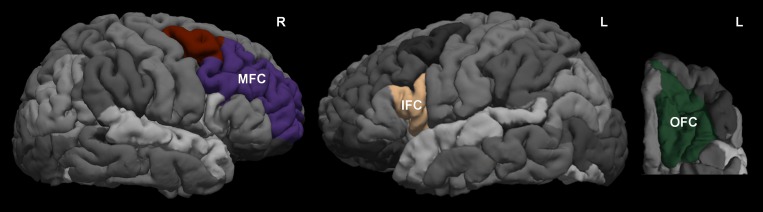
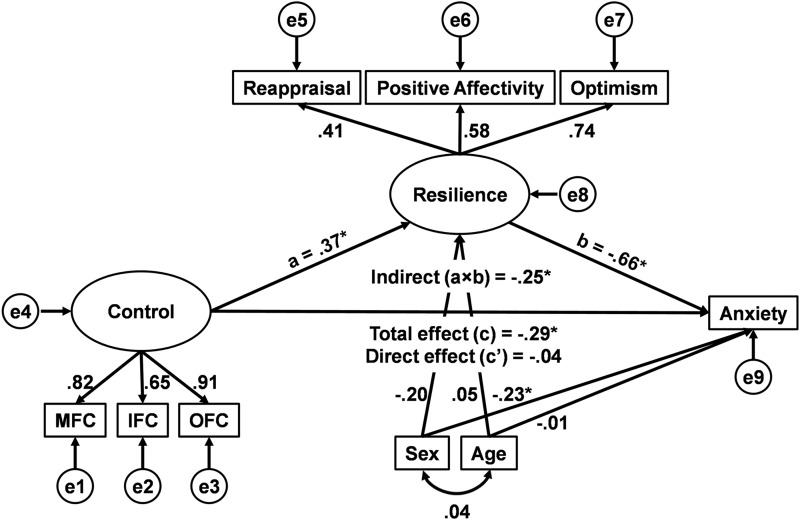
Clarifying individual differences that predict resilience or vulnerability to emotional distress is crucial for identifying etiological factors contributing to affective disturbances, and to promoting emotional well-being. Despite recent progress identifying specific brain regions and personality traits, it remains unclear whether there are common factors underlying the structural aspects of the brain and the personality traits that, in turn, protect against symptoms of emotional distress. In the present study, an integrative structural equation model was developed to examine the associations among (1) a latent construct of , representing the volumes of a system of prefrontal cortical (PFC) regions including middle, inferior, and orbital frontal cortices; (2) a latent construct of personality traits including cognitive reappraisal, positive affectivity, and optimism; and (3) and symptoms, in a sample of 85 healthy young adults. Results showed that the latent construct of PFC volumes positively predicted the latent construct of , which in turn negatively predicted . Mediation analysis confirmed that greater latent PFC volume is indirectly associated with lower symptoms through greater latent trait . The model did not show a significant mediation for . These results support the idea that there are common volumetric and personality factors that help protect against symptoms of emotional distress. These findings provide strong evidence that such brain-personality-symptom approaches can provide novel insights with valuable implications for understanding the interaction of these factors in healthy and clinically diagnosed individuals.
阐明能够预测恢复力或易受情绪困扰影响的个体差异,对于确定导致情感障碍的病因因素以及促进情绪健康至关重要。尽管最近在确定特定脑区和人格特质方面取得了进展,但尚不清楚大脑结构方面和人格特质背后是否存在共同因素,而这些因素反过来又能预防情绪困扰症状。在本研究中,开发了一个综合结构方程模型,以检验85名健康年轻成年人样本中以下三者之间的关联:(1)一个潜在结构,代表包括额中回、额下回和眶额皮质在内的前额叶皮质(PFC)区域系统的体积;(2)一个包括认知重评、积极情感和乐观主义的人格特质潜在结构;(3)抑郁和焦虑症状。结果表明,PFC体积的潜在结构正向预测了人格特质的潜在结构,而人格特质的潜在结构又负向预测了抑郁和焦虑症状。中介分析证实,更大的潜在PFC体积通过更大的潜在特质人格特质与更低的抑郁症状间接相关。该模型对焦虑症状未显示出显著的中介作用。这些结果支持了这样一种观点,即存在共同的体积和人格因素有助于预防情绪困扰症状。这些发现提供了有力证据,表明这种脑-人格-症状方法可以提供新的见解,对理解这些因素在健康个体和临床诊断个体中的相互作用具有重要意义。