Department of Pathology and Hepatology, The Fifth Medical Center of Chinese PLA General Hospital, Beijing, China.
Department of Infectious Diseases, The First Affiliated Hospital of Bengbu Medical College, Bengbu, China.
J Hepatol. 2020 Oct;73(4):807-816. doi: 10.1016/j.jhep.2020.05.002. Epub 2020 May 11.
BACKGROUND & AIMS: Liver enzyme abnormalities are common in patients with coronavirus disease 2019 (COVID-19). Whether or not severe acute respiratory syndrome coronavirus 2 (SARS-CoV-2) infection can lead to liver damage remains unknown. Herein, we reported the clinical characteristics and liver pathological manifestations of COVID-19 patients with liver enzyme abnormalities.
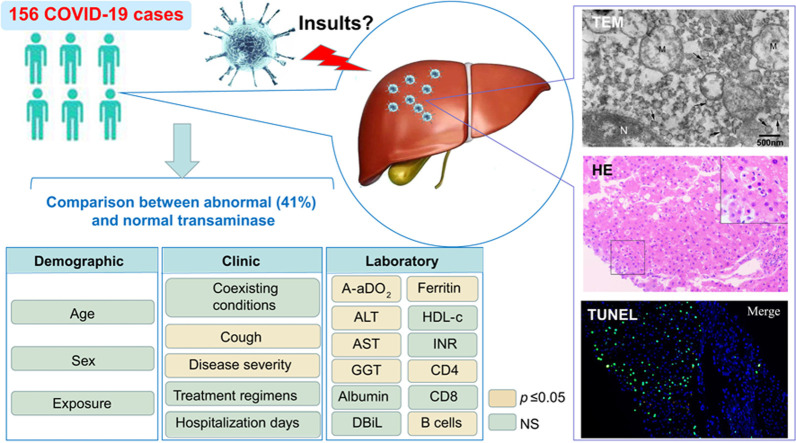
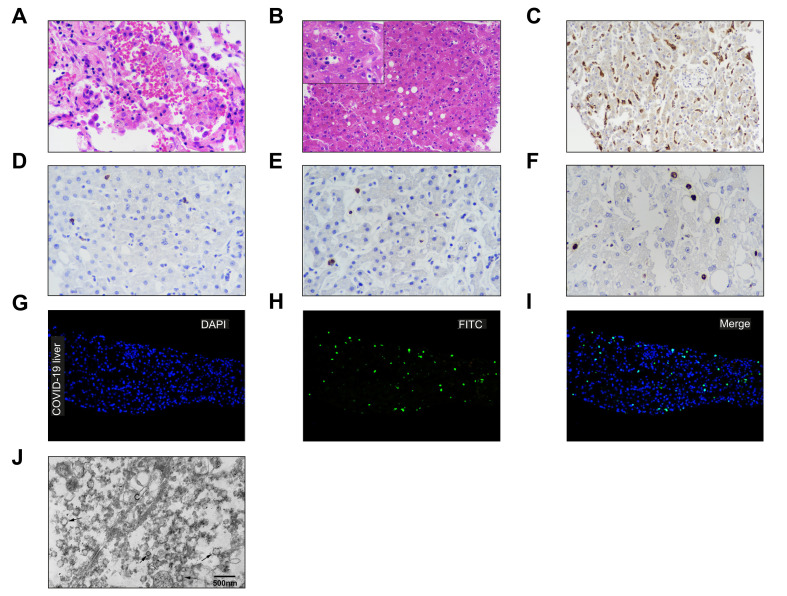
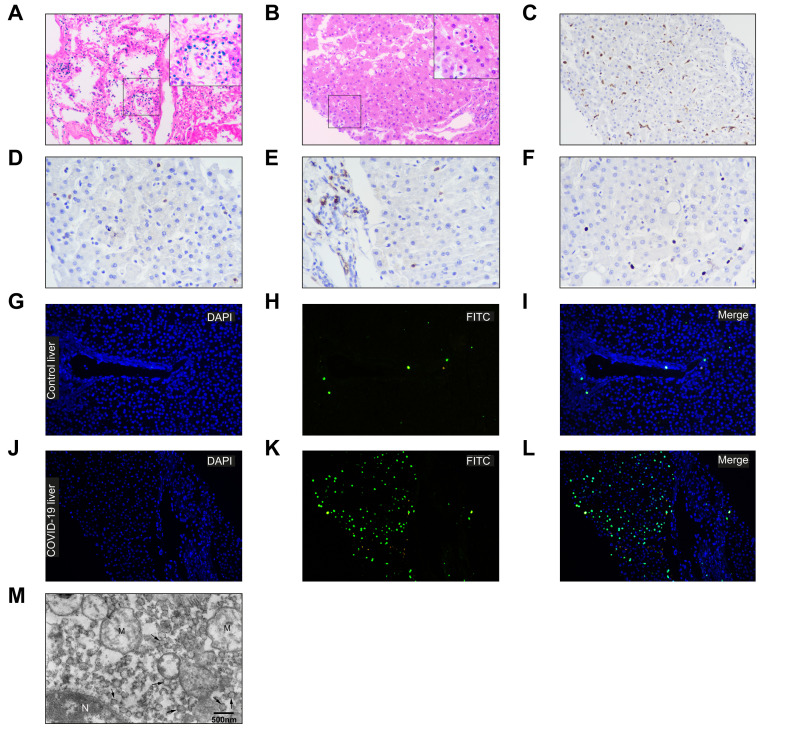
We analyzed 156 patients diagnosed with COVID-19 from 2 designated centers in China and compared clinical features between patients with or without elevated aminotransferases. Postmortem liver biopsies were obtained from 2 cases who had elevated aminotransferases. We investigated the patterns of liver impairment by electron microscopy, immunohistochemistry, TUNEL assay and pathological studies.
Sixty-four out of 156 (41.0%) patients with COVID-19 had elevated aminotransferases. The median levels of alanine aminotransferase were 50 U/L 19 U/L, respectively, aspartate aminotransferase were 45.5 U/L 24 U/L, respectively in abnormal and normal aminotransferase groups. Liver enzyme abnormalities were associated with disease severity, as well as a series of laboratory tests including higher alveolar-arterial oxygen partial pressure difference, higher gamma-glutamyltransferase, lower albumin, decreased CD4+ T cells and B lymphocytes. Ultrastructural examination identified typical coronavirus particles, characterized by spike structures, in the cytoplasm of hepatocytes in 2 COVID-19 cases. SARS-CoV-2-infected hepatocytes displayed conspicuous mitochondrial swelling, endoplasmic reticulum dilatation and glycogen granule decrease. Histologically, massive hepatic apoptosis and some binuclear hepatocytes were observed. Taken together, both ultrastructural and histological evidence indicated a typical lesion of viral infection. Immunohistochemical results showed scarce CD4+ and CD8+ lymphocytes. No obvious eosinophil infiltration, cholestasis, fibrin deposition, granuloma, massive central necrosis, or interface hepatitis were observed.
SARS-CoV-2 infection in the liver directly contributes to hepatic impairment in patients with COVID-19. Hence, a surveillance of viral clearance in liver and long-term outcome of COVID-19 is required.
Liver enzyme abnormalities are common in patients with coronavirus disease 2019 (COVID-19). We reported the clinical characteristics and liver pathological manifestations of COVID-19 patients with elevated liver enzymes. Our findings suggested that SARS-CoV-2 infection of the liver is a crucial factor contributing to hepatic impairment in patients with COVID-19.
新型冠状病毒病 2019(COVID-19)患者常出现肝酶异常。严重急性呼吸综合征冠状病毒 2(SARS-CoV-2)感染是否会导致肝损伤尚不清楚。在此,我们报告了 COVID-19 伴有肝酶异常患者的临床特征和肝脏病理表现。
我们分析了来自中国 2 个指定中心的 156 例确诊 COVID-19 患者,并比较了转氨酶升高与正常患者的临床特征。对 2 例转氨酶升高的患者进行了肝活检。我们通过电子显微镜、免疫组织化学、TUNEL 检测和组织病理学研究来研究肝损伤的模式。
156 例 COVID-19 患者中有 64 例(41.0%)出现肝酶升高。丙氨酸氨基转移酶升高组和正常组的中位水平分别为 50 U/L 和 19 U/L,天门冬氨酸氨基转移酶分别为 45.5 U/L 和 24 U/L。肝酶异常与疾病严重程度以及一系列实验室检查相关,包括肺泡-动脉氧分压差升高、γ-谷氨酰转移酶升高、白蛋白降低、CD4+T 细胞和 B 淋巴细胞减少。超微结构检查发现 2 例 COVID-19 患者的肝细胞胞质中存在典型的冠状病毒颗粒,具有刺突结构。感染 SARS-CoV-2 的肝细胞表现出明显的线粒体肿胀、内质网扩张和糖原颗粒减少。组织学上观察到大量肝凋亡和一些双核肝细胞。总之,超微结构和组织学证据均表明存在典型的病毒感染病变。免疫组织化学结果显示 CD4+和 CD8+淋巴细胞稀少。未见明显嗜酸性粒细胞浸润、胆汁淤积、纤维蛋白沉积、肉芽肿、大量中央坏死或界面肝炎。
SARS-CoV-2 感染肝脏直接导致 COVID-19 患者肝损伤。因此,需要监测肝脏中病毒的清除情况和 COVID-19 的长期结局。
新型冠状病毒病 2019(COVID-19)患者常出现肝酶异常。我们报告了 COVID-19 伴有肝酶升高患者的临床特征和肝脏病理表现。我们的研究结果表明,SARS-CoV-2 感染肝脏是导致 COVID-19 患者肝损伤的一个重要因素。