Laboratoire d'Anthropologie et de Psychologie Cliniques, Cognitives et Sociales (LAPCOS), Université Cote d'Azur, Nice, France.
School of Psychology, University of Keele, Keele, United Kingdom.
Sci Rep. 2020 May 21;10(1):8447. doi: 10.1038/s41598-020-65158-y.
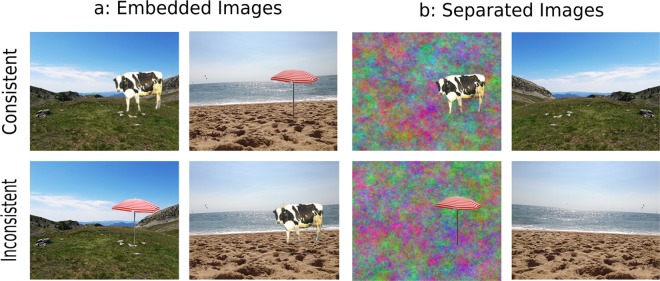
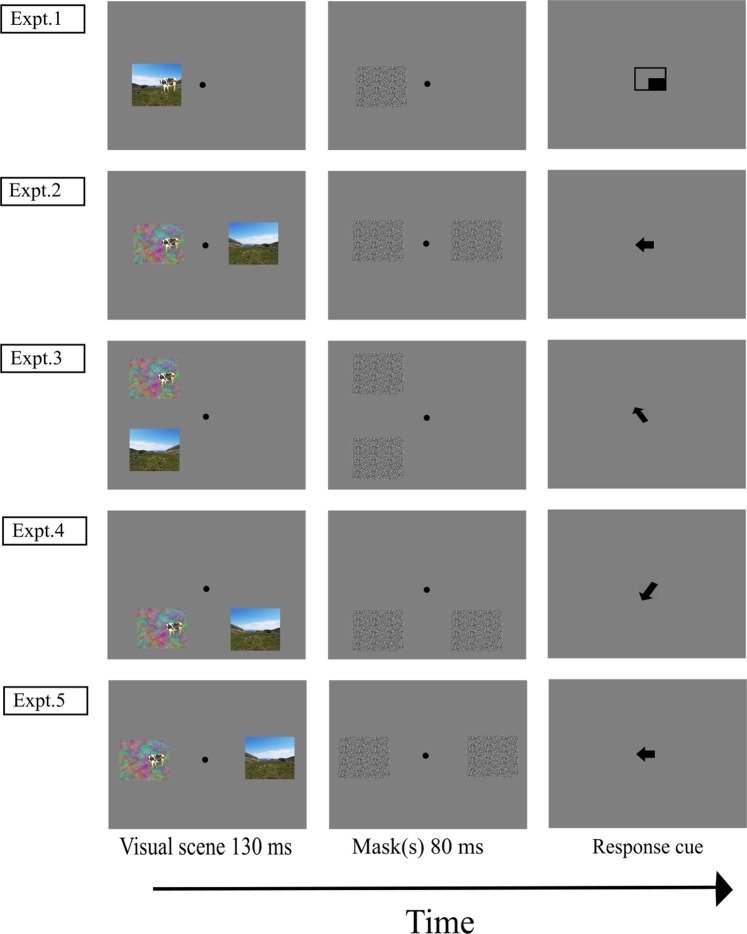
Visual categorization improves when object-context associations in scenes are semantically consistent, thus predictable from schemas stored in long-term memory. However, it is unclear whether this is due to differences in early perceptual processing, in matching of memory representations or in later stages of response selection. We tested these three concurrent explanations across five experiments. At each trial, participants had to categorize a scene context and an object briefly presented within the same image (Experiment 1), or separately in simultaneous images (Experiments 2-5). We analyzed unilateral (Experiments 1, 3) and bilateral presentations (Experiments 2, 4, 5), and presentations on the screen's horizontal midline (Experiments 1-2) and in the upper and lower visual fields (Experiments 3, 4). In all the experiments, we found a semantic consistency advantage for both context categorization and object categorization. This shows that the memory for object-context semantic associations is activated regardless of whether these two scene components are integrated in the same percept. Our study suggests that the facilitation effect of semantic consistency on categorization occurs at the stage of matching the percept with previous knowledge, supporting the object selection account and extending this framework to an object-context reciprocal influence on matching processes (object-context selection account).
当场景中的目标-上下文关联在语义上一致时,即可以从长期记忆中存储的模式中预测到,那么视觉分类会得到改善。然而,目前尚不清楚这是由于早期感知处理、记忆表示的匹配还是在反应选择的后期阶段的差异所致。我们在五个实验中测试了这三个同时发生的解释。在每个试验中,参与者必须对场景上下文和在同一图像中短暂呈现的对象进行分类(实验 1),或者在同时呈现的图像中分别进行分类(实验 2-5)。我们分析了单侧(实验 1、3)和双侧呈现(实验 2、4、5),以及屏幕水平中线(实验 1-2)和上下视野(实验 3、4)上的呈现。在所有实验中,我们都发现上下文分类和对象分类都存在语义一致性优势。这表明,无论这两个场景组件是否整合在同一个感知中,对目标-上下文语义关联的记忆都会被激活。我们的研究表明,语义一致性对分类的促进作用发生在将感知与先前知识匹配的阶段,支持对象选择理论,并将该框架扩展到对象-上下文对匹配过程的相互影响(对象-上下文选择理论)。