Program in Molecular Medicine, School of Life Sciences, National Yang-Ming University and Academia Sinica, Taipei, 11221, Taiwan.
Institute of Microbiology and Immunology, National Yang-Ming University, Taipei, 11221, Taiwan.
Sci Rep. 2020 May 21;10(1):8422. doi: 10.1038/s41598-020-65422-1.
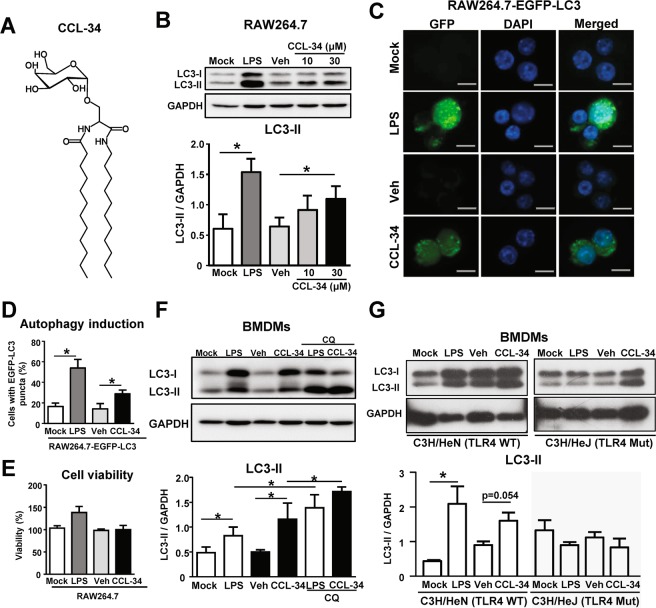
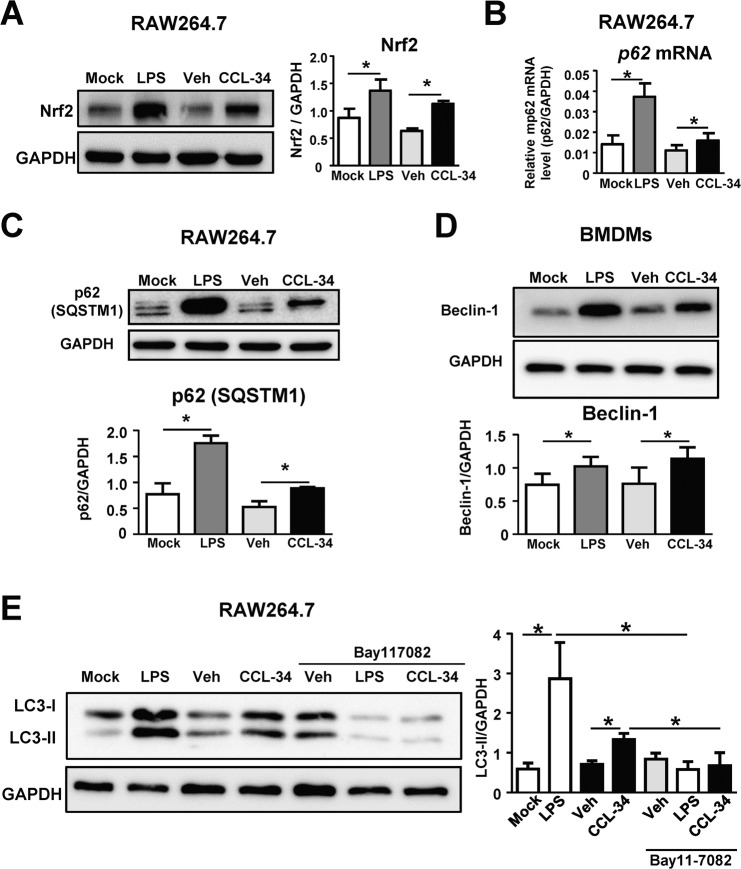
Toll-like receptors (TLRs) play crucial roles in host immune defenses. Recently, TLR-mediated autophagy is reported to promote immune responses via increasing antigen processing and presentation in antigen presenting cells. The present study examined whether the synthetic TLR4 activator (CCL-34) could induce autophagy to promote innate and adaptive immunity. In addition, the potential of CCL-34 as an immune adjuvant in vivo was also investigated. Our data using RAW264.7 cells and bone marrow-derived macrophages showed that CCL-34 induced autophagy through a TLR4-NF-κB pathway. The autophagy-related molecules (Nrf2, p62 and Beclin 1) were activated in RAW264.7 cells and bone marrow-derived macrophages under CCL-34 treatment. CCL-34-stimulated macrophages exhibited significant antigen-processing activity and induced the proliferation of antigen-specific CD4+T cells as well as the production of activated T cell-related cytokines, IL-2 and IFN-γ. Furthermore, CCL-34 immunization in mice induced infiltration of monocytes in the peritoneal cavity and elevation of antigen-specific IgG in the serum. CCL-34 treatment in vivo did not cause toxicity based on serum biochemical profiles. Notably, the antigen-specific responses induced by CCL-34 were attenuated by the autophagy inhibitor, 3-methyladenine. In summary, we demonstrated CCL-34 can induce autophagy to promote antigen-specific immune responses and act as an efficient adjuvant.
Toll 样受体 (TLRs) 在宿主免疫防御中发挥着至关重要的作用。最近有研究报道,TLR 介导的自噬通过增加抗原提呈细胞中的抗原加工和呈递来促进免疫反应。本研究旨在探讨合成 TLR4 激动剂 (CCL-34) 是否能够诱导自噬来促进固有和适应性免疫。此外,还研究了 CCL-34 作为体内免疫佐剂的潜力。我们使用 RAW264.7 细胞和骨髓来源的巨噬细胞的数据表明,CCL-34 通过 TLR4-NF-κB 途径诱导自噬。自噬相关分子 (Nrf2、p62 和 Beclin 1) 在 CCL-34 处理的 RAW264.7 细胞和骨髓来源的巨噬细胞中被激活。CCL-34 刺激的巨噬细胞表现出显著的抗原加工活性,并诱导抗原特异性 CD4+T 细胞的增殖以及激活的 T 细胞相关细胞因子 IL-2 和 IFN-γ 的产生。此外,CCL-34 免疫接种在小鼠中诱导腹腔单核细胞浸润和血清中抗原特异性 IgG 的升高。基于血清生化谱,CCL-34 治疗在体内不会引起毒性。值得注意的是,自噬抑制剂 3-甲基腺嘌呤可减弱 CCL-34 诱导的抗原特异性反应。综上所述,我们证明了 CCL-34 可以诱导自噬来促进抗原特异性免疫反应,并作为一种有效的佐剂。