Department of Oral Pathology, Alborz University of Medical Sciences, Karaj, Iran.
Department of Cognitive Neuroscience, Institute for Cognitive Science Studies, Tehran, Iran.
Sci Rep. 2020 May 21;10(1):8475. doi: 10.1038/s41598-020-65145-3.
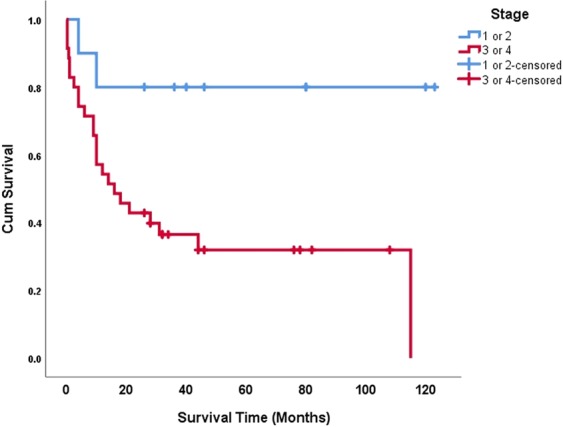
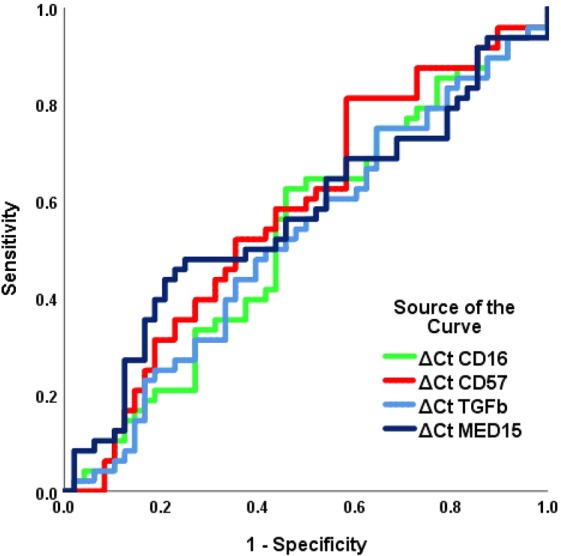
Owing to the high incidence and mortality of oral squamous cell carcinoma (OSCC), knowledge of its diagnostic and prognostic factors is of significant value. The biomarkers 'CD16, CD57, transforming growth factor beta 1 (TGF-β1), and MED15' can play crucial roles in tumorigenesis, and hence might contribute to diagnosis, prognosis, and treatment. Since there was no previous study on MED15 in almost all cancers, and since the studies on diagnostic/prognostic values of the other three biomarkers were a few in OSCC (if any) and highly controversial, this study was conducted. Biomarker expressions in all OSCC tissues and their adjacent normal tissues available at the National Tumor Bank (n = 4 biomarkers × [48 cancers + 48 controls]) were estimated thrice using qRT-PCR. Diagnostic values of tumors were assessed using receiver-operator characteristic (ROC) curves. Factors contributing to patients' survival over 10 years were assessed using multiple Cox regressions. ROC curves were used to estimate cut-off points for significant prognostic variables (α = 0.05). Areas under the curve pertaining to diagnostic values of all markers were non-significant (P > 0.15). Survival was associated positively with tumoral upregulation of TGF-β1 and downregulation of CD16, CD57, and MED15. It was also associated positively with younger ages, lower histological grades, milder Jacobson clinical TNM stages (and lower pathological Ns), smaller and thinner tumors, and surgery cases not treated with incisional biopsy (Cox regression, P < 0.05). The cut-off point for clinical stage -as the only variable with a significant area under the curve- was between the stages 2 and 3. Increased TGF-β1 and reduced CD16, CD57, and MED15 expressions in the tumor might independently favor the prognosis. Clinical TNM staging might be one of the most reliable prognostic factors, and stages above 2 can predict a considerably poorer prognosis.
由于口腔鳞状细胞癌(OSCC)的发病率和死亡率较高,因此了解其诊断和预后因素具有重要意义。生物标志物“CD16、CD57、转化生长因子-β1(TGF-β1)和 MED15”在肿瘤发生中起着至关重要的作用,因此可能有助于诊断、预后和治疗。由于之前在几乎所有癌症中都没有关于 MED15 的研究,并且由于其他三种生物标志物的诊断/预后价值的研究在 OSCC 中(如果有的话)很少且极具争议,因此进行了这项研究。使用 qRT-PCR 三次评估了国家肿瘤库中所有 OSCC 组织及其相邻正常组织中的生物标志物表达(4 种生物标志物×[48 例癌症+48 例对照])。使用接收器操作特性(ROC)曲线评估肿瘤的诊断价值。使用多 Cox 回归评估对患者 10 年以上生存有影响的因素。ROC 曲线用于估计具有显著预后意义的变量的截止点(α=0.05)。所有标志物的诊断价值相关曲线下面积均无统计学意义(P>0.15)。生存与肿瘤中 TGF-β1 的上调和 CD16、CD57 和 MED15 的下调呈正相关。它还与较年轻的年龄、较低的组织学分级、较温和的 Jacobson 临床 TNM 分期(和较低的病理 Ns)、较小和较薄的肿瘤以及未接受切开活检治疗的手术病例呈正相关(Cox 回归,P<0.05)。具有显著曲线下面积的唯一变量(临床分期)的截止点为 2 期和 3 期之间。肿瘤中 TGF-β1 的增加和 CD16、CD57 和 MED15 的表达减少可能独立地有利于预后。临床 TNM 分期可能是最可靠的预后因素之一,分期高于 2 可预测预后较差。