Computational Health Informatics Program, Boston Children's Hospital, Boston, USA.
Department of Pediatrics, Harvard Medical School, Boston, USA.
Sci Rep. 2020 May 21;10(1):8419. doi: 10.1038/s41598-020-65112-y.
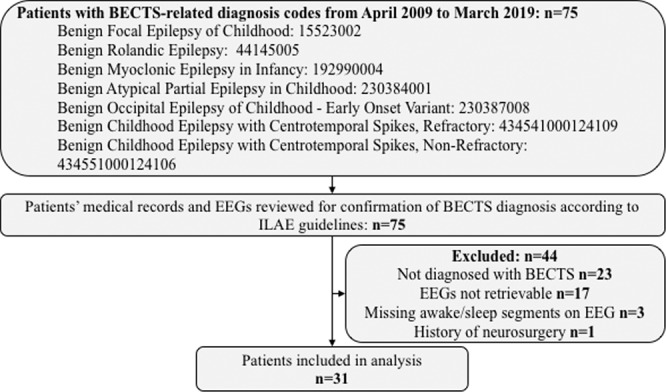
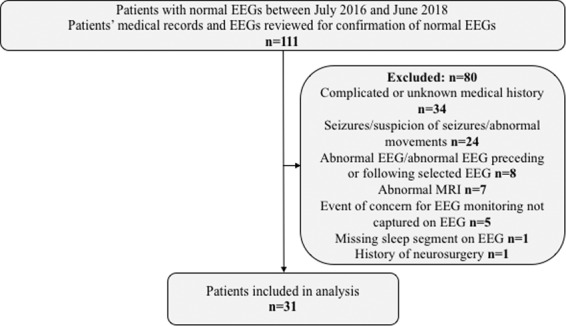
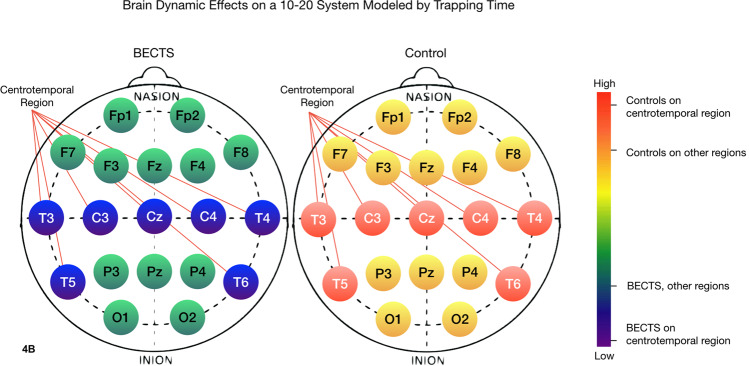
Childhood epilepsy with centrotemporal spikes, previously known as Benign Epilepsy with Centro-temporal Spikes (BECTS) or Rolandic Epilepsy, is one of the most common forms of focal childhood epilepsy. Despite its prevalence, BECTS is often misdiagnosed or missed entirely. This is in part due to the nocturnal and brief nature of the seizures, making it difficult to identify during a routine electroencephalogram (EEG). Detecting brain activity that is highly associated with BECTS on a brief, awake EEG has the potential to improve diagnostic screening for BECTS and predict clinical outcomes. For this study, 31 patients with BECTS were retrospectively selected from the BCH Epilepsy Center database along with a contrast group of 31 patients in the database who had no form of epilepsy and a normal EEG based on a clinical chart review. Nonlinear features, including multiscale entropy and recurrence quantitative analysis, were computed from 30-second segments of awake EEG signals. Differences were found between these multiscale nonlinear measures in the two groups at all sensor locations, while visual EEG inspection by a board-certified child neurologist did not reveal any distinguishing features. Moreover, a quantitative difference in the nonlinear measures (sample entropy, trapping time and the Lyapunov exponents) was found in the centrotemporal region of the brain, the area associated with a greater tendency to have unprovoked seizures, versus the rest of the brain in the BECTS patients. This difference was not present in the contrast group. As a result, the epileptic zone in the BECTS patients appears to exhibit lower complexity, and these nonlinear measures may potentially serve as a clinical screening tool for BECTS, if replicated in a larger study population.
儿童中央颞区棘波灶癫痫,以前称为良性癫痫伴中央颞区棘波(BECTS)或罗兰多癫痫,是最常见的儿童局灶性癫痫之一。尽管它很常见,但 BECTS 经常被误诊或完全漏诊。部分原因是癫痫发作具有夜间和短暂的特点,使得在常规脑电图(EEG)中很难识别。在短暂的清醒脑电图上检测与 BECTS 高度相关的脑活动有可能改善 BECTS 的诊断筛查,并预测临床结果。在这项研究中,通过回顾性地从 BCH 癫痫中心数据库中选择了 31 名 BECTS 患者,并与数据库中的 31 名无任何形式癫痫且根据临床图表审查脑电图正常的患者进行对比。从清醒脑电图信号的 30 秒片段中计算了非线性特征,包括多尺度熵和递归定量分析。在所有传感器位置,这两个组之间的这些多尺度非线性测量值存在差异,而由 board-certified 儿童神经病学家进行的视觉脑电图检查并未显示出任何有区别的特征。此外,在大脑中央颞区(与更有可能出现自发性癫痫相关的区域)而非 BECTS 患者大脑的其余部分,发现了非线性测量值(样本熵、捕获时间和李雅普诺夫指数)的定量差异。在对照组中不存在这种差异。因此,BECTS 患者的癫痫区似乎表现出较低的复杂性,这些非线性测量值如果在更大的研究人群中得到复制,可能成为 BECTS 的临床筛查工具。