Division of Developmental Medicine, Boston Children's Hospital, Harvard Medical School, Boston, MA, 02115, USA.
Department of Neurology, Boston Children's Hospital, Harvard Medical School, Boston, MA, 02115, USA.
J Neurodev Disord. 2021 Nov 30;13(1):57. doi: 10.1186/s11689-021-09405-x.
Early identification of autism spectrum disorder (ASD) provides an opportunity for early intervention and improved developmental outcomes. The use of electroencephalography (EEG) in infancy has shown promise in predicting later ASD diagnoses and in identifying neural mechanisms underlying the disorder. Given the high co-morbidity with language impairment, we and others have speculated that infants who are later diagnosed with ASD have altered language learning, including phoneme discrimination. Phoneme learning occurs rapidly in infancy, so altered neural substrates during the first year of life may serve as early, accurate indicators of later autism diagnosis.
Using EEG data collected at two different ages during a passive phoneme task in infants with high familial risk for ASD, we compared the predictive accuracy of a combination of feature selection and machine learning models at 6 months (during native phoneme learning) and 12 months (after native phoneme learning), and we identified a single model with strong predictive accuracy (100%) for both ages. Samples at both ages were matched in size and diagnoses (n = 14 with later ASD; n = 40 without ASD). Features included a combination of power and nonlinear measures across the 10‑20 montage electrodes and 6 frequency bands. Predictive features at each age were compared both by feature characteristics and EEG scalp location. Additional prediction analyses were performed on all EEGs collected at 12 months; this larger sample included 67 HR infants (27 HR-ASD, 40 HR-noASD).
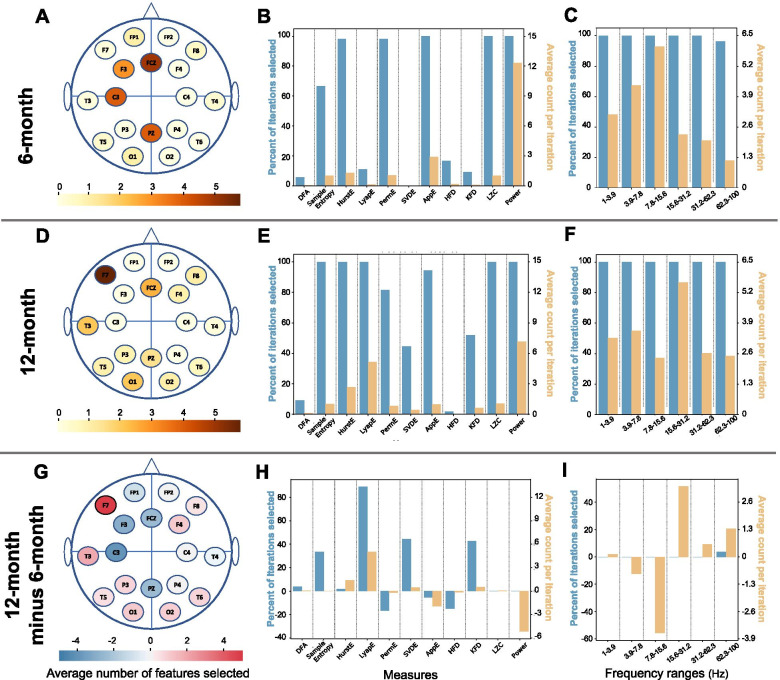
Using a combination of Pearson correlation feature selection and support vector machine classifier, 100% predictive diagnostic accuracy was observed at both 6 and 12 months. Predictive features differed between the models trained on 6- versus 12-month data. At 6 months, predictive features were biased to measures from central electrodes, power measures, and frequencies in the alpha range. At 12 months, predictive features were more distributed between power and nonlinear measures, and biased toward frequencies in the beta range. However, diagnosis prediction accuracy substantially decreased in the larger, more behaviorally heterogeneous 12-month sample.
These results demonstrate that speech processing EEG measures can facilitate earlier identification of ASD but emphasize the need for age-specific predictive models with large sample sizes to develop clinically relevant classification algorithms.
早期识别自闭症谱系障碍(ASD)为早期干预和改善发育结果提供了机会。在婴儿期使用脑电图(EEG)已显示出预测以后 ASD 诊断和识别障碍神经机制的潜力。鉴于与语言障碍的高共病率,我们和其他人推测,以后被诊断为 ASD 的婴儿的语言学习发生了改变,包括语音辨别。语音在婴儿期迅速学习,因此生命的第一年中改变的神经基质可能成为以后自闭症诊断的早期、准确指标。
使用在具有高 ASD 家族风险的婴儿进行被动语音任务时在两个不同年龄收集的 EEG 数据,我们比较了在 6 个月(在母语语音学习期间)和 12 个月(在母语语音学习之后)时特征选择和机器学习模型组合的预测准确性,并且确定了一个在两个年龄段都具有强预测准确性(100%)的单一模型。两个年龄段的样本大小和诊断均匹配(以后有 ASD 的 14 例;没有 ASD 的 40 例)。特征包括在 10-20 导联电极和 6 个频带中横跨的功率和非线性测量的组合。在每个年龄段比较预测特征时,既考虑了特征特征,又考虑了 EEG 头皮位置。在 12 个月时收集的所有 EEG 上进行了额外的预测分析;这个更大的样本包括 67 名 HR 婴儿(27 名 HR-ASD,40 名 HR-noASD)。
使用 Pearson 相关特征选择和支持向量机分类器的组合,在 6 个月和 12 个月时均观察到 100%的预测诊断准确性。在基于 6 个月和 12 个月数据训练的模型之间,预测特征有所不同。在 6 个月时,预测特征偏向于中央电极、功率测量和阿尔法频带的频率的测量。在 12 个月时,预测特征在功率和非线性测量之间分布更多,偏向于β频带的频率。但是,在更大、行为上更具异质性的 12 个月样本中,诊断预测准确性大大降低。
这些结果表明,语音处理 EEG 测量可以促进 ASD 的早期识别,但强调需要具有大样本量的特定年龄的预测模型来开发临床相关的分类算法。