Ma Danyan, Zheng Xuanling, Dong Lianqin, Zheng Caiyu, Chen Yun, Chen Zheng, Lin MingZhu, Li Xuejun, Li Zhibin, Liu Changqin
School of Medicine, Xiamen University, Xiamen City, Fujian Province, People's Republic of China.
Department of Endocrinology and Diabetes, Xiamen Clinical Medical Center for Endocrine and Metabolic Diseases, Fujian Province Key Laboratory of Diabetes Translational Medicine, The First Affiliated Hospital of Xiamen University, Xiamen City, Fujian Province, People's Republic of China.
Diabetes Metab Syndr Obes. 2020 Apr 28;13:1391-1398. doi: 10.2147/DMSO.S250694. eCollection 2020.
To explore the association of serum vitamin-D levels with the severity of obstructive sleep apnea (OSA) in patients with type 2 diabetes mellitus (T2DM).
A cross-sectional study of 136 patients with T2DM who underwent overnight polysomnography (PSG) tests and serum 25-hydroxyvitamin-D3 (25(OH)D3) level detections was conducted. Multivariable linear regression and logistic regression analyses were performed to determine the associations of serum 25(OH)D3 levels with apnea-hypopnea index (AHI) and obstructive sleep apnea (OSA).
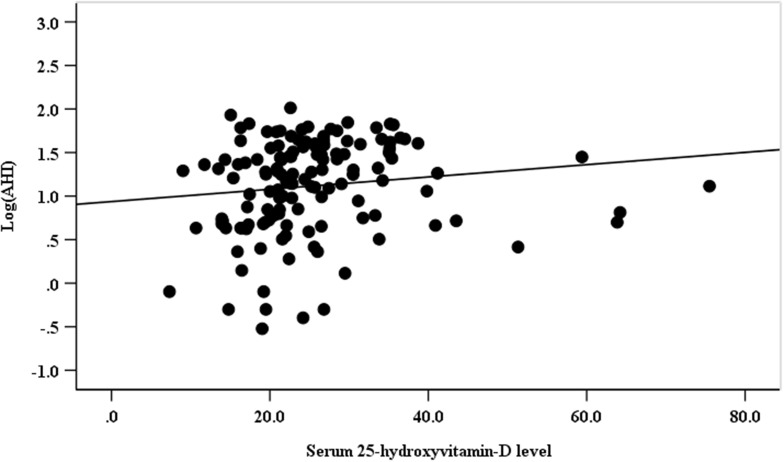
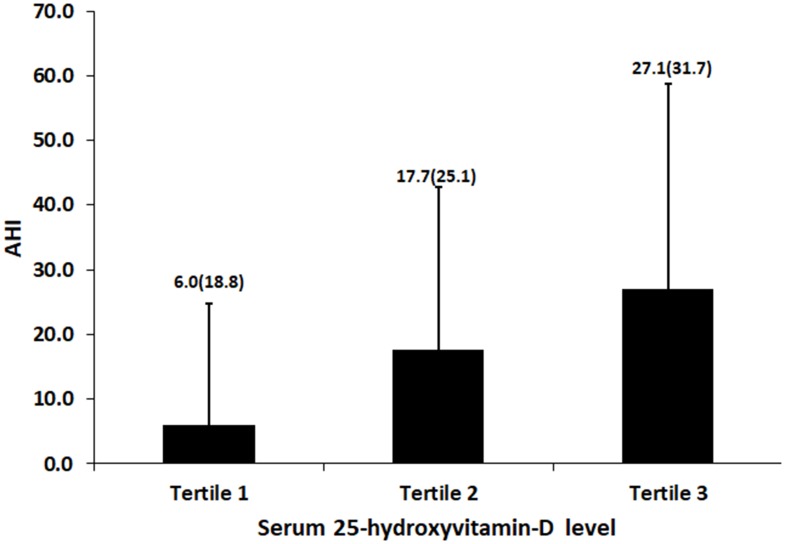
The prevalence rates of OSA were 84.4% for male and 65.2% for female patients, respectively (p = 0.011). With increasing severities of OSA categories (none, mild, moderate and severe), patients were more likely to be male and obese, but there was no significant difference in serum 25(OH)D3 level ((mean ± standard deviation) 21.8 ± 8.8, 27.7 ± 14.6, 24.2 ± 9.8 and 26.8 ± 6.2 ng/mL, respectively, p=0.086). Serum 25(OH)D3 level was not significantly correlated with AHI (log-transformed), with the correlation coefficient of 0.133 (p=0.124). With adjustment for potential confounding factors, multivariable linear regression and logistic regression analyses showed that serum 25(OH)D3 level was not significantly associated with either AHI (log-transformed) or the risk of OSA, with the standardized regression coefficient (95% confidence interval (CI)) of 0.098 (-0.004-0.014, p=0.252) and the adjusted odds ratio (95% CI) of 1.055 (0.991-1.124, p=0.095), respectively.
Serum 25(OH)D3 level was not significantly associated with either AHI or the risk of OSA in patients with T2DM.
探讨2型糖尿病(T2DM)患者血清维生素D水平与阻塞性睡眠呼吸暂停(OSA)严重程度之间的关联。
对136例接受夜间多导睡眠图(PSG)检查及血清25-羟维生素D3(25(OH)D3)水平检测的T2DM患者进行横断面研究。采用多变量线性回归和逻辑回归分析来确定血清25(OH)D3水平与呼吸暂停低通气指数(AHI)及阻塞性睡眠呼吸暂停(OSA)之间的关联。
男性和女性患者的OSA患病率分别为84.4%和65.2%(p = 0.011)。随着OSA严重程度分类(无、轻度、中度和重度)的增加,患者更可能为男性且肥胖,但血清25(OH)D3水平无显著差异((均值±标准差)分别为21.8±8.8、27.7±14.6、24.2±9.8和26.8±6.2 ng/mL,p = 0.086)。血清25(OH)D3水平与AHI(对数转换后)无显著相关性,相关系数为0.133(p = 0.124)。在对潜在混杂因素进行校正后,多变量线性回归和逻辑回归分析显示,血清25(OH)D3水平与AHI(对数转换后)或OSA风险均无显著关联,标准化回归系数(95%置信区间(CI))为0.098(-0.004 - 0.014,p = 0.252),调整后的比值比(95% CI)为1.055(0.991 - 1.124,p = 0.095)。
T2DM患者的血清25(OH)D3水平与AHI或OSA风险均无显著关联。