State Key Laboratory of Natural Medicines, Department of Pharmaceutics, China Pharmaceutical University, Nanjing 210009, China.
Center for Drug Delivery and Nanomedicine, Department of Pharmaceutical Sciences, University of Nebraska Medical Center, Omaha, NE 68198, USA.
Sci Adv. 2020 May 15;6(20):eaaz9240. doi: 10.1126/sciadv.aaz9240. eCollection 2020 May.
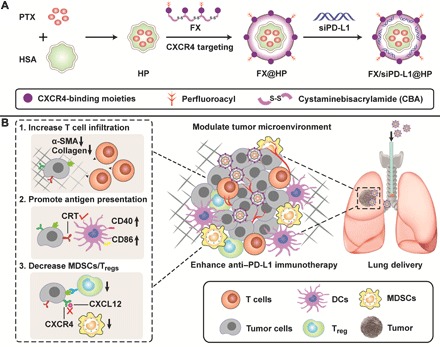
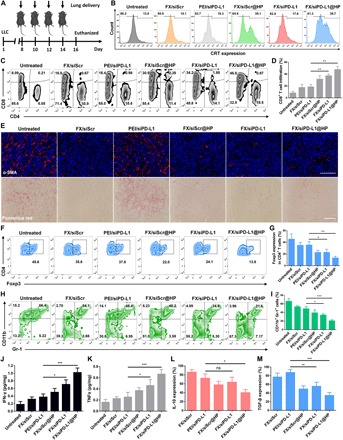
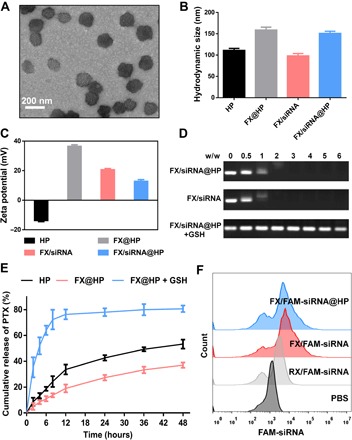
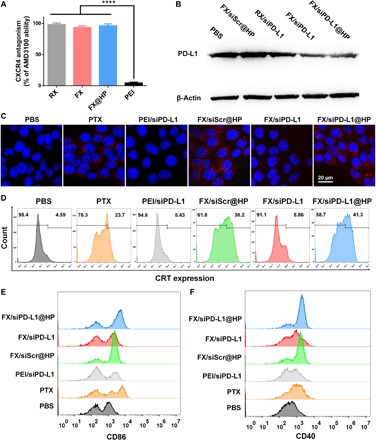
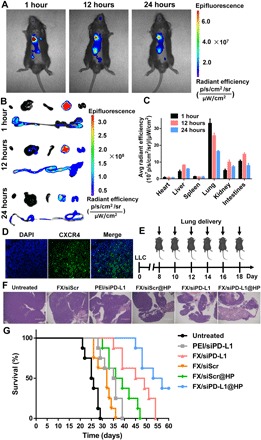
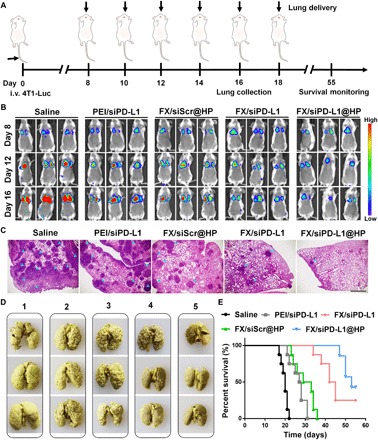
Anti-programmed cell death 1 ligand 1 (PD-L1) therapy is extraordinarily effective in select patients with cancer. However, insufficient lymphocytic infiltration, weak T cell-induced inflammation, and immunosuppressive cell accumulation in the tumor microenvironment (TME) may greatly diminish the efficacy. Here, we report development of the FX@HP nanocomplex composed of fluorinated polymerized CXCR4 antagonism (FX) and paclitaxel-loaded human serum albumin (HP) for pulmonary delivery of anti-PD-L1 small interfering RNA (siPD-L1) to treat orthotopic lung tumors. FX@HP induced T cell infiltration, increased expression of calreticulin on tumor cells, and reduced the myeloid-derived suppressor cells/regulatory T cells in the TME, thereby acting synergistically with siPD-L1 for effective immunotherapy. Our work suggests that the CXCR4-inhibiting nanocomplex decreases tumor fibrosis, facilitates T cell infiltration and relieves immunosuppression to modulate the immune process to improve the objective response rate of anti-PD-L1 immunotherapy.
抗程序性细胞死亡蛋白 1 配体 1(PD-L1)治疗在某些癌症患者中非常有效。然而,肿瘤微环境(TME)中淋巴细胞浸润不足、T 细胞诱导的炎症反应较弱以及免疫抑制细胞积聚,可能会大大降低疗效。在这里,我们报告了由氟化聚合趋化因子受体 4 拮抗(FX)和载紫杉醇人血清白蛋白(HP)组成的 FX@HP 纳米复合物的开发,用于肺部递送抗 PD-L1 小干扰 RNA(siPD-L1),以治疗原位肺肿瘤。FX@HP 诱导 T 细胞浸润,增加肿瘤细胞钙网蛋白的表达,并减少 TME 中的髓源性抑制细胞/调节性 T 细胞,从而与 siPD-L1 协同作用,进行有效的免疫治疗。我们的工作表明,CXCR4 抑制纳米复合物可减少肿瘤纤维化,促进 T 细胞浸润并缓解免疫抑制,从而调节免疫过程,提高抗 PD-L1 免疫治疗的客观缓解率。