Khunti Kamlesh, Hassanein Mohamed, Lee Moon-Kyu, Mohan Viswanathan, Amod Aslam
Diabetes Research Centre, University of Leicester, Leicester, UK.
Department of Endocrinology, Dubai Hospital, Dubai, United Arab Emirates.
Diabetes Ther. 2020 Aug;11(Suppl 2):33-48. doi: 10.1007/s13300-020-00833-x. Epub 2020 May 21.
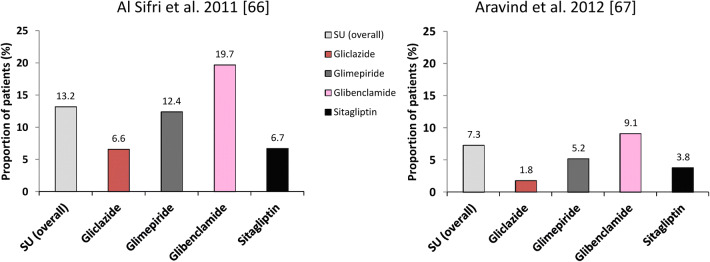
In patients with type 2 diabetes mellitus (T2DM) who require additional glucose-lowering on top of first-line metformin monotherapy, sulfonylureas are the most common choice for second-line therapy followed by dipeptidyl peptidase inhibitors (DPP-4i). This article summarises presentations at a symposium entitled "Real-World Evidence and New Perspectives with Gliclazide MR" held at the International Diabetes Federation Congress in Busan, South Korea on 4 December 2019. Although guideline recommendations vary between countries, the guidelines with the highest quality ratings include sulfonylureas as one of the preferred choices as second-line therapy for T2DM. Data from randomised controlled trials (RCTs) have consistently demonstrated that sulfonylureas are effective glucose-lowering agents and that the risk of severe hypoglycaemia with these agents is low. In addition, both RCTs and real-world observational studies have shown no increased risk of mortality or cardiovascular disease with the use of newer-generation sulfonylureas compared with other classes of glucose-lowering treatments. However, differences between sulfonylureas do exist, with gliclazide being associated with a significantly lower risk of mortality or cardiovascular mortality compared with glibenclamide, as well as the lowest incidence of severe hypoglycaemia compared with other agents in this class. Recent real-world studies into the effectiveness and safety of gliclazide appear to confirm these findings, and publication of new data from these studies in patients with T2DM in the UK, and in Muslim patients who are fasting during Ramadan, are awaited with interest. Another study being undertaken with gliclazide is a pan-India study in patients with maturity-onset diabetes of the young (MODY) subtypes 1, 3 and 12. Patients with these MODY subtypes respond particularly well to sulfonylurea treatment, and sulfonylureas are the first-line agents of choice in these patients. These new and ongoing studies will add to the cumulative data on the efficacy and safety of certain sulfonylureas in patients with diabetes.
在需要在一线二甲双胍单药治疗基础上进一步降低血糖的2型糖尿病(T2DM)患者中,磺脲类药物是二线治疗最常用的选择,其次是二肽基肽酶抑制剂(DPP-4i)。本文总结了2019年12月4日在韩国釜山国际糖尿病联盟大会上举行的题为“格列齐特缓释片的真实世界证据和新视角”研讨会的发言内容。尽管各国的指南建议有所不同,但质量评级最高的指南将磺脲类药物列为T2DM二线治疗的首选药物之一。随机对照试验(RCT)的数据一致表明,磺脲类药物是有效的降糖药物,使用这些药物发生严重低血糖的风险较低。此外,RCT和真实世界观察性研究均表明,与其他降糖治疗类别相比,使用新一代磺脲类药物不会增加死亡或心血管疾病风险。然而,磺脲类药物之间确实存在差异,与格列本脲相比,格列齐特的死亡或心血管死亡风险显著较低,与该类其他药物相比,严重低血糖的发生率也最低。最近关于格列齐特有效性和安全性的真实世界研究似乎证实了这些发现,人们期待着在英国T2DM患者以及斋月期间禁食的穆斯林患者中发表这些研究的新数据。另一项关于格列齐特的研究是在印度针对年轻的成年发病型糖尿病(MODY)1、3和12亚型患者进行的全印度研究。这些MODY亚型患者对磺脲类治疗反应特别好,磺脲类药物是这些患者的一线首选药物。这些新的和正在进行的研究将增加关于某些磺脲类药物在糖尿病患者中疗效和安全性的累积数据。