University of Colorado Boulder, Department of Electrical, Computer and Energy Engineering, Boulder,, United States.
University of Colorado Boulder, Department of Applied Mathematics, Boulder, Colorado, United States.
J Biomed Opt. 2020 May;25(5):1-13. doi: 10.1117/1.JBO.25.5.056501.
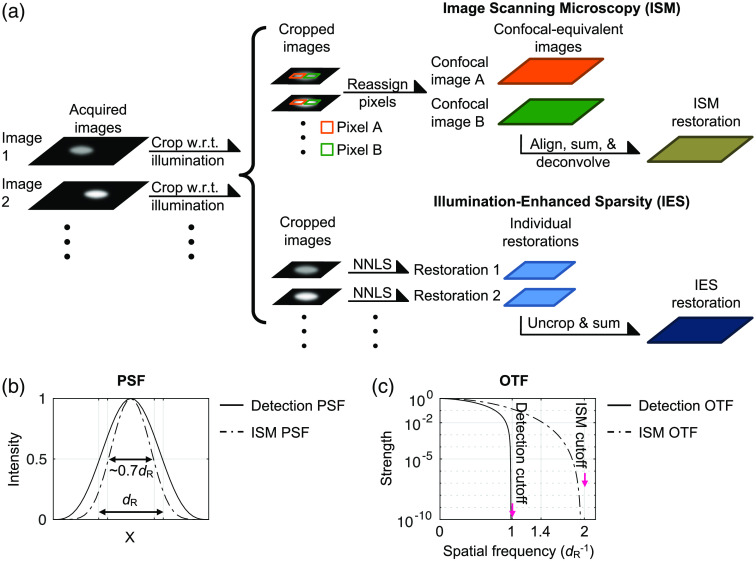
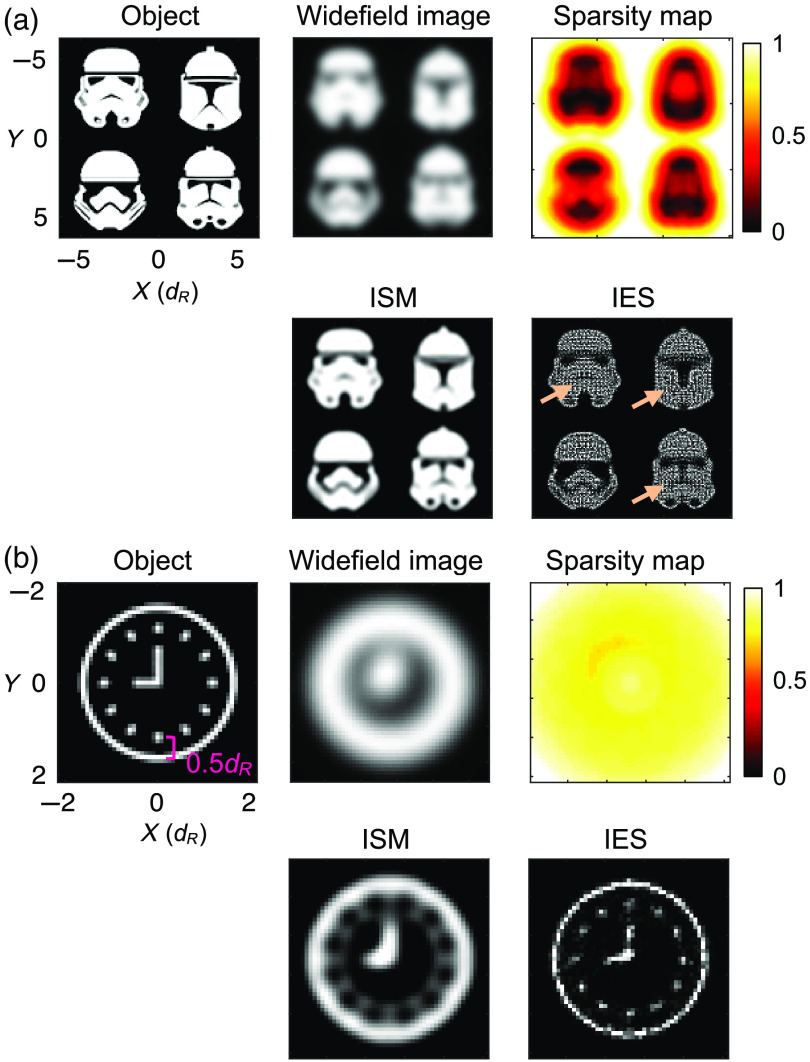
It is commonly assumed that using the objective lens to create a tightly focused light spot for illumination provides a twofold resolution improvement over the Rayleigh resolution limit and that resolution improvement is independent of object properties. Nevertheless, such an assumption has not been carefully examined. We examine this assumption by analyzing the performance of two super-resolution methods, known as image scanning microscopy (ISM) and illumination-enhanced sparsity (IES).
We aim to identify the fundamental differences between the two methods, and to provide examples that help researchers determine which method to utilize for different imaging conditions.
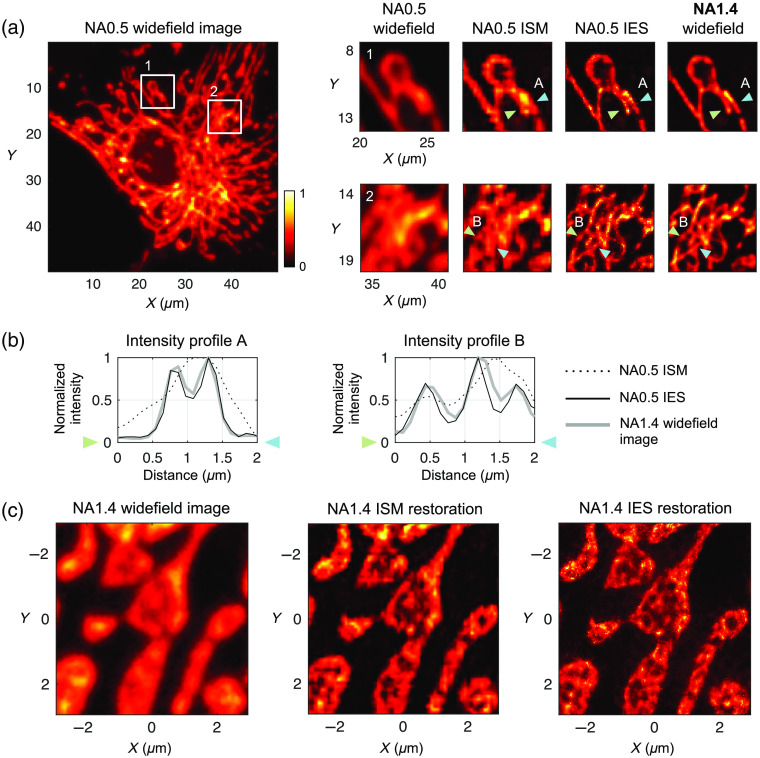
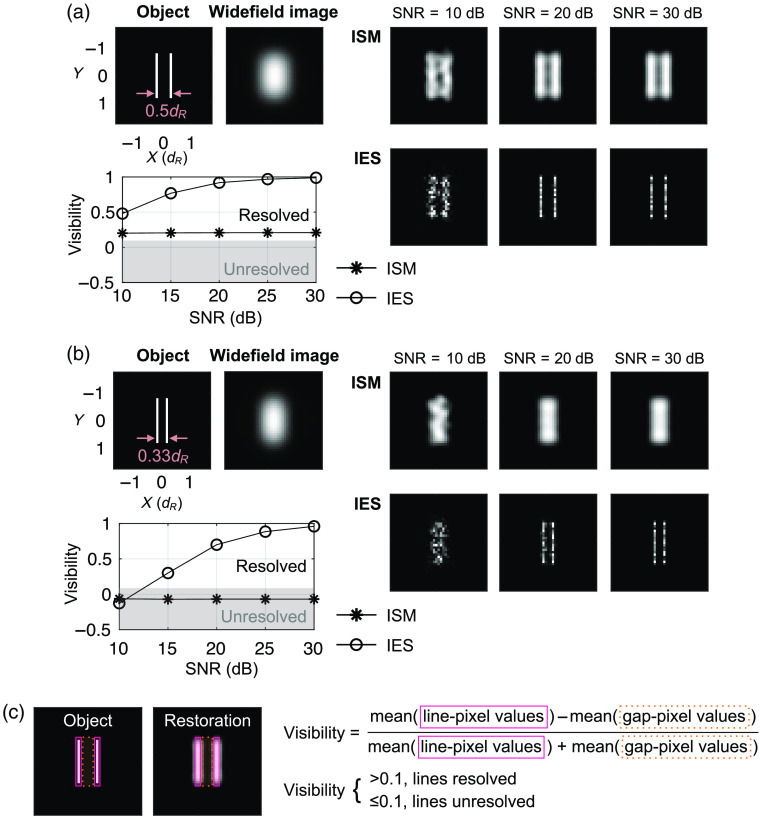
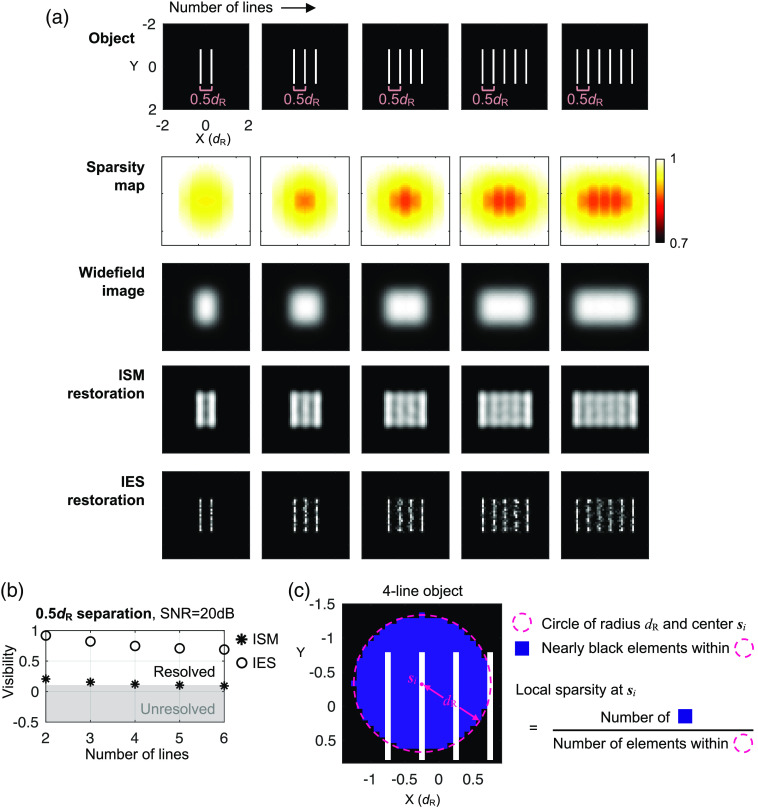
We input the same image datasets into the two methods and analyze their restorations. In numerical simulations, we design objects of distinct brightness and sparsity levels for imaging. We use biological imaging experiments to verify the simulation results.
The resolution of IES often exceeds twice the Rayleigh resolution limit when imaging sparse objects. A decrease in object sparsity negatively affects the resolution improvement in both methods.
The IES method is superior for imaging sparse objects with its main features being bright and small against a dark, large background. For objects that are largely bright with small dark features, the ISM method is favorable.
人们普遍认为,使用物镜创建用于照明的紧密聚焦光斑可以提供两倍于瑞利分辨率极限的分辨率提高,并且分辨率提高与物体性质无关。然而,这种假设尚未经过仔细检查。我们通过分析两种超分辨率方法(称为图像扫描显微镜(ISM)和照明增强稀疏性(IES))的性能来检验该假设。
我们旨在确定这两种方法之间的根本区别,并提供有助于研究人员确定在不同成像条件下使用哪种方法的示例。
我们将相同的图像数据集输入到两种方法中,并分析它们的恢复结果。在数值模拟中,我们设计了具有不同亮度和稀疏度水平的物体进行成像。我们使用生物成像实验来验证模拟结果。
当对稀疏物体进行成像时,IES 的分辨率通常超过瑞利分辨率极限的两倍。物体稀疏度的降低会对两种方法的分辨率提高产生负面影响。
IES 方法在对具有明亮和小的背景与暗、大背景的稀疏物体进行成像方面具有优势。对于主要为明亮且带有小暗特征的物体,ISM 方法更为有利。