Institute of Clinical Medicine - Neurology, University of Eastern Finland, Kuopio, Finland.
Neuro Center, Neurology, Kuopio University Hospital, Kuopio, Finland.
Ann Clin Transl Neurol. 2020 Jun;7(6):903-910. doi: 10.1002/acn3.51041. Epub 2020 May 22.
The aim of the present study was to compare the levels of serum neurofilament light chain (sNfL) in frontotemporal lobar degeneration (FTLD) patients of different clinical subtypes (bvFTD, PPA, and FTLD-MND) and with or without the C9orf72 repeat expansion, and to correlate sNfL levels to disease progression, assessed by the brain atrophy rate and survival time.
The sNfL levels were determined from 78 FTLD patients (C9orf72 repeat expansion carriers [n = 26] and non-carriers [n = 52]) with Single Molecule Array (SIMOA). The progression of brain atrophy was evaluated using repeated T1-weighted MRI scans and the survival time from medical records.
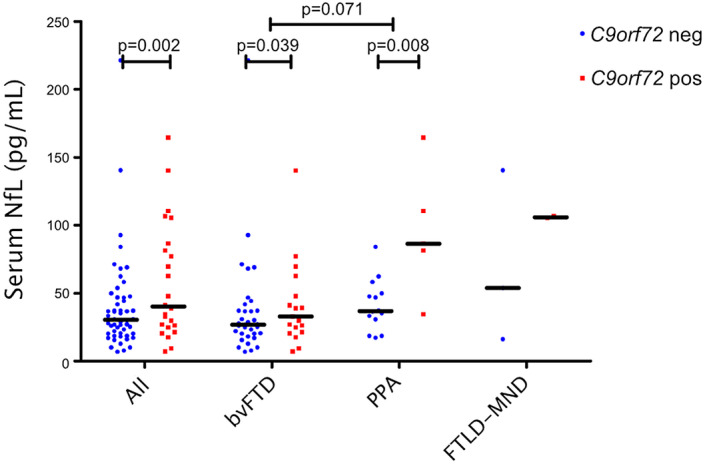
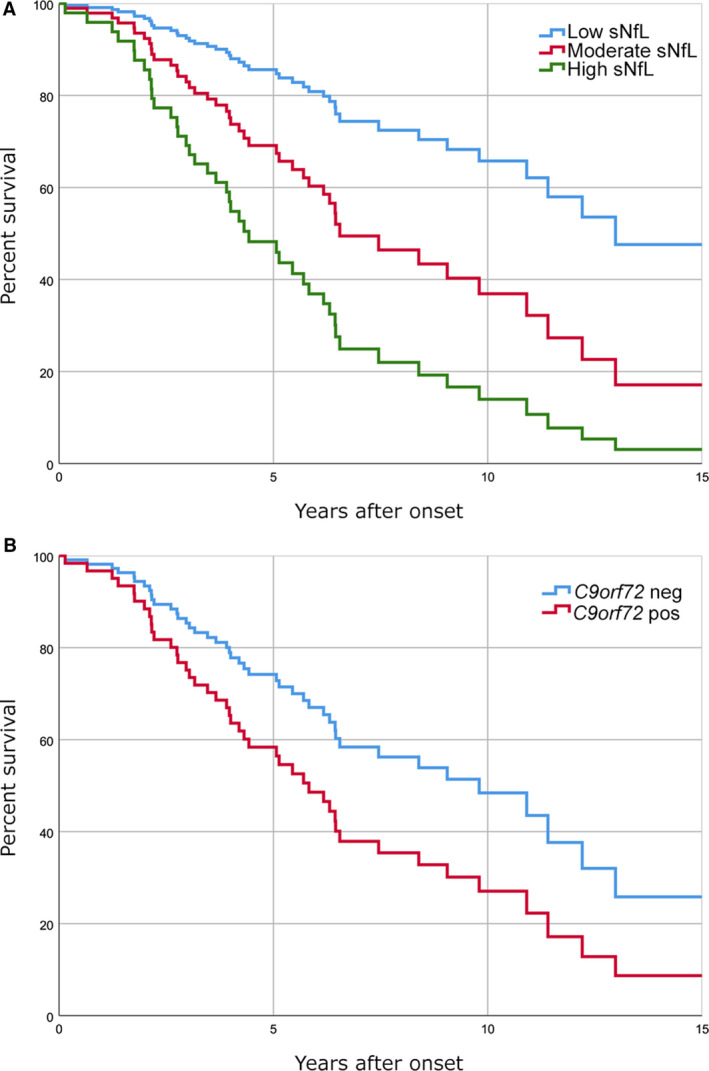
In the total FTLD cohort, sNfL levels were significantly higher in C9orf72 repeat expansion carriers compared to non-carriers. Considering clinical phenotypes, sNfL levels were higher in the C9orf72 repeat expansion carriers than in the non-carriers in bvFTD and PPA groups. Furthermore, sNfL levels were the highest in the FTLD-MND group (median 105 pg/mL) and the lowest in the bvFTD group (median 27 pg/mL). Higher sNfL levels significantly correlated with frontal cortical atrophy rate and subcortical grey matter atrophy rate. The higher sNfL levels also associated with shorter survival time.
Our results indicate that the C9orf72 repeat expansion carriers show elevated sNFL levels compared to non-carriers and that the levels differ among different clinical phenotypes of FTLD. Higher sNfL levels correlated with a shorter survival time and cortical and subcortical atrophy rates. Thus, sNfL could prove as a potential prognostic biomarker in FTLD.
本研究旨在比较不同临床亚型(bvFTD、PPA 和 FTLD-MND)的额颞叶变性(FTLD)患者和是否存在 C9orf72 重复扩展的 FTLD 患者的血清神经丝轻链(sNfL)水平,并将 sNfL 水平与脑萎缩率和生存时间评估的疾病进展相关联。
通过单分子阵列(SIMOA)测定了 78 例 FTLD 患者(C9orf72 重复扩展携带者[n=26]和非携带者[n=52])的 sNfL 水平。使用重复 T1 加权 MRI 扫描评估脑萎缩的进展,从病历中评估生存时间。
在总 FTLD 队列中,C9orf72 重复扩展携带者的 sNfL 水平明显高于非携带者。考虑到临床表型,在 bvFTD 和 PPA 组中,C9orf72 重复扩展携带者的 sNfL 水平高于非携带者。此外,在 FTLD-MND 组中 sNfL 水平最高(中位数 105pg/mL),在 bvFTD 组中最低(中位数 27pg/mL)。较高的 sNfL 水平与额皮质萎缩率和皮质下灰质萎缩率显著相关。较高的 sNfL 水平也与较短的生存时间相关。
我们的研究结果表明,与非携带者相比,C9orf72 重复扩展携带者表现出升高的 sNFL 水平,并且在不同的 FTLD 临床表型之间存在差异。较高的 sNfL 水平与较短的生存时间以及皮质和皮质下萎缩率相关。因此,sNfL 可能成为 FTLD 的一种潜在预后生物标志物。