Sattler Rita, Traynor Bryan J, Robertson Janice, Van Den Bosch Ludo, Barmada Sami J, Svendsen Clive N, Disney Matthew D, Gendron Tania F, Wong Philip C, Turner Martin R, Boxer Adam, Babu Suma, Benatar Michael, Kurnellas Michael, Rohrer Jonathan D, Donnelly Christopher J, Bustos Lynette M, Van Keuren-Jensen Kendall, Dacks Penny A, Sabbagh Marwan N
Barrow Neurological Institute, 2910 N Third Ave, Phoenix, AZ, 85013, USA.
Neuromuscular Diseases Research Section, Laboratory of Neurogenetics, National Institute on Aging, National Institutes of Health, Bethesda, MD, USA.
Neurol Ther. 2023 Dec;12(6):1821-1843. doi: 10.1007/s40120-023-00548-8. Epub 2023 Oct 17.
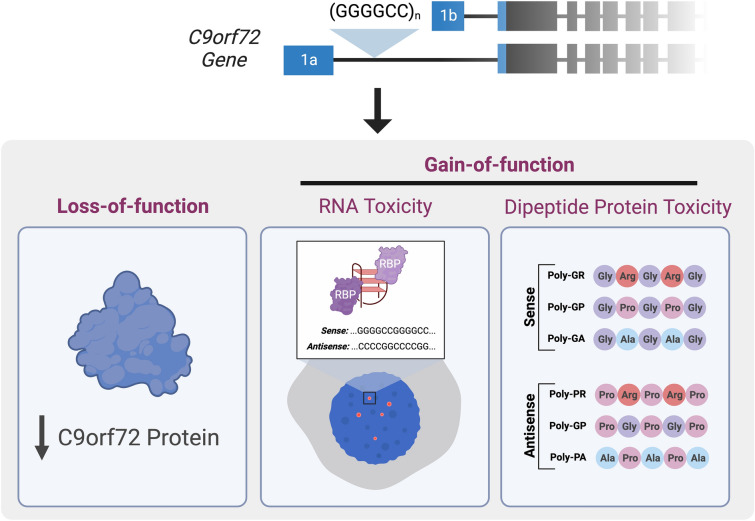
A summit held March 2023 in Scottsdale, Arizona (USA) focused on the intronic hexanucleotide expansion in the C9ORF72 gene and its relevance in frontotemporal dementia (FTD) and amyotrophic lateral sclerosis (ALS; C9ORF72-FTD/ALS). The goal of this summit was to connect basic scientists, clinical researchers, drug developers, and individuals affected by C9ORF72-FTD/ALS to evaluate how collaborative efforts across the FTD-ALS disease spectrum might break down existing disease silos. Presentations and discussions covered recent discoveries in C9ORF72-FTD/ALS disease mechanisms, availability of disease biomarkers and recent advances in therapeutic development, and clinical trial design for prevention and treatment for individuals affected by C9ORF72-FTD/ALS and asymptomatic pathological expansion carriers. The C9ORF72-associated hexanucleotide repeat expansion is an important locus for both ALS and FTD. C9ORF72-FTD/ALS may be characterized by loss of function of the C9ORF72 protein and toxic gain of functions caused by both dipeptide repeat (DPR) proteins and hexanucleotide repeat RNA. C9ORF72-FTD/ALS therapeutic strategies discussed at the summit included the use of antisense oligonucleotides, adeno-associated virus (AAV)-mediated gene silencing and gene delivery, and engineered small molecules targeting RNA structures associated with the C9ORF72 expansion. Neurofilament light chain, DPR proteins, and transactive response (TAR) DNA-binding protein 43 (TDP-43)-associated molecular changes were presented as biomarker candidates. Similarly, brain imaging modalities (i.e., magnetic resonance imaging [MRI] and positron emission tomography [PET]) measuring structural, functional, and metabolic changes were discussed as important tools to monitor individuals affected with C9ORF72-FTD/ALS, at both pre-symptomatic and symptomatic disease stages. Finally, summit attendees evaluated current clinical trial designs available for FTD or ALS patients and concluded that therapeutics relevant to FTD/ALS patients, such as those specifically targeting C9ORF72, may need to be tested with composite endpoints covering clinical symptoms of both FTD and ALS. The latter will require novel clinical trial designs to be inclusive of all patient subgroups spanning the FTD/ALS spectrum.
2023年3月在美国亚利桑那州斯科茨代尔举行的一次峰会聚焦于C9ORF72基因中的内含子六核苷酸扩增及其与额颞叶痴呆(FTD)和肌萎缩侧索硬化症(ALS;C9ORF72-FTD/ALS)的相关性。本次峰会的目标是将基础科学家、临床研究人员、药物研发人员以及受C9ORF72-FTD/ALS影响的个人联系起来,评估在FTD-ALS疾病范围内的合作努力如何打破现有的疾病壁垒。报告和讨论涵盖了C9ORF72-FTD/ALS疾病机制的最新发现、疾病生物标志物的可用性以及治疗开发的最新进展,以及针对受C9ORF72-FTD/ALS影响的个体和无症状病理扩增携带者的预防和治疗的临床试验设计。C9ORF72相关的六核苷酸重复扩增是ALS和FTD的一个重要基因座。C9ORF72-FTD/ALS的特征可能是C9ORF72蛋白的功能丧失以及由二肽重复(DPR)蛋白和六核苷酸重复RNA引起的功能毒性增加。峰会上讨论的C9ORF72-FTD/ALS治疗策略包括使用反义寡核苷酸、腺相关病毒(AAV)介导的基因沉默和基因递送,以及针对与C9ORF72扩增相关的RNA结构的工程小分子。神经丝轻链、DPR蛋白和反式激活反应(TAR)DNA结合蛋白43(TDP-43)相关的分子变化被作为生物标志物候选物进行了介绍。同样,测量结构、功能和代谢变化的脑成像方式(即磁共振成像[MRI]和正电子发射断层扫描[PET])被讨论为在症状前和症状期监测受C9ORF72-FTD/ALS影响的个体的重要工具。最后,峰会参与者评估了目前可用于FTD或ALS患者的临床试验设计,并得出结论,与FTD/ALS患者相关的治疗方法,如那些专门针对C9ORF72的治疗方法,可能需要用涵盖FTD和ALS临床症状的复合终点进行测试。后者将需要新颖的临床试验设计以纳入跨越FTD/ALS范围的所有患者亚组。