Zwicker Jeffrey I, Roopkumar Joanna, Puligandla Maneka, Schlechter Benjamin L, Sharda Anish V, Peereboom David, Joyce Robin, Bockorny Bruno, Neuberg Donna, Bauer Kenneth A, Khorana Alok A
Division of Hematology, Beth Israel Deaconess Medical Center, Harvard Medical School, Boston, MA.
Division of Hematology and Oncology, Taussig Cancer Institute, Cleveland Clinic, Cleveland, OH.
Blood Adv. 2020 May 26;4(10):2254-2260. doi: 10.1182/bloodadvances.2020001804.
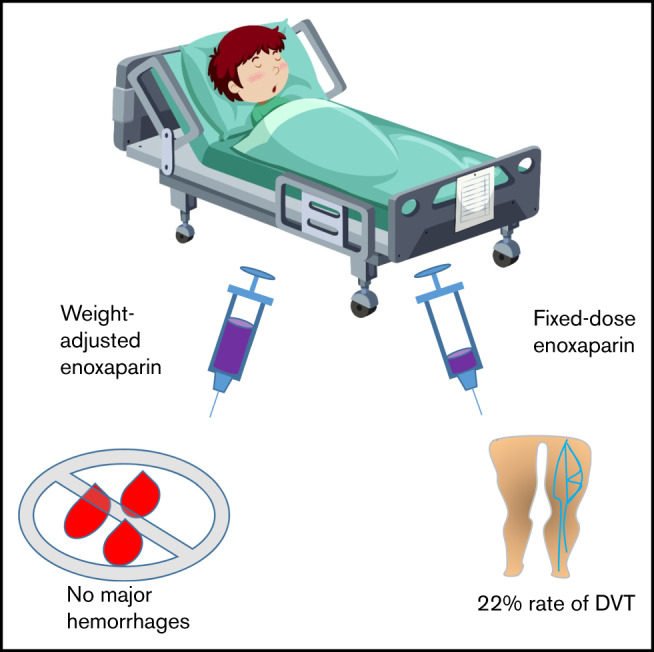
Hospitalized patients with cancer are at an increased risk of developing venous thromboembolism (VTE). The recommendation for routine pharmacologic thromboprophylaxis in hospitalized patients with cancer to prevent VTE is based on extrapolation of results from noncancer cohorts. There are limited data to support the efficacy and safety of fixed-dose low-molecular-weight heparin (LMWH) regimens in high-risk hospitalized patients with cancer. We conducted a randomized, double-blinded, phase 2 trial in hospitalized patients with active cancer at high risk of developing VTE based on Padua risk score. Patients were randomly assigned to fixed-dose enoxaparin (40 mg daily) vs weight-adjusted enoxaparin (1 mg/kg daily) during hospitalization. The primary objectives were to evaluate the safety of dose-adjusted enoxaparin and evaluate the incidence of VTE with fixed-dose enoxaparin. Blinded clinical assessments were performed at day 14, and patients randomly assigned to fixed-dose enoxaparin subsequently underwent a bilateral lower extremity ultrasound. A total of 50 patients were enrolled and randomized. The median weight of patients enrolled in weight-adjusted enoxaparin arm was 76 kg (range, 60.9-124.5 kg). There were no major hemorrhages or symptomatic VTE in either arm. At time of completion of the blinded clinical assessment, there was only 1 incidentally identified pulmonary embolus that occurred in the weight-adjusted arm. In the group randomly assigned to fixed-dose enoxaparin who subsequently underwent surveillance ultrasound, the cumulative incidence of DVT was 22% (90% binomial confidence interval, 0%-51.3%). This phase 2 trial confirms a high incidence of asymptomatic VTE among high-risk hospitalized patients with cancer and that weight-adjusted LMWH thromboprophylaxis is feasible and well-tolerated. This trial was registered at www.clinicaltrials.gov as #NCT02706249.
癌症住院患者发生静脉血栓栓塞(VTE)的风险增加。对癌症住院患者进行常规药物性血栓预防以预防VTE的建议是基于非癌症队列研究结果的推断。支持固定剂量低分子肝素(LMWH)方案在高危癌症住院患者中的疗效和安全性的数据有限。我们基于帕多瓦风险评分,对有发生VTE高风险的活动性癌症住院患者进行了一项随机、双盲、2期试验。患者在住院期间被随机分配至固定剂量依诺肝素组(每日40毫克)或体重调整剂量依诺肝素组(每日1毫克/千克)。主要目标是评估剂量调整后的依诺肝素的安全性,并评估固定剂量依诺肝素的VTE发生率。在第14天进行盲法临床评估,随后随机分配至固定剂量依诺肝素组的患者接受双侧下肢超声检查。共纳入50例患者并进行随机分组。体重调整剂量依诺肝素组纳入患者的中位体重为76千克(范围为60.9 - 124.5千克)。两组均未发生大出血或有症状的VTE。在盲法临床评估完成时,体重调整剂量组仅偶然发现1例肺栓塞。在随后接受监测超声检查的随机分配至固定剂量依诺肝素组中,DVT的累积发生率为22%(90%二项式置信区间,0% - 51.3%)。这项2期试验证实,高危癌症住院患者中无症状VTE的发生率很高,且体重调整的LMWH血栓预防是可行的且耐受性良好。该试验已在www.clinicaltrials.gov上注册,注册号为#NCT02706249。