Program against Cancer Therapeutic Resistance (ProCURE), Metabolism and Cancer Group, Catalan Institute of Oncology, 17007 Girona, Spain.
Girona Biomedical Research Institute, 17190 Salt, Girona, Spain.
Biomolecules. 2020 May 18;10(5):780. doi: 10.3390/biom10050780.
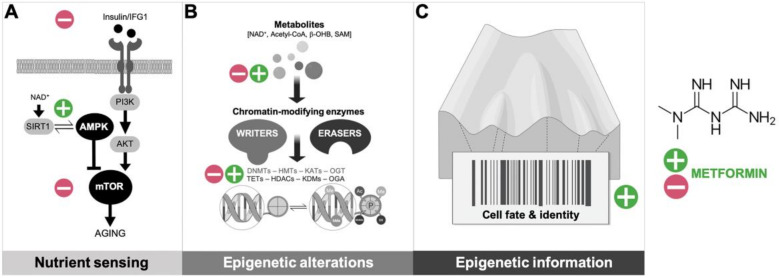
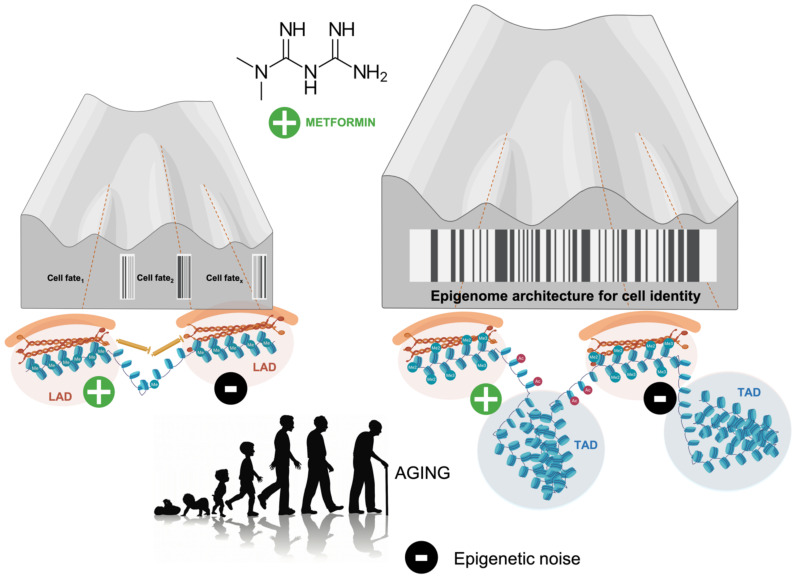
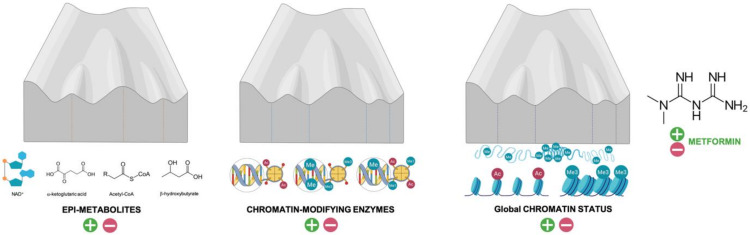
The biguanide metformin is the first drug to be tested as a gerotherapeutic in the clinical trial TAME (Targeting Aging with Metformin). The current consensus is that metformin exerts indirect pleiotropy on core metabolic hallmarks of aging, such as the insulin/insulin-like growth factor 1 and AMP-activated protein kinase/mammalian Target Of Rapamycin signaling pathways, downstream of its primary inhibitory effect on mitochondrial respiratory complex I. Alternatively, but not mutually exclusive, metformin can exert regulatory effects on components of the biologic machinery of aging itself such as chromatin-modifying enzymes. An integrative metabolo-epigenetic outlook supports a new model whereby metformin operates as a guardian of cell identity, capable of retarding cellular aging by preventing the loss of the information-theoretic nature of the epigenome. The ultimate anti-aging mechanism of metformin might involve the global preservation of the epigenome architecture, thereby ensuring cell fate commitment and phenotypic outcomes despite the challenging effects of aging noise. Metformin might therefore inspire the development of new gerotherapeutics capable of preserving the epigenome architecture for cell identity. Such gerotherapeutics should replicate the ability of metformin to halt the erosion of the epigenetic landscape, mitigate the loss of cell fate commitment, delay stochastic/environmental DNA methylation drifts, and alleviate cellular senescence. Yet, it remains a challenge to confirm if regulatory changes in higher-order genomic organizers can connect the capacity of metformin to dynamically regulate the three-dimensional nature of epigenetic landscapes with the 4 dimension, the aging time.
二甲双胍是第一种在临床试验 TAME(二甲双胍靶向衰老)中作为 gerotherapeutic 进行测试的药物。目前的共识是,二甲双胍通过其对线粒体呼吸复合物 I 的主要抑制作用,对衰老的核心代谢特征(如胰岛素/胰岛素样生长因子 1 和 AMP 激活的蛋白激酶/哺乳动物雷帕霉素靶蛋白信号通路)产生间接的多效性。或者,二甲双胍可以对衰老本身的生物学机制的组成部分(如染色质修饰酶)发挥调节作用,但不是相互排斥的。综合代谢 - 表观遗传观点支持一种新模型,即二甲双胍作为细胞身份的守护者,通过防止表观基因组信息理论性质的丧失,能够延缓细胞衰老。二甲双胍的最终抗衰老机制可能涉及到表观基因组架构的全局保存,从而确保细胞命运的承诺和表型结果,尽管存在衰老噪声的挑战。二甲双胍因此可能启发开发新的 gerotherapeutics,能够保持细胞身份的表观基因组架构。这种 gerotherapeutics 应该复制二甲双胍的能力,阻止表观基因组景观的侵蚀,减轻细胞命运承诺的丧失,延迟随机/环境 DNA 甲基化漂移,并缓解细胞衰老。然而,确认高级基因组组织者的调节变化是否能够将二甲双胍动态调节表观基因组景观的三维性质的能力与 4 维(衰老时间)联系起来仍然是一个挑战。