Institute for Systems Genetics and Department of Biochemistry and Molecular Pharmacology, NYU Langone Health, New York, NY, USA.
Cellarity Inc., Cambridge, MA, USA.
Nat Struct Mol Biol. 2020 Feb;27(2):179-191. doi: 10.1038/s41594-020-0374-z. Epub 2020 Feb 10.
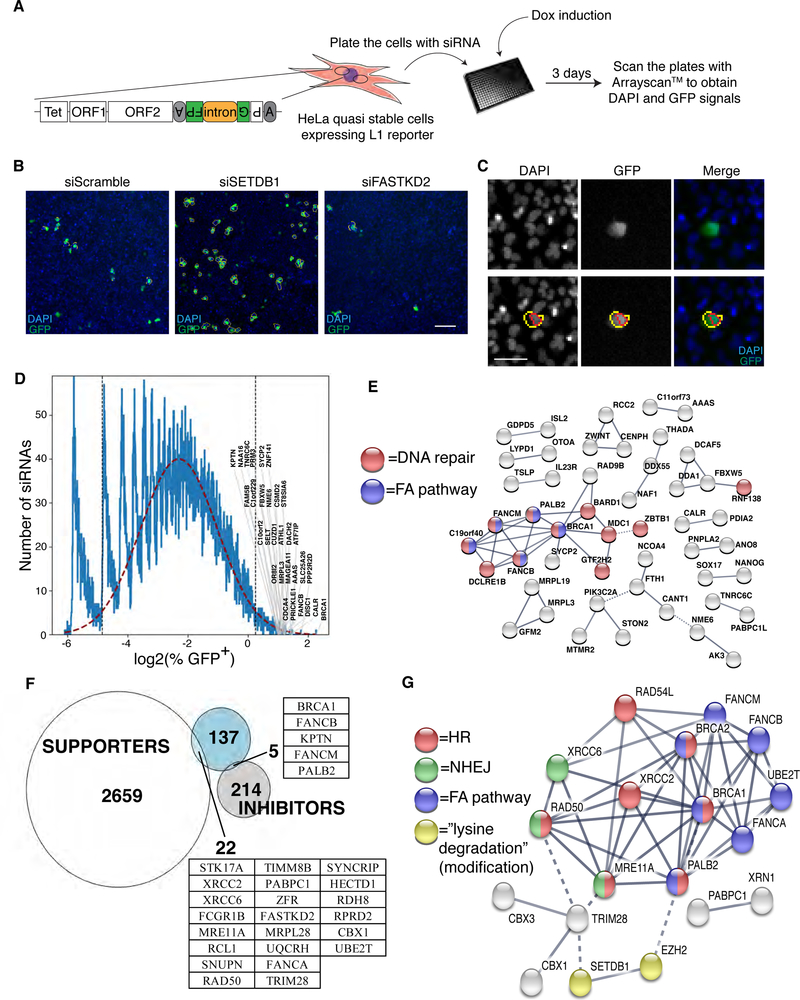
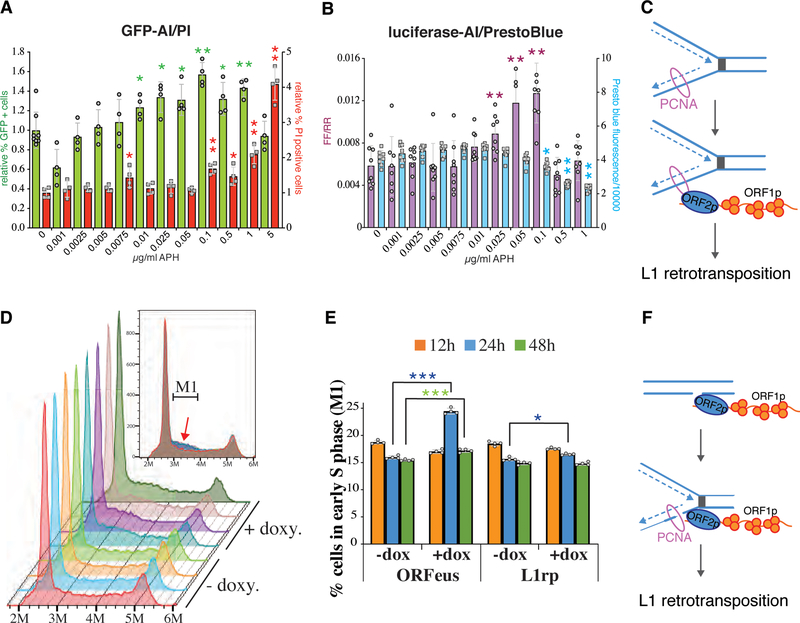
Long interspersed element-1 (LINE-1, or L1) is the only autonomous retrotransposon that is active in human cells. Different host factors have been shown to influence L1 mobility; however, systematic analyses of these factors are limited. Here, we developed a high-throughput microscopy-based retrotransposition assay that identified the double-stranded break (DSB) repair and Fanconi anemia (FA) factors active in the S/G2 phase as potent inhibitors and regulators of L1 activity. In particular, BRCA1, an E3 ubiquitin ligase with a key role in several DNA repair pathways, directly affects L1 retrotransposition frequency and structure and plays a distinct role in controlling L1 ORF2 protein translation through L1 mRNA binding. These results suggest the existence of a 'battleground' at the DNA replication fork between homologous recombination (HR) factors and L1 retrotransposons and reveal a potential role for L1 in the genotypic evolution of tumors characterized by BRCA1 and HR repair deficiencies.
长散在元件 1(LINE-1,或 L1)是唯一在人类细胞中活跃的自主逆转录转座子。已经表明,不同的宿主因素会影响 L1 的移动性;然而,这些因素的系统分析受到限制。在这里,我们开发了一种基于高通量显微镜的逆转录转座酶活性检测分析方法,鉴定出在 S/G2 期活跃的双链断裂(DSB)修复和范可尼贫血(FA)因子,是 L1 活性的有效抑制剂和调节剂。特别是 BRCA1,一种在几种 DNA 修复途径中起关键作用的 E3 泛素连接酶,直接影响 L1 逆转录转座频率和结构,并通过 L1 mRNA 结合在控制 L1 ORF2 蛋白翻译中发挥独特作用。这些结果表明,在同源重组(HR)因子和 L1 逆转座子之间的 DNA 复制叉处存在一个“战场”,并揭示了 L1 在以 BRCA1 和 HR 修复缺陷为特征的肿瘤的基因型进化中可能发挥的作用。