Voormolen Daphne C, Zeldovich Marina, Haagsma Juanita A, Polinder Suzanne, Friedrich Sarah, Maas Andrew I R, Wilson Lindsay, Steyerberg Ewout W, Covic Amra, Andelic Nada, Plass Anne Marie, Wu Yi-Jhen, Asendorf Thomas, von Steinbüechel Nicole, Center-Tbi Participants Investigators Center-Tbi
Department of Public Health, Erasmus MC, University Medical Center Rotterdam, 3000 CA Rotterdam, The Netherlands.
Institute of Medical Psychology and Medical Sociology, University Medical Center Göttingen, 37073 Göttingen, Germany.
J Clin Med. 2020 May 18;9(5):1525. doi: 10.3390/jcm9051525.
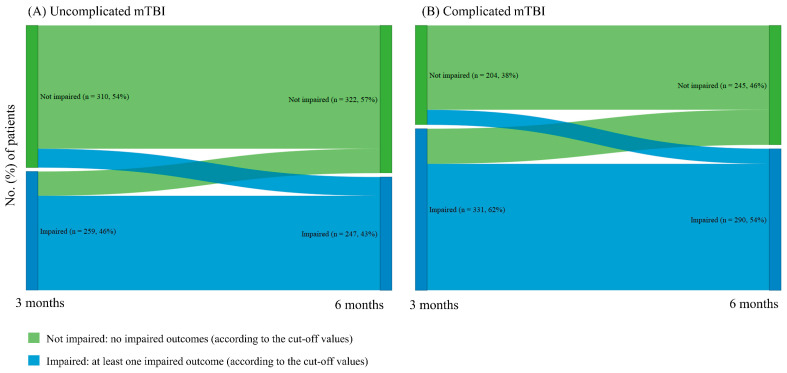
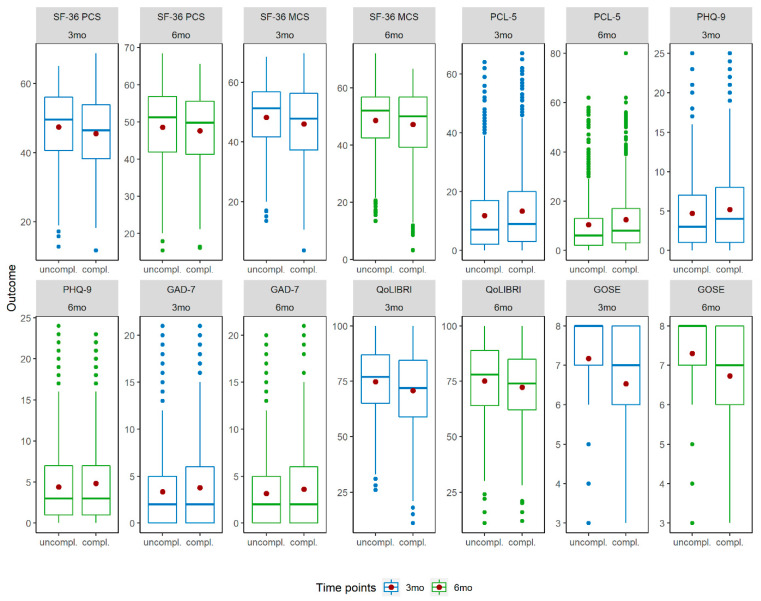
The objective of this study was to provide a comprehensive examination of the relation of complicated and uncomplicated mild traumatic brain injury (mTBI) with multidimensional outcomes at three- and six-months after TBI. We analyzed data from the Collaborative European NeuroTrauma Effectiveness Research (CENTER-TBI) research project. Patients after mTBI (Glasgow Coma scale (GCS) score of 13-15) enrolled in the study were differentiated into two groups based on computed tomography (CT) findings: complicated mTBI (presence of any traumatic intracranial injury on first CT) and uncomplicated mTBI (absence of any traumatic intracranial injury on first CT). Multidimensional outcomes were assessed using seven instruments measuring generic and disease-specific health-related quality of life (HRQoL) (SF-36 and QOLIBRI), functional outcome (GOSE), and psycho-social domains including symptoms of post-traumatic stress disorder (PTSD) (PCL-5), depression (PHQ-9), and anxiety (GAD-7). Data were analyzed using a multivariate repeated measures approach (MANOVA-RM), which inspected mTBI groups at three- and six-months post injury. Patients after complicated mTBI had significantly lower GOSE scores, reported lower physical and mental component summary scores based on the SF-36 version 2, and showed significantly lower HRQoL measured by QOLIBRI compared to those after uncomplicated mTBI. There was no difference between mTBI groups when looking at psychological outcomes, however, a slight improvement in PTSD symptoms and depression was observed for the entire sample from three to six months. Patients after complicated mTBI reported lower generic and disease specific HRQoL and worse functional outcome compared to individuals after uncomplicated mTBI at three and six months. Both groups showed a tendency to improve from three to six months after TBI. The complicated mTBI group included more patients with an impaired long-term outcome than the uncomplicated group. Nevertheless, patients, clinicians, researchers, and decisions-makers in health care should take account of the short and long-term impact on outcome for patients after both uncomplicated and complicated mTBI.
本研究的目的是全面考察单纯性和复杂性轻度创伤性脑损伤(mTBI)与脑损伤后3个月和6个月时多维度预后的关系。我们分析了欧洲神经创伤协作有效性研究(CENTER-TBI)项目的数据。纳入本研究的mTBI患者(格拉斯哥昏迷量表(GCS)评分为13 - 15分)根据计算机断层扫描(CT)结果分为两组:复杂性mTBI(首次CT检查存在任何创伤性颅内损伤)和单纯性mTBI(首次CT检查未发现任何创伤性颅内损伤)。使用七种工具评估多维度预后,这些工具测量一般和疾病特异性的健康相关生活质量(HRQoL)(SF - 36和QOLIBRI)、功能预后(GOSE)以及心理社会领域,包括创伤后应激障碍(PTSD)症状(PCL - 5)、抑郁(PHQ - 9)和焦虑(GAD - 7)。采用多变量重复测量方法(MANOVA - RM)进行数据分析,该方法在损伤后3个月和6个月时对mTBI组进行检查。与单纯性mTBI患者相比,复杂性mTBI患者的GOSE评分显著更低,基于SF - 36第2版报告的身体和心理成分总结评分更低,并且QOLIBRI测量的HRQoL显著更低。在观察心理预后时,mTBI组之间没有差异,然而,整个样本在3个月至6个月期间PTSD症状和抑郁有轻微改善。与单纯性mTBI患者相比复杂性mTBI患者在3个月和6个月时报告的一般和疾病特异性HRQoL更低,功能预后更差。两组在脑损伤后3个月至6个月均有改善趋势。复杂性mTBI组中远期预后受损的患者比单纯性组更多。尽管如此,医疗保健中的患者、临床医生、研究人员和决策者应考虑单纯性和复杂性mTBI对患者预后的短期和长期影响。