Rajesh Yetirajam, Sarkar Devanand
Department of Human and Molecular Genetics, Massey Cancer Center, VCU Institute of Molecular Medicine (VIMM), Virginia Commonwealth University, Richmond, VA 23298, USA.
Cancers (Basel). 2020 May 20;12(5):1290. doi: 10.3390/cancers12051290.
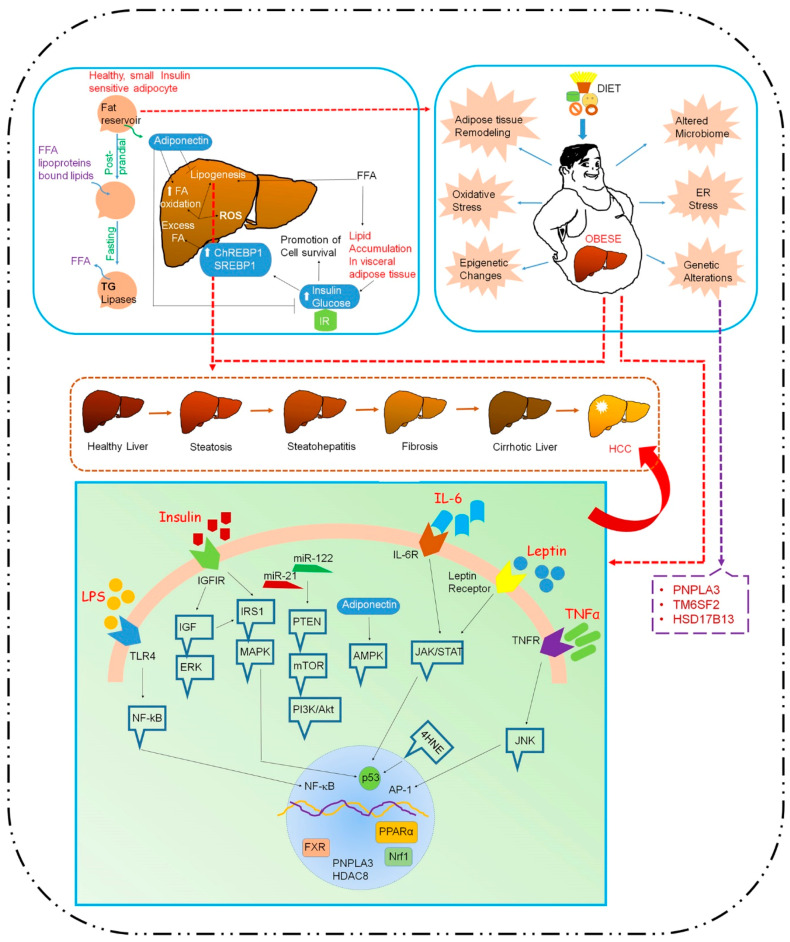
Obesity is a global, intractable issue, altering inflammatory and stress response pathways, and promoting tissue adiposity and tumorigenesis. Visceral fat accumulation is correlated with primary tumor recurrence, poor prognosis and chemotherapeutic resistance. Accumulating evidence highlights a close association between obesity and an increased incidence of hepatocellular carcinoma (HCC). Obesity drives HCC, and obesity-associated tumorigenesis develops via nonalcoholic fatty liver (NAFL), progressing to nonalcoholic steatohepatitis (NASH) and ultimately to HCC. The better molecular elucidation and proteogenomic characterization of obesity-associated HCC might eventually open up potential therapeutic avenues. The mechanisms relating obesity and HCC are correlated with adipose tissue remodeling, alteration in the gut microbiome, genetic factors, ER stress, oxidative stress and epigenetic changes. During obesity-related hepatocarcinogenesis, adipokine secretion is dysregulated and the nuclear factor erythroid 2 related factor 1 (Nrf-1), nuclear factor kappa B (NF-κB), mammalian target of rapamycin (mTOR), phosphatidylinositol-3-kinase (PI3K)/phosphatase and tensin homolog (PTEN)/Akt, and Janus kinase/signal transducer and activator of transcription (JAK/STAT) signaling pathways are activated. This review captures the present trends allied with the molecular mechanisms involved in obesity-associated hepatic tumorigenesis, showcasing next generation molecular therapeutic strategies and their mechanisms for the successful treatment of HCC.
肥胖是一个全球性的、棘手的问题,它改变炎症和应激反应途径,促进组织肥胖和肿瘤发生。内脏脂肪堆积与原发性肿瘤复发、预后不良和化疗耐药相关。越来越多的证据表明肥胖与肝细胞癌(HCC)发病率增加密切相关。肥胖促使HCC发生,肥胖相关的肿瘤发生通过非酒精性脂肪性肝病(NAFL)发展而来,进而发展为非酒精性脂肪性肝炎(NASH),最终发展为HCC。对肥胖相关HCC进行更好的分子阐释和蛋白质基因组学表征可能最终会开辟潜在的治疗途径。肥胖与HCC相关的机制与脂肪组织重塑、肠道微生物群改变、遗传因素、内质网应激、氧化应激和表观遗传变化有关。在肥胖相关的肝癌发生过程中,脂肪因子分泌失调,核因子红细胞2相关因子1(Nrf-1)、核因子κB(NF-κB)、雷帕霉素靶蛋白(mTOR)、磷脂酰肌醇-3-激酶(PI3K)/磷酸酶和张力蛋白同源物(PTEN)/Akt以及Janus激酶/信号转导子和转录激活子(JAK/STAT)信号通路被激活。本综述阐述了与肥胖相关肝肿瘤发生所涉及的分子机制相关的当前趋势,展示了下一代分子治疗策略及其成功治疗HCC的机制。