Immunopathology and Cancer Biomarkers, Centro di Riferimento Oncologico di Aviano (CRO), IRCCS, Aviano, Italy.
Laboratory of Molecular Medicine and Genomics, Department of Medicine, Surgery and Dentistry 'Scuola Medica Salernitana', University of Salerno, Baronissi, SA, Italy.
Cell Death Dis. 2020 May 22;11(5):392. doi: 10.1038/s41419-020-2585-y.
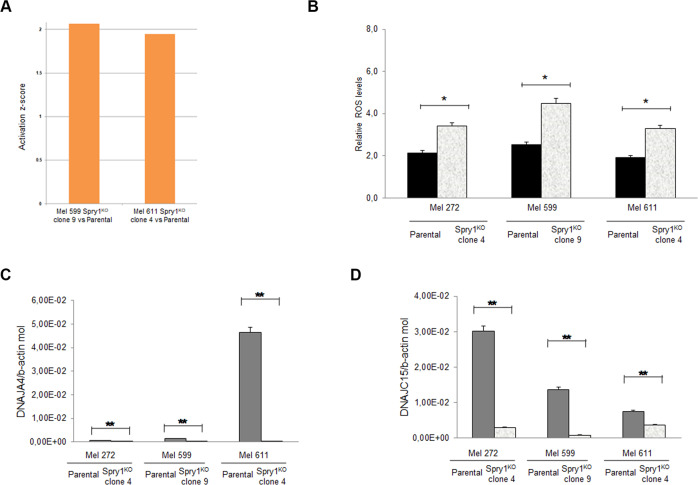
Mitogen-activated protein kinase (MAPK) pathway activation is a central step in BRAF-mutant cutaneous melanoma (CM) pathogenesis. In the last years, Spry1 has been frequently described as an upstream regulator of MAPK signaling pathway. However, its specific role in BRAF-mutant CM is still poorly defined. Here, we report that Spry1 knockdown (Spry1) in three BRAF-mutant CM cell lines markedly induced cell cycle arrest and apoptosis, repressed cell proliferation in vitro, and impaired tumor growth in vivo. Furthermore, our findings indicated that Spry1 reduced the expression of several markers of epithelial-mesenchymal transition, such as MMP-2 both in vitro and in vivo. These effects were associated with a sustained and deleterious phosphorylation of ERK1/2. In addition, p38 activation along with an increase in basal ROS levels were found in Spry1 clones compared to parental CM cell lines, suggesting that BRAF-mutant CM may restrain the activity of Spry1 to avoid oncogenic stress and to enable tumor growth. Consistent with this hypothesis, treatment with the BRAF inhibitor (BRAFi) vemurafenib down-regulated Spry1 levels in parental CM cell lines, indicating that Spry1 expression is sustained by the MAPK/ERK signaling pathway in a positive feedback loop that safeguards cells from the potentially toxic effects of ERK1/2 hyperactivation. Disruption of this feedback loop rendered Spry1 cells more susceptible to apoptosis and markedly improved response to BRAFi both in vitro and in vivo, as a consequence of the detrimental effect of ERK1/2 hyperactivation observed upon Spry1 abrogation. Therefore, targeting Spry1 might offer a treatment strategy for BRAF-mutant CM by inducing the toxic effects of ERK-mediated signaling.
丝裂原活化蛋白激酶(MAPK)通路的激活是 BRAF 突变型皮肤黑色素瘤(CM)发病机制的关键步骤。近年来,Spry1 被频繁描述为 MAPK 信号通路的上游调节剂。然而,其在 BRAF 突变型 CM 中的具体作用仍未得到明确界定。在这里,我们报告在三种 BRAF 突变型 CM 细胞系中敲低 Spry1(Spry1)可显著诱导细胞周期停滞和细胞凋亡,抑制体外细胞增殖,并损害体内肿瘤生长。此外,我们的研究结果表明,Spry1 降低了几种上皮-间充质转化标志物的表达,如 MMP-2,无论是在体外还是体内。这些效应与 ERK1/2 的持续和有害磷酸化有关。此外,与亲本 CM 细胞系相比,Spry1 克隆中发现 p38 的激活以及基础 ROS 水平的增加,表明 BRAF 突变型 CM 可能会抑制 Spry1 的活性,以避免致癌应激并促进肿瘤生长。与这一假设一致的是,BRAF 抑制剂(BRAFi)vemurafenib 处理可下调亲本 CM 细胞系中的 Spry1 水平,表明 Spry1 的表达受到 MAPK/ERK 信号通路的正反馈调节,该通路通过保护细胞免受 ERK1/2 过度激活的潜在毒性作用。破坏这种反馈回路使 Spry1 细胞对凋亡更敏感,并显著改善了体外和体内对 BRAFi 的反应,这是由于 Spry1 阻断后观察到的 ERK1/2 过度激活的有害影响。因此,通过诱导 ERK 介导的信号转导的毒性作用,靶向 Spry1 可能为 BRAF 突变型 CM 提供一种治疗策略。