Research Institute of the McGill University Health Centre, McGill University, Montreal, QC, H4A 3J1, Canada.
Department of Cell Biology, Research Institute of Oncology and Hematology, Cancer Care Manitoba, University of Manitoba, Winnipeg, Canada.
Sci Rep. 2020 May 22;10(1):8532. doi: 10.1038/s41598-020-65640-7.
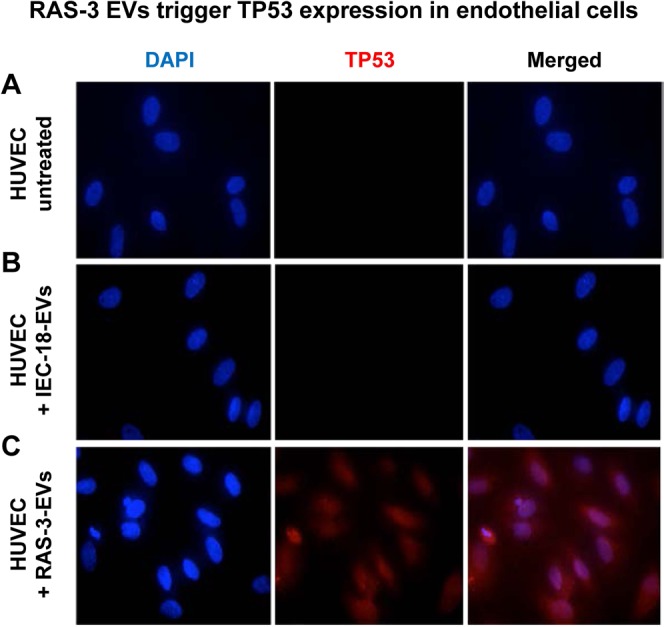
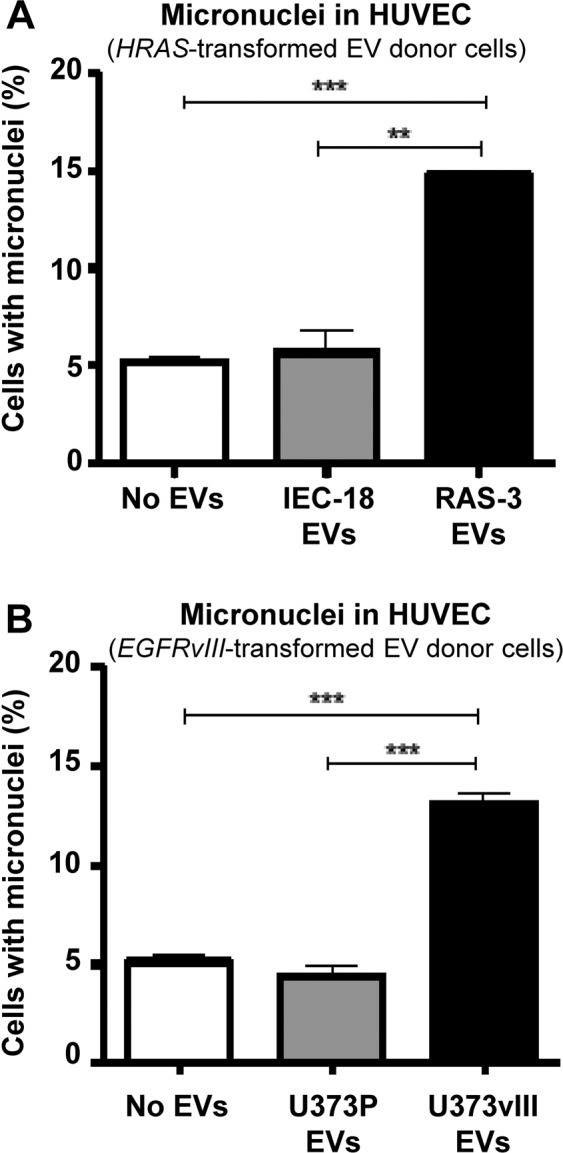
Oncogenic transformation impacts cancer cell interactions with their stroma, including through formation of abnormal blood vessels. This influence is often attributed to angiogenic growth factors, either soluble, or associated with tumor cell-derived extracellular vesicles (EVs). Here we examine some of the cancer-specific components of EV-mediated tumor-vascular interactions, including the impact of genetic driver mutations and genetic instability. Cancer cells expressing mutant HRAS oncogene exhibit aberrations of chromatin architecture, aneuploidy, cytoplasmic chromatin deposition and formation of micronuclei with a non-random chromosome content. EVs released from such HRAS-driven cells carry genomic DNA, including oncogenic sequences, and transfer this material to endothelial cells while inducing abnormal formation of micronuclei, along with cell migration and proliferation. Micronuclei were also triggered following treatment with EVs derived from glioma cells (and stem cells) expressing EGFRvIII oncogene, and in both endothelial cells and astrocytes. EVs from HRAS and EGFRvIII-driven cancer cells carry 19 common proteins while EVs from indolent control cells exhibit more divergent proteomes. Immortalized endothelial cell lines with disrupted TP53 pathway were refractory to EV-mediated micronuclei induction. We suggest that oncogenic transformation and intercellular trafficking of cancer-derived EVs may contribute to pathological vascular responses in cancer due to intercellular transmission of genomic instability.
致癌转化会影响癌细胞与其基质的相互作用,包括形成异常血管。这种影响通常归因于血管生成生长因子,无论是可溶性的,还是与肿瘤细胞衍生的细胞外囊泡(EVs)相关的。在这里,我们研究了 EV 介导的肿瘤血管相互作用中的一些癌症特异性成分,包括遗传驱动突变和遗传不稳定性的影响。表达突变 HRAS 癌基因的癌细胞表现出染色质结构、非整倍体、细胞质染色质沉积和带有非随机染色体含量的微核形成的异常。这种 HRAS 驱动的细胞释放的 EV 携带基因组 DNA,包括致癌序列,并将这种物质转移到内皮细胞,同时诱导异常的微核形成,以及细胞迁移和增殖。在用表达 EGFRvIII 癌基因的神经胶质瘤细胞(和干细胞)衍生的 EV 处理后,内皮细胞和星形胶质细胞中也触发了微核。HRAS 和 EGFRvIII 驱动的癌细胞的 EV 携带 19 种共同蛋白质,而惰性对照细胞的 EV 则表现出更多的蛋白质组差异。TP53 途径被破坏的永生化内皮细胞系对 EV 介导的微核诱导具有抗性。我们认为,致癌转化和癌细胞衍生的 EV 的细胞间转运可能由于基因组不稳定性的细胞间传递而导致癌症中的病理性血管反应。