Department of Biological Sciences, University of Pittsburgh, Pittsburgh, PA, USA.
Department of Microbiology and Immunology, University of Michigan, Ann Arbor, MI, USA.
Virus Genes. 2020 Aug;56(4):430-438. doi: 10.1007/s11262-020-01767-z. Epub 2020 May 23.
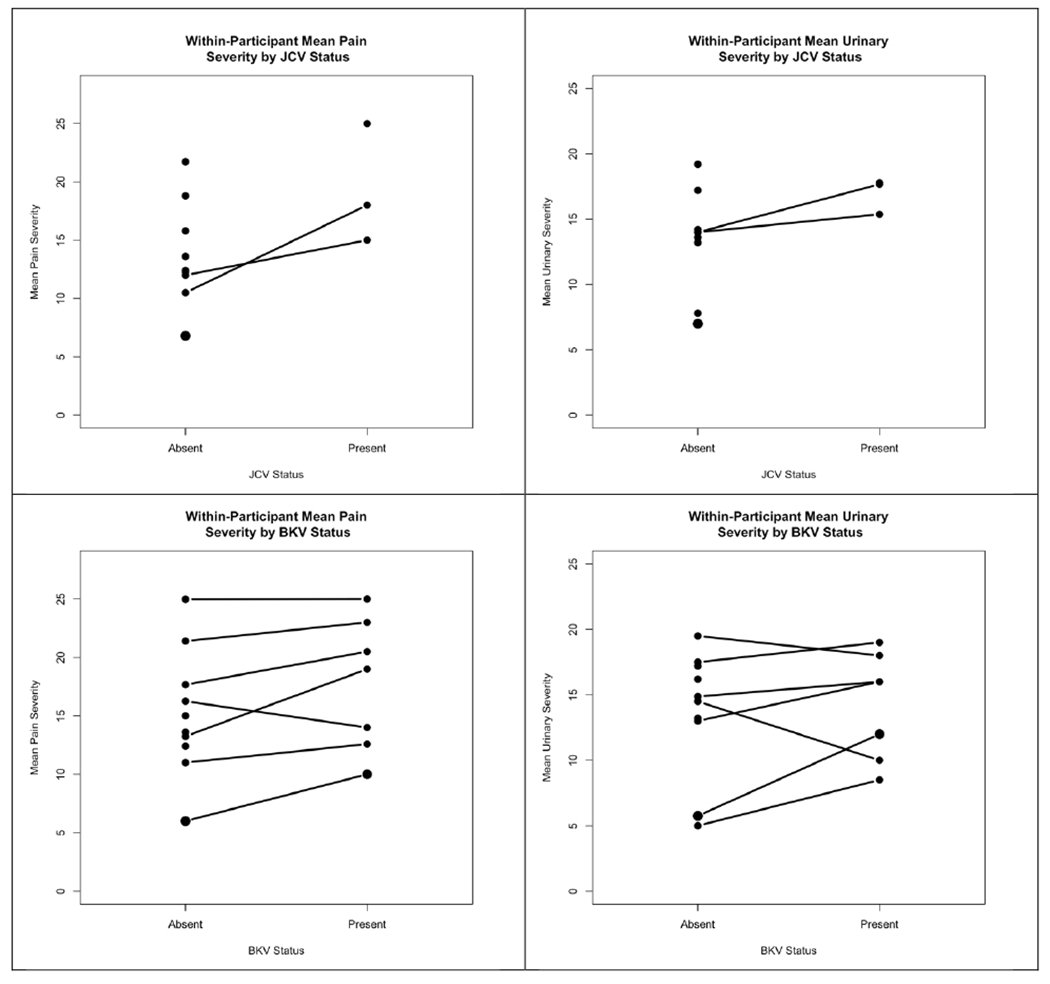
The question of whether some cases of interstitial cystitis may have an infectious etiology has been debated for some time. Previous studies have looked for the presence of certain specific viruses, but generally did not use the types of sensitive and unbiased approaches that are currently available. As part of the MAPP (Multidisciplinary Approach to the Study of Chronic Pelvic Pain) Research Network, we examined urine specimens from interstitial cystitis patients who provided specimens over time and also reported various symptoms at the time of urine collection. We first performed next-generation sequencing to look for the presence of viruses in urines, and detected two human polyomaviruses that are known to be excreted into urine, BKPyV and JCPyV. We were especially interested in BKPyV because it is a known cause of another bladder disease, hemorrhagic cystitis, in bone marrow transplant recipients. Further analysis of individual samples indicates a trend toward higher excretion of polyomaviruses in patients experiencing increased symptoms.
一段时间以来,人们一直在争论某些间质性膀胱炎病例是否可能具有传染性病因。先前的研究曾寻找某些特定病毒的存在,但通常没有采用目前可用的敏感和无偏倚的方法类型。作为 MAPP(慢性盆腔疼痛多学科研究方法)研究网络的一部分,我们检查了间质性膀胱炎患者随时间提供的尿液标本,并在收集尿液时报告了各种症状。我们首先进行了下一代测序,以寻找尿液中病毒的存在,并检测到两种已知会排泄到尿液中的人类多瘤病毒,即 BKPyV 和 JCPyV。我们对 BKPyV 特别感兴趣,因为它是骨髓移植受者另一种膀胱疾病出血性膀胱炎的已知病因。对个别样本的进一步分析表明,症状加重的患者多瘤病毒的排泄呈上升趋势。