School of Pharmacy, Faculty of Medicine and Health, The University of Sydney, Sydney, NSW, 2006, Australia.
University Library, The University of Sydney, Sydney, Australia.
BMC Med Educ. 2020 May 24;20(1):165. doi: 10.1186/s12909-020-02082-9.
In healthcare, preceptors act as a role model and supervisor, thereby facilitating the socialisation and development of the preceptee into a professional fit to practice. To ensure a consistent approach to every preceptorship experience, preceptor competencies should be measured or assessed to ensure that the desired outcomes are achieved. Defining these would ensure quality management and could inform development of an preceptor competency framework. This review aimed to evaluate the evidence for preceptor competencies and assessment in health professions.
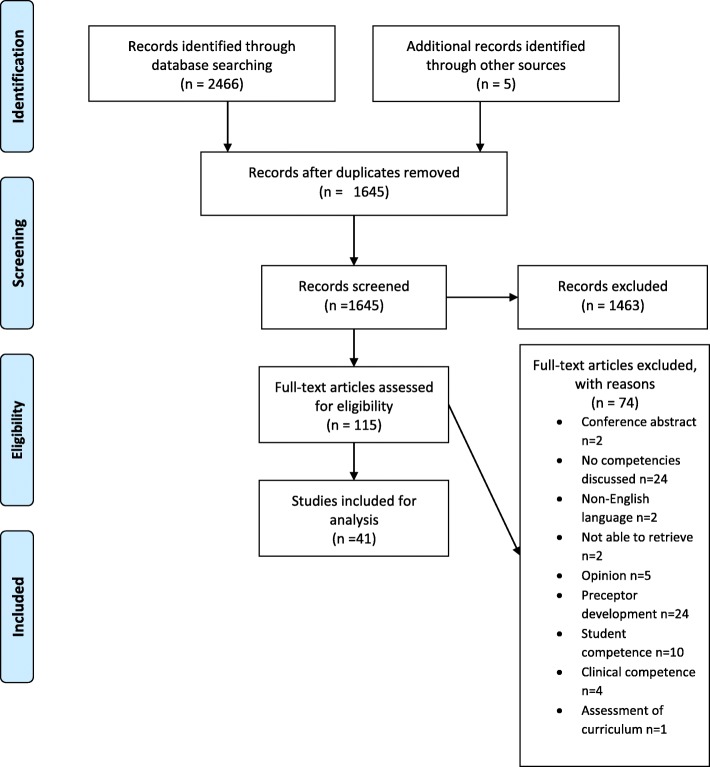
This study followed the PRISMA ScR scoping review guidelines. A database search was conducted in Embase, Medline, CINAHL and IPA in 2019. Articles were included if they defined criteria for competency, measured or assessed competency, or described performance indicators of preceptors. A modified GRADE CERQual approach and CASP quality assessment were used to appraise identified competencies, performance indicators and confidence in evidence.
Forty one studies identified 17 evidence-based competencies, of which 11 had an associated performance indicator. The competency of preceptors was most commonly measured using a preceptee completed survey (moderate to high confidence as per CERQual), followed by preceptor self-assessment, and peer-assessment. Preceptee outcomes as a measure of preceptor performance had good but limited evidence.
Competencies with defined performance indicators allow for effective measurement and may be modifiable with training. To measure preceptor competency, the preceptor perspective, as well as peer and preceptee assessment is recommended. These findings can provide the basis for a common preceptor competency framework in health professions.
在医疗保健领域,导师作为榜样和主管,促进被指导者的社会化和发展,使其成为适合实践的专业人员。为了确保每个导师制体验都采用一致的方法,应该衡量或评估导师的能力,以确保实现预期的结果。定义这些能力将确保质量管理,并为导师能力框架的制定提供信息。本综述旨在评估卫生专业人员导师能力和评估的证据。
本研究遵循 PRISMA ScR 范围综述指南。在 2019 年,在 Embase、Medline、CINAHL 和 IPA 数据库中进行了数据库搜索。如果文章定义了能力标准、衡量或评估了能力、或描述了导师的绩效指标,则将其纳入。使用改良的 GRADE CERQual 方法和 CASP 质量评估来评估确定的能力、绩效指标和证据的可信度。
41 项研究确定了 17 项基于证据的能力,其中 11 项具有相关的绩效指标。导师能力最常使用被指导者完成的调查来衡量(根据 CERQual,为中等至高度可信度),其次是导师自我评估和同行评估。作为衡量导师绩效的指标,被指导者的结果具有良好但有限的证据。
具有明确绩效指标的能力允许进行有效的衡量,并且可能通过培训进行修改。为了衡量导师的能力,建议从导师、同行和被指导者的角度进行评估。这些发现可以为卫生专业人员的通用导师能力框架提供基础。