Hirsch-Moverman Yael, Mantell Joanne E, Lebelo Limakatso, Howard Andrea A, Hesseling Anneke C, Nachman Sharon, Frederix Koen, Maama Llang Bridget, El-Sadr Wafaa M
ICAP at Columbia University, Mailman School of Public Health, 722 West 168th Street, MSPH Box 18, New York, NY, 10032, USA.
Department of Epidemiology, Columbia University, New York, NY, USA.
BMC Health Serv Res. 2020 May 25;20(1):461. doi: 10.1186/s12913-020-05324-0.
The World Health Organization estimated that 1.12 million children developed tuberculosis (TB) in 2018, and at least 200,000 children died from TB. Implementation of effective child contact management is an important strategy to prevent childhood TB but these practices often are not prioritized or implemented, particularly in low- and middle-income countries. This study aimed to explore attitudes of healthcare providers toward TB prevention and perceived facilitators and challenges to child contact management in Lesotho, a high TB burden country. Qualitative data were collected via group and individual in-depth interviews with 12 healthcare providers at five health facilities in one district and analyzed using a thematic framework.
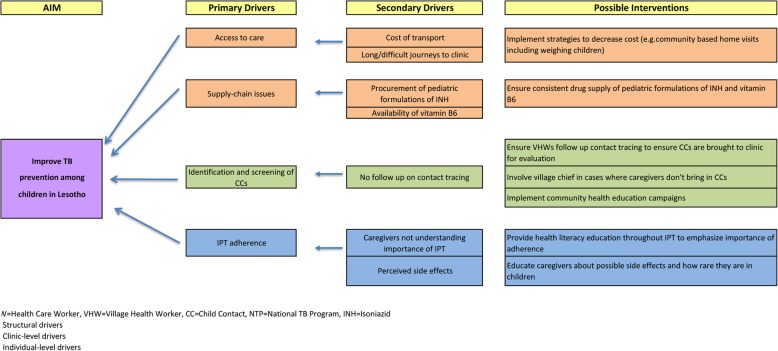
Healthcare providers in our study were interested and committed to improve child TB contact management and identified facilitators and challenges to a successful childhood TB prevention program. Facilitators included: provider understanding of the importance of TB prevention and enhanced provider training on child TB contact management, with a particular focus on ruling out TB in children and addressing side effects. Challenges identified by providers were at multiple levels -- structural, clinic, and individual and included: [1] access to care, [2] supply-chain issues, [3] identification and screening of child contacts, and [4] adherence to isoniazid preventive therapy.
Given the significant burden of TB morbidity and mortality in young children and the recent requirement by the WHO to report IPT initiation in child contacts, prioritization of child TB contact management is imperative and should include enhanced provider training on childhood TB and mentorship as well as strategies to eliminate challenges. Strategies that enable more efficient child TB contact management delivery include creating standardized tools that facilitate the implementation, tracking, and monitoring of child TB contact management coupled with guidance and mentorship from the district health management team. To tackle access to care challenges, we propose delivering intensive community health education, conducting community screening more efficiently using standardized tools, and facilitating access to services in the community.
世界卫生组织估计,2018年有112万儿童患结核病,至少20万儿童死于结核病。实施有效的儿童接触者管理是预防儿童结核病的一项重要策略,但这些措施往往未得到优先考虑或实施,尤其是在低收入和中等收入国家。本研究旨在探讨莱索托(一个结核病负担较重的国家)医疗服务提供者对结核病预防的态度以及对儿童接触者管理的感知促进因素和挑战。通过对一个地区五家医疗机构的12名医疗服务提供者进行小组和个人深度访谈收集定性数据,并使用主题框架进行分析。
我们研究中的医疗服务提供者有兴趣并致力于改善儿童结核病接触者管理,并确定了成功开展儿童结核病预防项目的促进因素和挑战。促进因素包括:医疗服务提供者对结核病预防重要性的理解以及加强对儿童结核病接触者管理的培训,尤其侧重于排除儿童结核病和处理副作用。医疗服务提供者确定的挑战存在于多个层面——结构层面、诊所层面和个人层面,包括:[1]获得医疗服务的机会,[2]供应链问题,[3]儿童接触者的识别和筛查,以及[4]异烟肼预防性治疗的依从性。
鉴于幼儿结核病发病率和死亡率负担沉重,以及世界卫生组织最近要求报告儿童接触者开始接受预防治疗的情况,必须优先考虑儿童结核病接触者管理,应包括加强对儿童结核病的医疗服务提供者培训和指导,以及消除挑战的策略。能够更高效地实施儿童结核病接触者管理的策略包括创建标准化工具,以促进儿童结核病接触者管理的实施、跟踪和监测,并结合地区卫生管理团队的指导和支持。为应对获得医疗服务的挑战,我们建议开展强化社区健康教育,使用标准化工具更高效地进行社区筛查,并促进社区获得服务。