Wellcome Centre for Integrative Neuroimaging, Department of Experimental Psychology, University of Oxford, Oxford, United Kingdom.
Univ Lyon, Université Lyon 1, Inserm, Stem Cell and Brain Research Institute U1208, Bron, France.
PLoS Biol. 2020 May 26;18(5):e3000605. doi: 10.1371/journal.pbio.3000605. eCollection 2020 May.
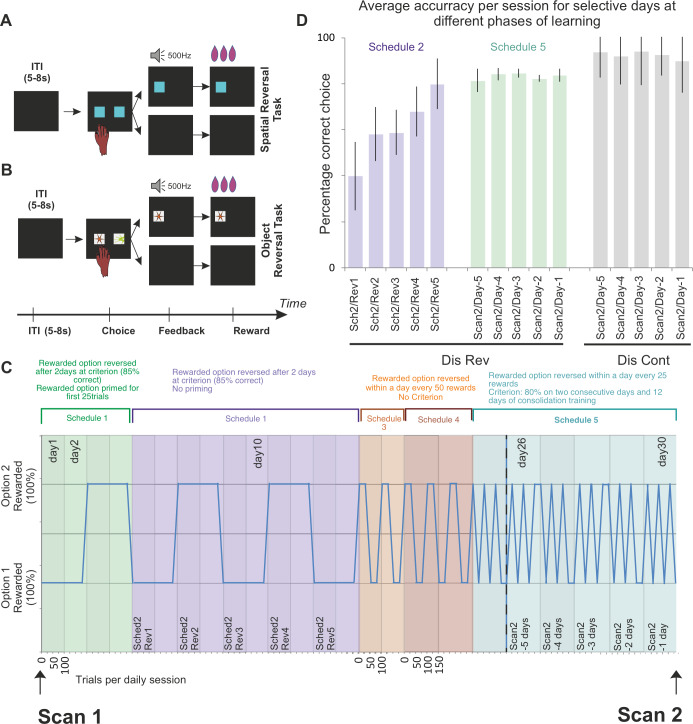
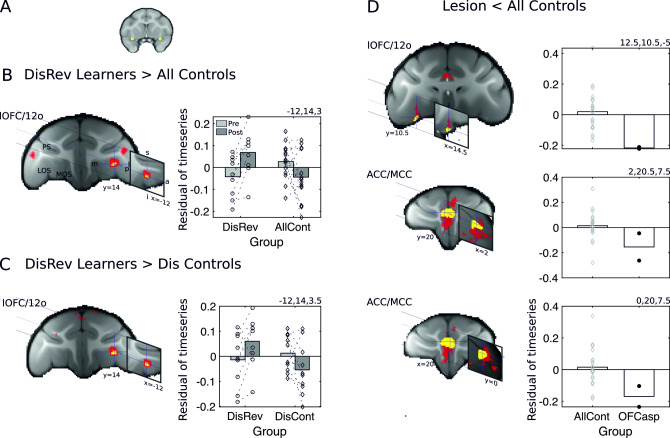
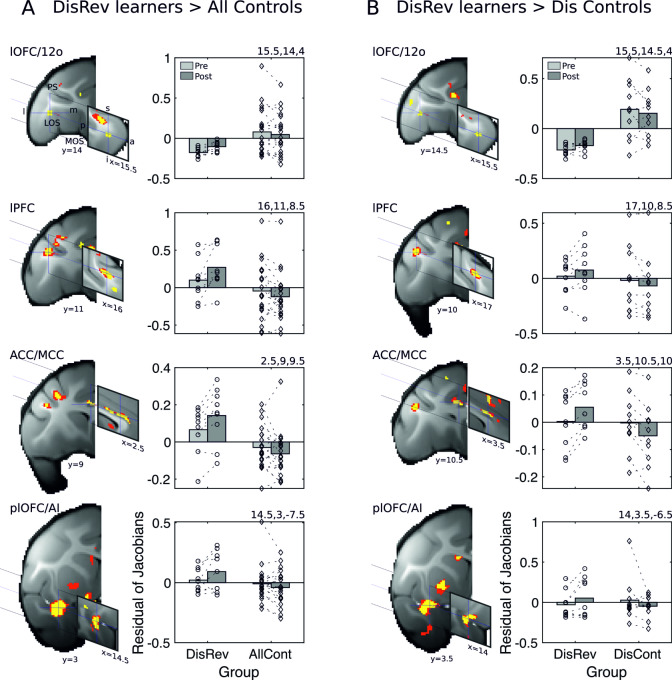
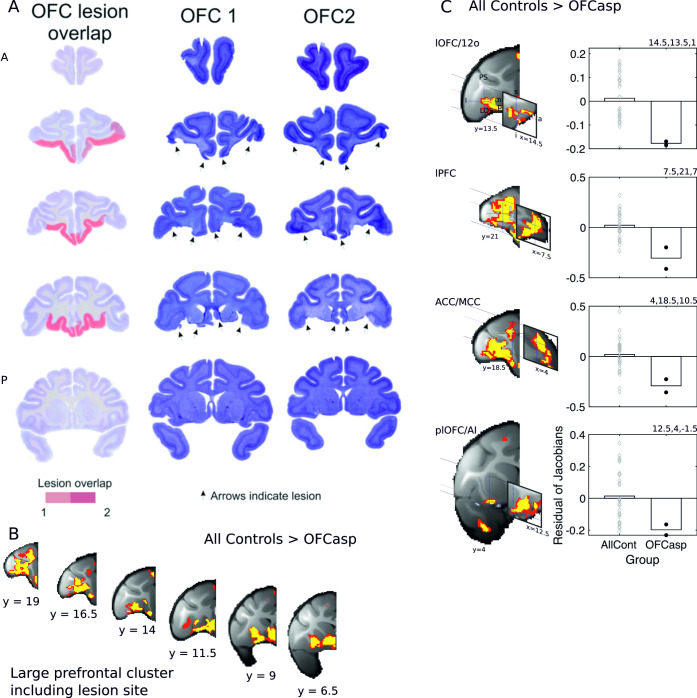
One of the most influential accounts of central orbitofrontal cortex-that it mediates behavioral flexibility-has been challenged by the finding that discrimination reversal in macaques, the classic test of behavioral flexibility, is unaffected when lesions are made by excitotoxin injection rather than aspiration. This suggests that the critical brain circuit mediating behavioral flexibility in reversal tasks lies beyond the central orbitofrontal cortex. To determine its identity, a group of nine macaques were taught discrimination reversal learning tasks, and its impact on gray matter was measured. Magnetic resonance imaging scans were taken before and after learning and compared with scans from two control groups, each comprising 10 animals. One control group learned discrimination tasks that were similar but lacked any reversal component, and the other control group engaged in no learning. Gray matter changes were prominent in posterior orbitofrontal cortex/anterior insula but were also found in three other frontal cortical regions: lateral orbitofrontal cortex (orbital part of area 12 [12o]), cingulate cortex, and lateral prefrontal cortex. In a second analysis, neural activity in posterior orbitofrontal cortex/anterior insula was measured at rest, and its pattern of coupling with the other frontal cortical regions was assessed. Activity coupling increased significantly in the reversal learning group in comparison with controls. In a final set of experiments, we used similar structural imaging procedures and analyses to demonstrate that aspiration lesion of central orbitofrontal cortex, of the type known to affect discrimination learning, affected structure and activity in the same frontal cortical circuit. The results identify a distributed frontal cortical circuit associated with behavioral flexibility.
中央眶额皮层在介导行为灵活性方面的作用是最有影响力的观点之一,但有研究发现,通过兴奋性毒素注射而不是抽吸造成的损伤,并不会影响猕猴(经典的行为灵活性测试)的辨别反转,这对其提出了挑战。这表明,在反转任务中介导行为灵活性的关键大脑回路超出了中央眶额皮层。为了确定其身份,一组 9 只猕猴被教授辨别反转学习任务,并测量其对灰质的影响。在学习前后进行磁共振成像扫描,并与来自两个对照组(每组 10 只动物)的扫描进行比较。一个对照组学习了类似的辨别任务,但没有反转成分,另一个对照组则没有学习。灰质变化在眶额后皮层/前岛叶明显,但也在其他三个额叶皮质区域发现:外侧眶额皮质(12 区的眶部[12o])、扣带皮质和外侧前额叶皮质。在第二项分析中,在静息状态下测量了眶额后皮层/前岛叶的神经活动,并评估了其与其他额叶皮质区域的耦合模式。与对照组相比,反转学习组的活动耦合显著增加。在最后一组实验中,我们使用类似的结构成像程序和分析来证明,已知会影响辨别学习的中央眶额皮层抽吸损伤会影响相同的额叶皮质回路的结构和活动。研究结果确定了一个与行为灵活性相关的分布式额叶皮质回路。