Al Dawish Mohamed, Alwin Robert Asirvatham, Al Shehri Khalid, Hawsawi Salwa, Mujammami Muhammad, Al Basha Ibrahim Ali, Alrasheed Mohannad, Asiri Shuaa, Alzouman Muneerah, Alkharashi Eyad
Department of Endocrinology, Prince Sultan Military Medical City, Riyadh, SAU.
Division of Endocrinology and Metabolism, Department of Medicine, King Saud University, Riyadh, SAU.
Cureus. 2020 May 19;12(5):e8202. doi: 10.7759/cureus.8202.
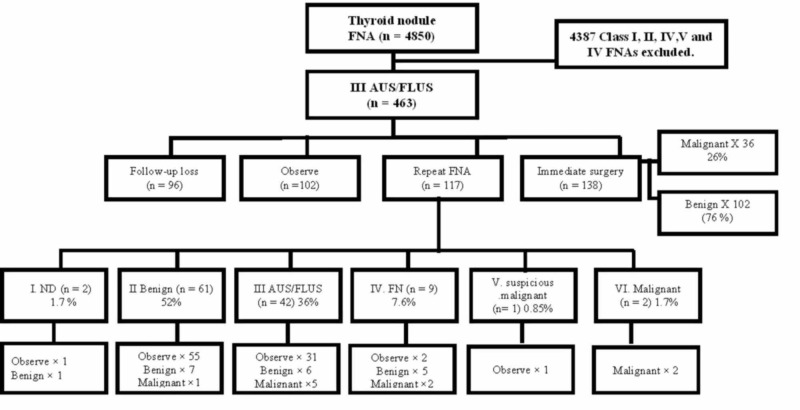
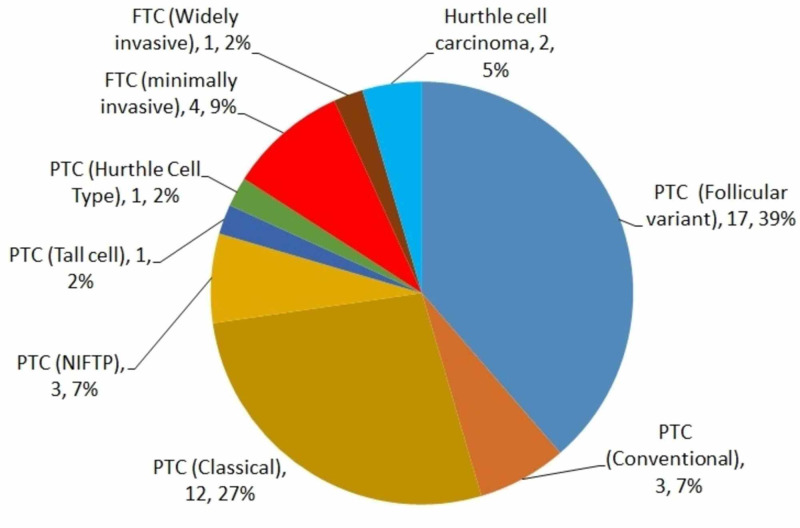
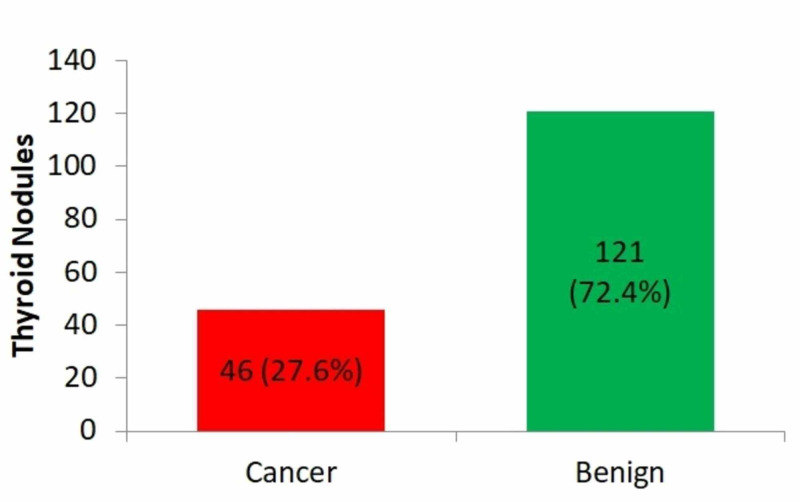
Background The Bethesda System for Reporting Thyroid Cytolopathology (TBSRTC) is the standardized category-based reporting system for thyroid nodule (TN) aspirations; however, atypia of undetermined significance/follicular lesion of undetermined significance (Bethesda category III, AUS/FLUS) is the most controversial category. The aim of this study was to identify the degree of malignancy risk and the related risk factors in the surgical pathology of the Bethesda Category III thyroid nodules. Methods A total of 4074 patients (15-90 years, 81.5% of females) were subjected to retrospective analysis, and a total of 463 nodules were classified as Bethesda Class III and included in the analysis. Once all the thyroid cytopathological slides and ultrasound (US) reports were reviewed, they were classified according to the Bethesda System for Reporting Thyroid Cytology, the American College of Radiology (ACR) and the Thyroid Imaging Reporting and Data System (TI-RADS). Results Among the 463 Bethesda class III nodules, 167 nodules were surgically excised, showing an overall malignancy of 27.6% (n = 46/167). Patients having thyroid-stimulating hormone (TSH) levels of >4.5 mIU/L (35%), TN <2 cm (34.6%), solid or nearly solid (28.7%), highly hypoechoic (58.3%), longer than wide (50%), lobulated (45.5%), punctate echogenic (48.6%), ACR TI-RAD 5 (55.2%) and falling under the ATA category of high suspicion (50%), displayed a higher risk of malignancy (ROM). The chi-square test revealed a strong association between the echogenicity, echogenic foci, ACR TI-RAD and American Thyroid Association (ATA) category between the malignant and benign nodules. The papillary thyroid carcinoma (PTC) follicular variant (39%) and PTC classical (27%) were identified, in this study population, as the commonest forms of thyroid cancer. Conclusion The nodules with AUS/FLUS cytology malignancy rate are comparable with the earlier estimations of other countries. The ACR TI-RAD displayed more accurate diagnostic performances in predicting malignancy in the Bethesda III nodules. However, to confirm the accuracy of the molecular marker tests in specific cytological scenarios, more extensive studies are required in the future.
背景 甲状腺细胞病理学报告的贝塞斯达系统(TBSRTC)是甲状腺结节(TN)细针穿刺抽吸的标准化分类报告系统;然而,意义不明确的非典型性/意义不明确的滤泡性病变(贝塞斯达Ⅲ类,AUS/FLUS)是最具争议的类别。本研究的目的是确定贝塞斯达Ⅲ类甲状腺结节手术病理中的恶性风险程度及相关危险因素。方法 对4074例患者(15 - 90岁,女性占81.5%)进行回顾性分析,共有463个结节被分类为贝塞斯达Ⅲ类并纳入分析。在复查所有甲状腺细胞病理切片和超声(US)报告后,根据甲状腺细胞病理学报告的贝塞斯达系统、美国放射学会(ACR)和甲状腺影像报告和数据系统(TI - RADS)进行分类。结果 在463个贝塞斯达Ⅲ类结节中,167个结节接受了手术切除,总体恶性率为27.6%(n = 46/167)。促甲状腺激素(TSH)水平>4.5 mIU/L的患者(35%)、TN<2 cm的患者(34.6%)、实性或近实性结节(28.7%)、高回声减低结节(58.3%)、长径大于短径的结节(50%)、分叶状结节(45.5%)、点状强回声结节(48.6%)、ACR TI - RAD 5类结节(55.2%)以及美国甲状腺协会(ATA)高度可疑类别的结节(50%),其恶性风险(ROM)更高。卡方检验显示,恶性结节与良性结节在回声、回声灶、ACR TI - RAD和ATA分类之间存在强关联。在本研究人群中,甲状腺乳头状癌(PTC)滤泡变异型(39%)和PTC经典型(27%)是最常见的甲状腺癌类型。结论 AUS/FLUS细胞学的结节恶性率与其他国家早期的估计相当。ACR TI - RAD在预测贝塞斯达Ⅲ类结节的恶性方面表现出更准确的诊断性能。然而,为了在特定细胞学情况下确认分子标志物检测的准确性,未来需要进行更广泛的研究。