
环境肠道功能障碍标志物与农村乌干达婴儿生长不良和铁状态不良有关。
Markers of Environmental Enteric Dysfunction Are Associated with Poor Growth and Iron Status in Rural Ugandan Infants.
机构信息
Division of Gastroenterology, Hepatology and Nutrition, Boston Children's Hospital, Boston, MA, USA.
USAID Feed the Future Innovation Lab for Nutrition at Tufts University, Boston, MA, USA.
出版信息
J Nutr. 2020 Aug 1;150(8):2175-2182. doi: 10.1093/jn/nxaa141.
BACKGROUND
Environmental enteric dysfunction (EED), characterized by altered intestinal permeability/inflammation, microbial translocation, and systemic inflammation (SI), may be a significant contributor to micronutrient deficiencies and poor growth in infants from low-resource settings.
OBJECTIVE
We examined associations among EED, SI, growth, and iron status at 6 mo of age.
METHODS
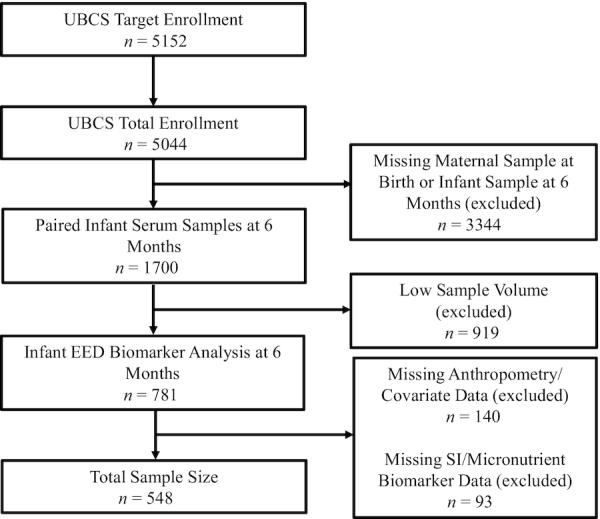
We performed a cross-sectional analysis of 6-mo-old infants (n = 548) enrolled in a Ugandan birth-cohort study (NCT04233944). EED was assessed via serum concentrations of anti-flagellin and anti- LPS immunoglobulins (Igs); SI was assessed via serum concentrations of ɑ1-acid glycoprotein (AGP) and C-reactive protein (CRP); iron status was assessed via serum concentrations of hemoglobin (Hb), soluble transferrin receptor (sTfR), and ferritin. Associations were assessed using adjusted linear regression analysis.
RESULTS
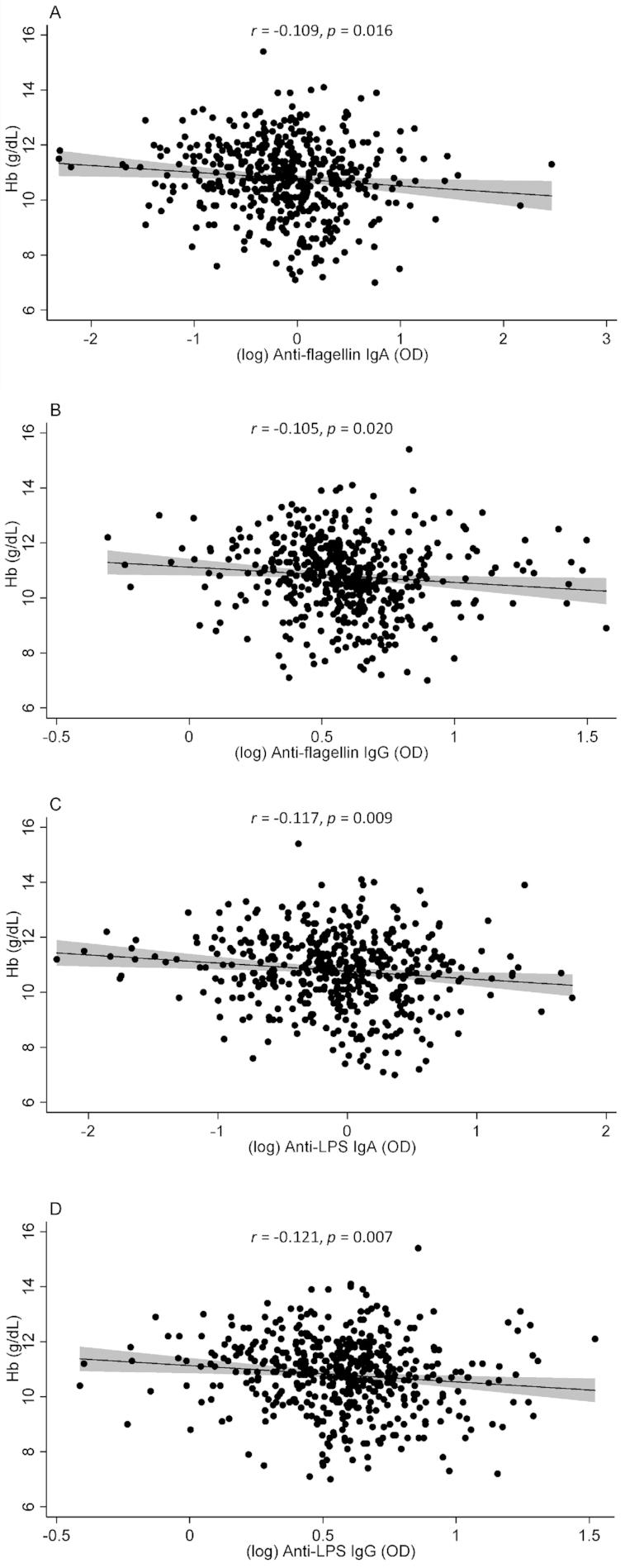
At 6 mo, ∼35% of infants were stunted [length-for-age z score (LAZ) < -2] and ∼53% were anemic [hemoglobin (Hb) <11.0 g/dL]. Nearly half (∼46%) had elevated AGP (>1 g/L) and ∼30% had elevated CRP (>5 mg/L). EED and SI biomarkers were significantly correlated (r = 0.142-0.193, P < 0.001 for all). In adjusted linear regression models, which included adjustments for SI, higher anti-flagellin IgA, anti-LPS IgA, and anti-LPS IgG concentrations were each significantly associated with lower LAZ [β (95% CI): -0.21 (-0.41, 0.00), -0.23 (-0.44, -0.03), and -0.33 (-0.58, -0.09)]. Furthermore, higher anti-flagellin IgA, anti-flagellin IgG, and anti-LPS IgA concentrations were significantly associated with lower Hb [β (95% CI): -0.24 (-0.45, -0.02), -0.58 (-1.13, 0.00), and -0.26 (-0.51, 0.00)] and higher anti-flagellin IgG and anti-LPS IgG concentrations were significantly associated with higher sTfR [β (95% CI): 2.31 (0.34, 4.28) and 3.13 (0.75, 5.51)].
CONCLUSIONS
EED is associated with both low LAZ and iron status in 6-mo-old infants. Further research on the mechanisms by which EED affects growth and micronutrient status is warranted.
背景
环境肠道功能障碍(EED)的特征是肠道通透性/炎症改变、微生物易位和全身炎症(SI),可能是造成资源匮乏环境下婴儿微量营养素缺乏和生长不良的重要原因。
目的
我们研究了 6 月龄婴儿的 EED、SI、生长和铁状态之间的关系。
方法
我们对参加乌干达出生队列研究(NCT04233944)的 548 名 6 月龄婴儿进行了横断面分析。通过血清抗鞭毛蛋白和抗脂多糖免疫球蛋白(Igs)浓度评估 EED;通过血清α1-酸性糖蛋白(AGP)和 C 反应蛋白(CRP)浓度评估 SI;通过血清血红蛋白(Hb)、可溶性转铁蛋白受体(sTfR)和铁蛋白浓度评估铁状态。使用调整后的线性回归分析评估相关性。
结果
6 月龄时,约 35%的婴儿发育迟缓(年龄别身长 z 评分(LAZ)<-2),约 53%的婴儿贫血(Hb<11.0g/dL)。近一半(约 46%)的婴儿 AGP 升高(>1g/L),约 30%的婴儿 CRP 升高(>5mg/L)。EED 和 SI 生物标志物呈显著相关(r=0.142-0.193,所有 P<0.001)。在调整后的线性回归模型中,包括对 SI 的调整后,较高的抗鞭毛蛋白 IgA、抗脂多糖 IgA 和抗脂多糖 IgG 浓度与较低的 LAZ[β(95%CI):-0.21(-0.41,0.00),-0.23(-0.44,-0.03)和-0.33(-0.58,-0.09)]显著相关。此外,较高的抗鞭毛蛋白 IgA、抗鞭毛蛋白 IgG 和抗脂多糖 IgA 浓度与较低的 Hb[β(95%CI):-0.24(-0.45,-0.02),-0.58(-1.13,0.00)和-0.26(-0.51,0.00)]显著相关,而较高的抗鞭毛蛋白 IgG 和抗脂多糖 IgG 浓度与较高的 sTfR[β(95%CI):2.31(0.34,4.28)和 3.13(0.75,5.51)]显著相关。
结论
EED 与 6 月龄婴儿的低 LAZ 和铁状态均相关。需要进一步研究 EED 影响生长和微量营养素状态的机制。
 Zotero 插件