• 文献检索
  • 文档翻译
  • 深度研究
  • 学术资讯
  • Suppr Zotero 插件Zotero 插件
  • 邀请有礼
  • 套餐&价格
  • 历史记录
应用&插件
Suppr Zotero 插件Zotero 插件浏览器插件Mac 客户端Windows 客户端微信小程序
定价
高级版会员购买积分包购买API积分包
服务
文献检索文档翻译深度研究API 文档MCP 服务
关于我们
关于 Suppr公司介绍联系我们用户协议隐私条款
关注我们

Suppr 超能文献

核心技术专利:CN118964589B侵权必究
粤ICP备2023148730 号-1Suppr @ 2026

文献检索

告别复杂PubMed语法,用中文像聊天一样搜索,搜遍4000万医学文献。AI智能推荐,让科研检索更轻松。

立即免费搜索

文件翻译

保留排版,准确专业,支持PDF/Word/PPT等文件格式,支持 12+语言互译。

免费翻译文档

深度研究

AI帮你快速写综述,25分钟生成高质量综述,智能提取关键信息,辅助科研写作。

立即免费体验

基于半导体量子点作为受体的生物发光能量转移。

Bioluminescence-Based Energy Transfer Using Semiconductor Quantum Dots as Acceptors.

机构信息

Ramakrishna Mission Vidyamandira, Belur Math, Howrah 711202, India.

Center for Bio/Molecular Science and Engineering, Code 6900, U.S. Naval Research Laboratory, Washington, DC 20375, USA.

出版信息

Sensors (Basel). 2020 May 21;20(10):2909. doi: 10.3390/s20102909.

DOI:10.3390/s20102909
PMID:32455561
原文链接:https://pmc.ncbi.nlm.nih.gov/articles/PMC7284562/
Abstract

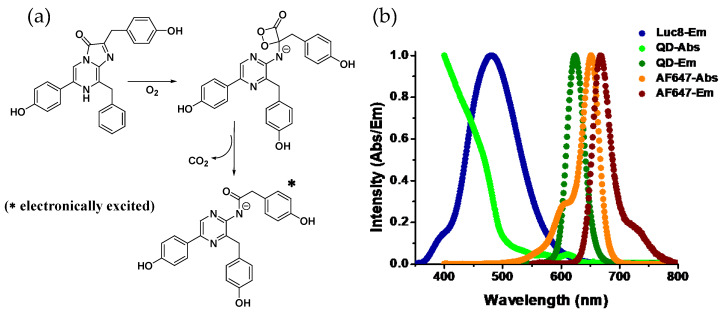
Bioluminescence resonance energy transfer (BRET) is the non-radiative transfer of energy from a bioluminescent protein donor to a fluorophore acceptor. It shares all the formalism of Förster resonance energy transfer (FRET) but differs in one key aspect: that the excited donor here is produced by biochemical means and not by an external illumination. Often the choice of BRET source is the bioluminescent protein luciferase, which catalyzes the oxidation of a substrate, typically coelenterazine, producing an oxidized product in its electronic excited state that, in turn, couples with a proximal fluorophore resulting in a fluorescence emission from the acceptor. The acceptors pertinent to this discussion are semiconductor quantum dots (QDs), which offer some unrivalled photophysical properties. Amongst other advantages, the QD's large Stokes shift is particularly advantageous as it allows easy and accurate deconstruction of acceptor signal, which is difficult to attain using organic dyes or fluorescent proteins. QD-BRET systems are gaining popularity in non-invasive bioimaging and as probes for biosensing as they don't require external optical illumination, which dramatically improves the signal-to-noise ratio by avoiding background auto-fluorescence. Despite the additional advantages such systems offer, there are challenges lying ahead that need to be addressed before they are utilized for translational types of research.

摘要

生物发光共振能量转移(BRET)是生物发光蛋白供体向荧光团受体的非辐射能量转移。它具有Förster 共振能量转移(FRET)的所有形式,但在一个关键方面有所不同:这里的激发供体是通过生化手段产生的,而不是通过外部照明产生的。通常,BRET 源的选择是生物发光蛋白荧光素酶,它催化底物的氧化,通常是腔肠素,产生其电子激发态的氧化产物,进而与邻近的荧光团偶联,导致从受体发出荧光。与本讨论相关的受体是半导体量子点(QD),它具有一些无与伦比的光物理性质。除其他优点外,QD 的大斯托克斯位移特别有利,因为它允许轻松准确地解构受体信号,这在使用有机染料或荧光蛋白时很难实现。QD-BRET 系统在非侵入性生物成像和生物传感探针中越来越受欢迎,因为它们不需要外部光学照明,这通过避免背景自发荧光极大地提高了信噪比。尽管此类系统具有额外的优势,但仍存在一些挑战需要解决,然后才能将其用于转化研究。
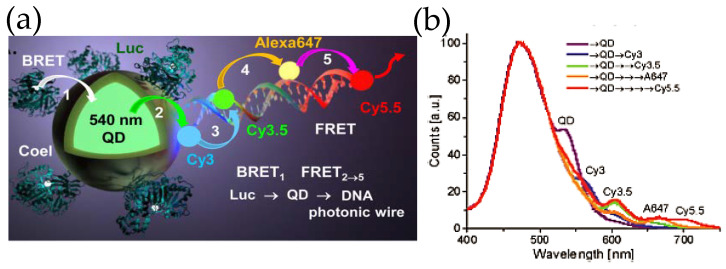
https://cdn.ncbi.nlm.nih.gov/pmc/blobs/5bed/7284562/1827c6aabaf0/sensors-20-02909-g007.jpg
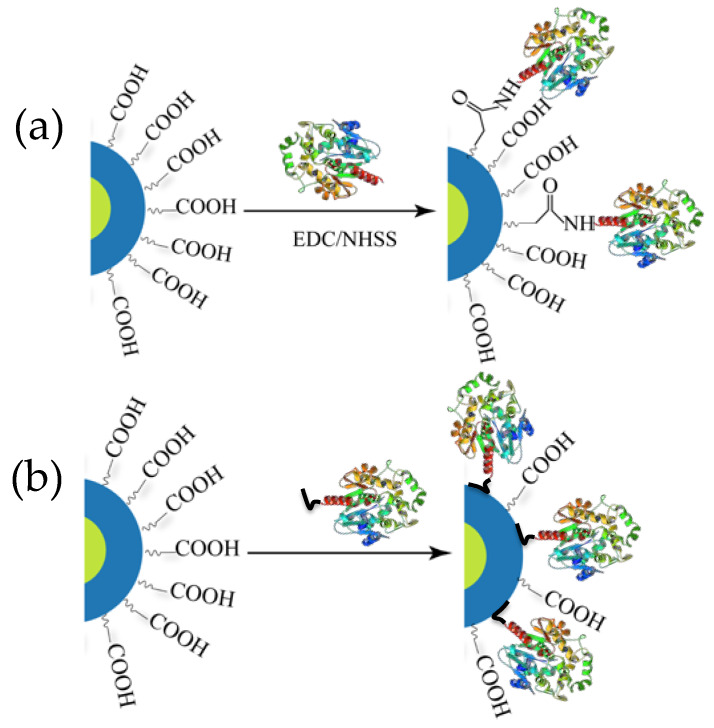
https://cdn.ncbi.nlm.nih.gov/pmc/blobs/5bed/7284562/cfa7cc77d3e9/sensors-20-02909-g001.jpg
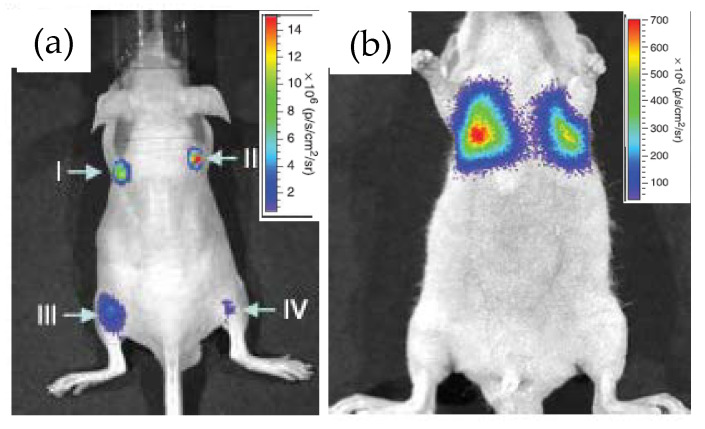
https://cdn.ncbi.nlm.nih.gov/pmc/blobs/5bed/7284562/ad9882dc0d0a/sensors-20-02909-g002.jpg
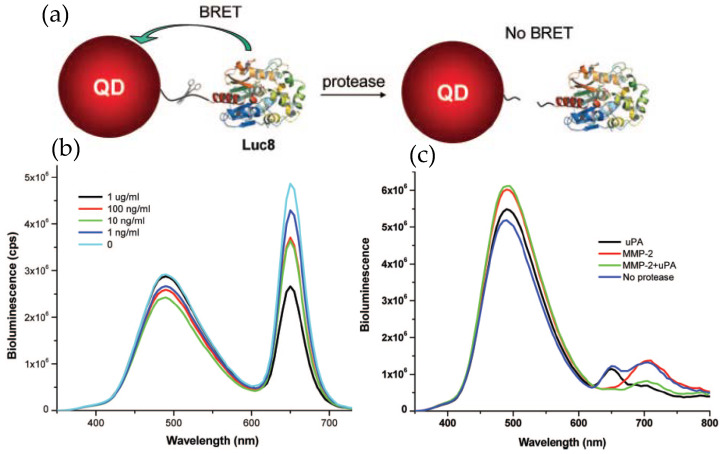
https://cdn.ncbi.nlm.nih.gov/pmc/blobs/5bed/7284562/ddcaa2c632b4/sensors-20-02909-g003.jpg
https://cdn.ncbi.nlm.nih.gov/pmc/blobs/5bed/7284562/4d891a01a174/sensors-20-02909-g004.jpg
https://cdn.ncbi.nlm.nih.gov/pmc/blobs/5bed/7284562/fea6e342cef7/sensors-20-02909-g005.jpg
https://cdn.ncbi.nlm.nih.gov/pmc/blobs/5bed/7284562/ff936c418417/sensors-20-02909-g006.jpg
https://cdn.ncbi.nlm.nih.gov/pmc/blobs/5bed/7284562/1827c6aabaf0/sensors-20-02909-g007.jpg
https://cdn.ncbi.nlm.nih.gov/pmc/blobs/5bed/7284562/cfa7cc77d3e9/sensors-20-02909-g001.jpg
https://cdn.ncbi.nlm.nih.gov/pmc/blobs/5bed/7284562/ad9882dc0d0a/sensors-20-02909-g002.jpg
https://cdn.ncbi.nlm.nih.gov/pmc/blobs/5bed/7284562/ddcaa2c632b4/sensors-20-02909-g003.jpg
https://cdn.ncbi.nlm.nih.gov/pmc/blobs/5bed/7284562/4d891a01a174/sensors-20-02909-g004.jpg
https://cdn.ncbi.nlm.nih.gov/pmc/blobs/5bed/7284562/fea6e342cef7/sensors-20-02909-g005.jpg
https://cdn.ncbi.nlm.nih.gov/pmc/blobs/5bed/7284562/ff936c418417/sensors-20-02909-g006.jpg
https://cdn.ncbi.nlm.nih.gov/pmc/blobs/5bed/7284562/1827c6aabaf0/sensors-20-02909-g007.jpg

相似文献

1
Bioluminescence-Based Energy Transfer Using Semiconductor Quantum Dots as Acceptors.基于半导体量子点作为受体的生物发光能量转移。
Sensors (Basel). 2020 May 21;20(10):2909. doi: 10.3390/s20102909.
2
Biosensing and imaging based on bioluminescence resonance energy transfer.基于生物发光共振能量转移的生物传感与成像
Curr Opin Biotechnol. 2009 Feb;20(1):37-44. doi: 10.1016/j.copbio.2009.01.001. Epub 2009 Feb 11.
3
Förster Resonance Energy Transfer between Quantum Dot Donors and Quantum Dot Acceptors.量子点供体与量子点受体之间的Förster共振能量转移。
Sensors (Basel). 2015 Jun 5;15(6):13288-325. doi: 10.3390/s150613288.
4
An enzymatically-sensitized sequential and concentric energy transfer relay self-assembled around semiconductor quantum dots.一种酶敏的顺序和同心能量转移接力自组装在半导体量子点周围。
Nanoscale. 2015 May 7;7(17):7603-14. doi: 10.1039/c5nr00828j.
5
Förster resonance energy transfer investigations using quantum-dot fluorophores.使用量子点荧光团的Förster共振能量转移研究。
Chemphyschem. 2006 Jan 16;7(1):47-57. doi: 10.1002/cphc.200500217.
6
Quantum dots as simultaneous acceptors and donors in time-gated Förster resonance energy transfer relays: characterization and biosensing.量子点作为时间门控Förster 共振能量转移继电器中的同时受体和供体:表征和生物传感。
J Am Chem Soc. 2012 Jan 25;134(3):1876-91. doi: 10.1021/ja210162f. Epub 2012 Jan 5.
7
QD-Based FRET Probes at a Glance.基于量子点的荧光共振能量转移探针概述。
Sensors (Basel). 2015 Jun 4;15(6):13028-51. doi: 10.3390/s150613028.
8
Novel multistep BRET-FRET energy transfer using nanoconjugates of firefly proteins, quantum dots, and red fluorescent proteins.新型萤火虫蛋白、量子点和红色荧光蛋白纳米复合物的多步 BRET-FRET 能量转移。
Nanoscale. 2013 Jun 21;5(12):5303-6. doi: 10.1039/c3nr01842c.
9
Recent developments in Förster resonance energy transfer (FRET) diagnostics using quantum dots.使用量子点的荧光共振能量转移(FRET)诊断技术的最新进展。
Anal Bioanal Chem. 2016 Jul;408(17):4475-83. doi: 10.1007/s00216-016-9434-y. Epub 2016 Mar 12.
10
Lanthanides and quantum dots as Förster resonance energy transfer agents for diagnostics and cellular imaging.镧系元素和量子点作为用于诊断和细胞成像的荧光共振能量转移剂。
Inorg Chem. 2014 Feb 17;53(4):1824-38. doi: 10.1021/ic4017883. Epub 2013 Oct 7.

引用本文的文献

1
Novel Estrogen Receptor Dimerization BRET-Based Biosensors for Screening Estrogenic Endocrine-Disrupting Chemicals.用于筛选雌激素类内分泌干扰化学物质的基于新型雌激素受体二聚化生物发光共振能量转移的生物传感器。
Biomater Res. 2024 Mar 7;28:0010. doi: 10.34133/bmr.0010. eCollection 2024.
2
Pursuing excitonic energy transfer with programmable DNA-based optical breadboards.采用可编程 DNA 光学实验平台实现激子能量转移。
Chem Soc Rev. 2023 Nov 13;52(22):7848-7948. doi: 10.1039/d0cs00936a.
3
Intracellular Ionic Strength Sensing Using NanoLuc.利用 NanoLuc 进行细胞内离子强度感应

本文引用的文献

1
A Multiparametric Evaluation of Quantum Dot Size and Surface-Grafted Peptide Density on Cellular Uptake and Cytotoxicity.量子点尺寸和表面接枝肽密度的多参数评价对细胞摄取和细胞毒性的影响。
Bioconjug Chem. 2020 Apr 15;31(4):1077-1087. doi: 10.1021/acs.bioconjchem.0c00078. Epub 2020 Apr 1.
2
Bayesian Network Resource for Meta-Analysis: Cellular Toxicity of Quantum Dots.贝叶斯网络资源用于荟萃分析:量子点的细胞毒性。
Small. 2019 Aug;15(34):e1900510. doi: 10.1002/smll.201900510. Epub 2019 Jun 17.
3
Recombinant Protein (Luciferase-IgG Binding Domain) Conjugated Quantum Dots for BRET-Coupled Near-Infrared Imaging of Epidermal Growth Factor Receptors.
Int J Mol Sci. 2021 Jan 12;22(2):677. doi: 10.3390/ijms22020677.
4
Coelenterazine-Dependent Luciferases as a Powerful Analytical Tool for Research and Biomedical Applications.依赖腔肠素的荧光素酶作为研究和生物医学应用的强大分析工具。
Int J Mol Sci. 2020 Oct 10;21(20):7465. doi: 10.3390/ijms21207465.
重组蛋白(荧光素酶-IgG 结合结构域)偶联量子点用于表皮生长因子受体 BRET 偶联近红外成像。
Bioconjug Chem. 2018 Apr 18;29(4):1466-1474. doi: 10.1021/acs.bioconjchem.8b00149. Epub 2018 Mar 19.
4
Chemi- and Bioluminescence of Cyclic Peroxides.环状过氧化物的化学发光和生物发光。
Chem Rev. 2018 Aug 8;118(15):6927-6974. doi: 10.1021/acs.chemrev.7b00649. Epub 2018 Mar 1.
5
Bioluminescence Resonance Energy Transfer (BRET)-coupled Annexin V-functionalized Quantum Dots for Near-Infrared Optical Detection of Apoptotic Cells.用于凋亡细胞近红外光学检测的生物发光共振能量转移(BRET)耦合膜联蛋白V功能化量子点
Chembiochem. 2017 Nov 16;18(22):2231-2235. doi: 10.1002/cbic.201700486. Epub 2017 Oct 18.
6
Nanoparticle cellular uptake by dendritic wedge peptides: achieving single peptide facilitated delivery.树枝状楔形肽介导的纳米颗粒细胞摄取:实现单肽促进传递。
Nanoscale. 2017 Jul 27;9(29):10447-10464. doi: 10.1039/c7nr03362a.
7
Energy Transfer with Semiconductor Quantum Dot Bioconjugates: A Versatile Platform for Biosensing, Energy Harvesting, and Other Developing Applications.半导体量子点生物缀合物的能量转移:用于生物传感、能量收集和其他新兴应用的多功能平台。
Chem Rev. 2017 Jan 25;117(2):536-711. doi: 10.1021/acs.chemrev.6b00030. Epub 2016 Jun 30.
8
Quantum dot-NanoLuc bioluminescence resonance energy transfer enables tumor imaging and lymph node mapping in vivo.量子点-纳米荧光素酶生物发光共振能量转移实现了体内肿瘤成像和淋巴结定位。
Chem Commun (Camb). 2016 May 19;52(43):6997-7000. doi: 10.1039/c6cc02764d.
9
Chemiluminescence and Bioluminescence as an Excitation Source in the Photodynamic Therapy of Cancer: A Critical Review.化学发光和生物发光作为癌症光动力疗法的激发源:批判性综述
Chemphyschem. 2016 Aug 4;17(15):2286-94. doi: 10.1002/cphc.201600270. Epub 2016 May 25.
10
Monitoring Enzymatic Proteolysis Using Either Enzyme- or Substrate-Bioconjugated Quantum Dots.使用酶或底物生物共轭量子点监测酶促蛋白水解
Methods Enzymol. 2016;571:19-54. doi: 10.1016/bs.mie.2016.01.001. Epub 2016 Feb 19.