Kebbach Maeruan, Darowski Martin, Krueger Sven, Schilling Christoph, Grupp Thomas M, Bader Rainer, Geier Andreas
Biomechanics and Implant Technology Research Laboratory, Department of Orthopaedics, Rostock University Medical Center, 18057 Rostock, Germany.
Aesculap AG Research and Development, 78532 Tuttlingen, Germany.
Materials (Basel). 2020 May 21;13(10):2365. doi: 10.3390/ma13102365.
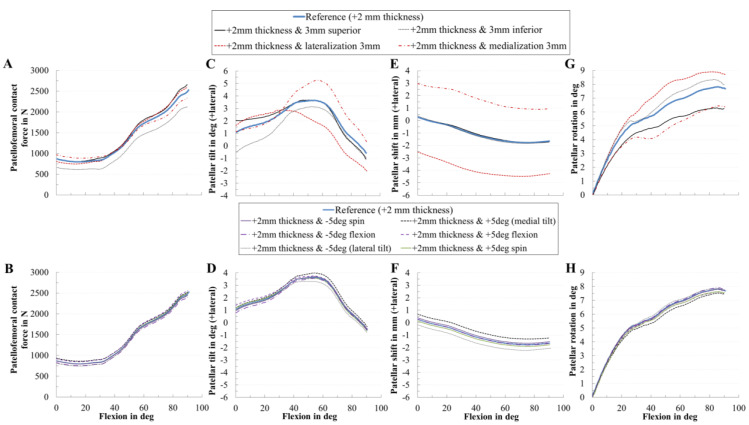
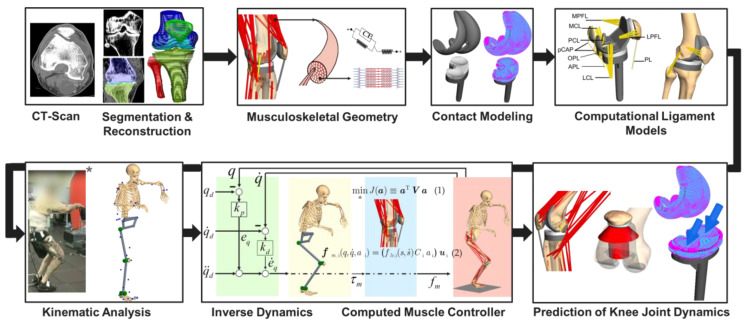
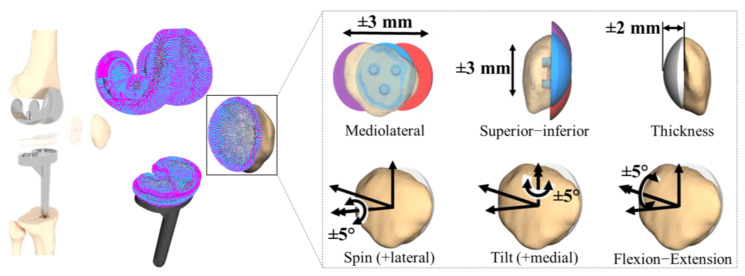
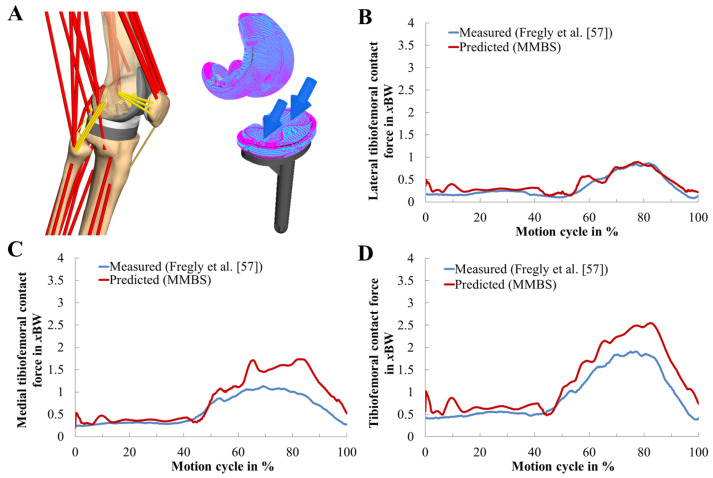
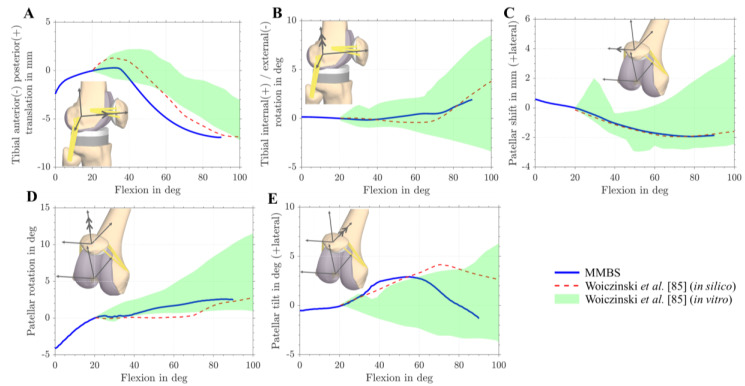
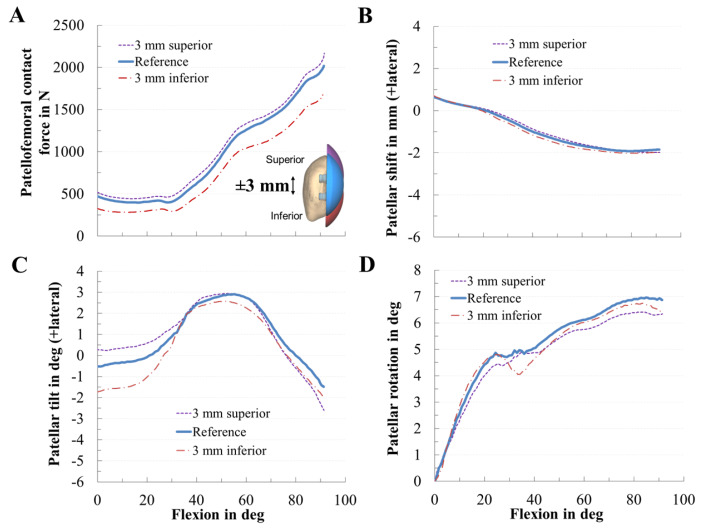
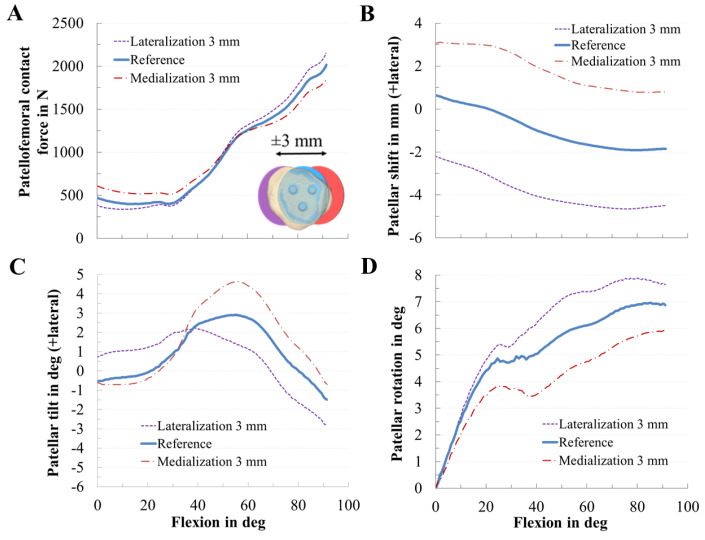
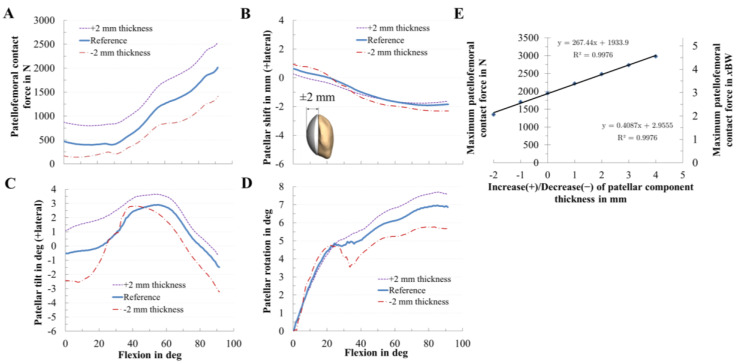
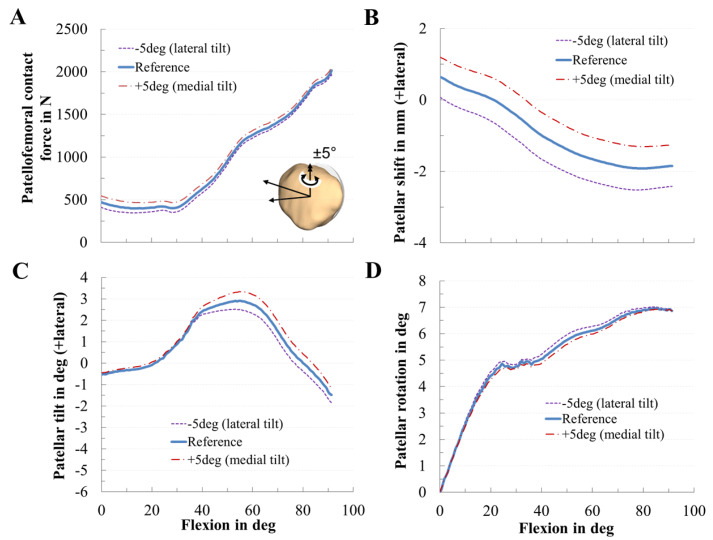
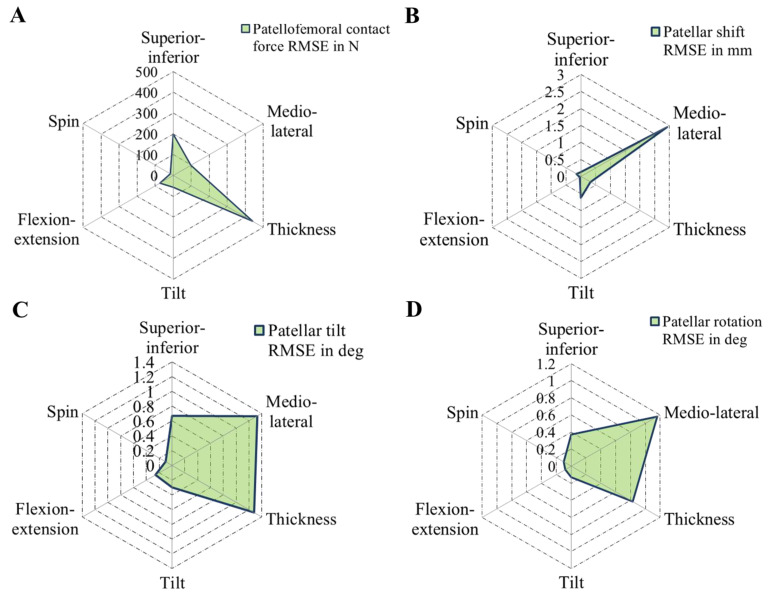
Patellofemoral (PF) disorders are considered a major clinical complication after total knee replacement (TKR). Malpositioning and design of the patellar component impacts knee joint dynamics, implant fixation and wear propagation. However, only a limited number of studies have addressed the biomechanical impact of the patellar component on PF dynamics and their results have been discussed controversially. To address these issues, we implemented a musculoskeletal multibody simulation (MMBS) study for the systematical analysis of the patellar component's thickness and positioning on PF contact forces and kinematics during dynamic squat motion with virtually implanted unconstrained cruciate-retaining (CR)-TKR. The patellar button thickness clearly increased the contact forces in the PF joint (up to 27%). Similarly, the PF contact forces were affected by superior-inferior positioning (up to 16%) and mediolateral positioning (up to 8%) of the patellar button. PF kinematics was mostly affected by the mediolateral positioning and the thickness of the patellar component. A medialization of 3 mm caused a lateral patellar shift by up to 2.7 mm and lateral patellar tilt by up to 1.6°. However, deviations in the rotational positioning of the patellar button had minor effects on PF dynamics. Aiming at an optimal intraoperative patellar component alignment, the orthopedic surgeon should pay close attention to the patellar component thickness in combination with its mediolateral and superior-inferior positioning on the retropatellar surface. Our generated MMBS model provides systematic and reproducible insight into the effects of patellar component positioning and design on PF dynamics and has the potential to serve as a preoperative analysis tool.
髌股(PF)疾病被认为是全膝关节置换术(TKR)后的主要临床并发症。髌骨组件的位置不当和设计会影响膝关节动力学、植入物固定和磨损扩展。然而,只有少数研究探讨了髌骨组件对PF动力学的生物力学影响,其结果也存在争议。为了解决这些问题,我们进行了一项肌肉骨骼多体模拟(MMBS)研究,以系统分析在虚拟植入无约束保留交叉韧带(CR)-TKR的动态深蹲运动过程中,髌骨组件的厚度和位置对PF接触力和运动学的影响。髌骨纽扣厚度明显增加了PF关节中的接触力(高达27%)。同样,PF接触力受髌骨纽扣上下位置(高达16%)和内外侧位置(高达8%)的影响。PF运动学主要受髌骨组件的内外侧位置和厚度影响。向内侧移位3 mm会导致髌骨向外移位高达2.7 mm,髌骨向外倾斜高达1.6°。然而,髌骨纽扣旋转位置的偏差对PF动力学影响较小。为了实现术中髌骨组件的最佳对线,骨科医生应密切关注髌骨组件的厚度及其在髌后表面的内外侧和上下位置。我们生成的MMBS模型为髌骨组件位置和设计对PF动力学的影响提供了系统且可重复的见解,并且有潜力作为术前分析工具。