Department of Nutrition and Movement Sciences, Maastricht University Medical Centre, 6200 MD Maastricht, The Netherlands.
NUTRIM School of Nutrition and Translational Research in Metabolism, Maastricht University, 6200 MD Maastricht, The Netherlands.
Nutrients. 2020 May 22;12(5):1512. doi: 10.3390/nu12051512.
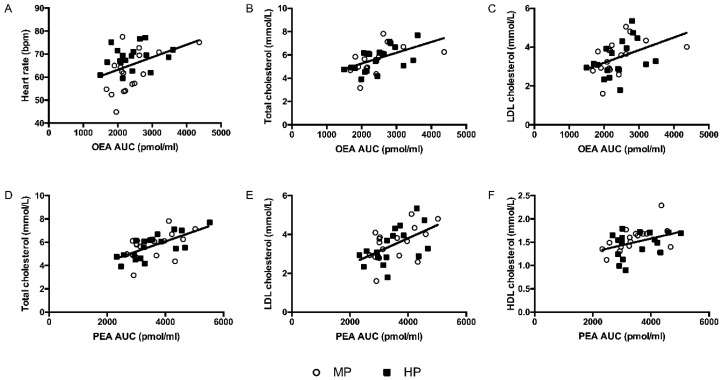
An unfavorable lipid profile and being overweight are known mediators in the development of cardiovascular disease (CVD) risk. The effect of diet, particularly high in protein, remains under discussion. Therefore, this study examines the effects of a high-protein (HP) diet on cardiometabolic health and vascular function (i.e., endothelial function, arterial stiffness, and retinal microvascular structure), and the possible association with plasma endocannabinoids and endocannabinoid-related compounds in overweight participants. Thirty-eight participants (64.5 ± 5.9 (mean ± SD) years; body mass index (BMI) 28.9 ± 4.0 kg/m) were measured for 48 h in a respiration chamber after body-weight maintenance for approximately 34 months following weight reduction. Diets with either a HP ( = 20) or moderate protein (MP; = 18) content (25%/45%/30% vs. 15%/55%/30% protein/carbohydrate/fat) were provided in energy balance. Validated markers for cardiometabolic health (i.e., office blood pressure (BP) and serum lipoprotein concentrations) and vascular function (i.e., brachial artery flow-mediated vasodilation, pulse wave analysis and velocity, and retinal microvascular calibers) were measured before and after those 48 h. Additionally, 24 h ambulatory BP, plasma anandamide (AEA), 2-arachidonoylglycerol (2-AG), oleoylethanolamide (OEA), palmitoylethanolamide (PEA), and pregnenolone (PREG) were analyzed throughout the day. Office and ambulatory BP, serum lipoprotein concentrations, and vascular function markers were not different between the groups. Only heart rate (HR) was higher in the HP group. HR was positively associated with OEA, while OEA and PEA were also positively associated with total cholesterol (TC) and low-density lipoprotein (LDL) cholesterol concentrations. Vascular function markers were not associated with endocannabinoids (or endocannabinoid-related substances). In conclusion, the HP diet did not affect cardiometabolic health and vascular function in overweight participants after completing a weight-loss intervention. Furthermore, our data indicate a possible association between OEA and PEA with TC and LDL cholesterol.
不利的血脂谱和超重是心血管疾病 (CVD) 风险发展的已知介质。饮食的影响,特别是高蛋白,仍在讨论中。因此,本研究检查了高蛋白 (HP) 饮食对心脏代谢健康和血管功能(即内皮功能、动脉僵硬和视网膜微血管结构)的影响,以及与超重参与者血浆内源性大麻素和内源性大麻素相关化合物的可能关联。38 名参与者(64.5 ± 5.9(均值 ± SD)岁;体重指数(BMI)28.9 ± 4.0 kg/m)在大约 34 个月的减肥后体重维持期间,在呼吸室内测量了 48 小时。提供了两种饮食,一种是 HP(=20),另一种是中等蛋白(MP;=18),能量平衡,饮食中蛋白质/碳水化合物/脂肪的比例分别为 25%/45%/30%和 15%/55%/30%。在这 48 小时前后,测量了心脏代谢健康(即办公室血压(BP)和血清脂蛋白浓度)和血管功能(即肱动脉血流介导的血管扩张、脉搏波分析和速度以及视网膜微血管口径)的有效标志物。此外,还分析了 24 小时动态血压、血浆花生四烯酸乙醇酰胺(AEA)、2-花生四烯酸甘油(2-AG)、油酰乙醇酰胺(OEA)、棕榈酰乙醇酰胺(PEA)和孕烯醇酮(PREG)全天的水平。办公室和动态血压、血清脂蛋白浓度和血管功能标志物在两组之间没有差异。只有 HP 组的心率(HR)较高。HR 与 OEA 呈正相关,而 OEA 和 PEA 也与总胆固醇(TC)和低密度脂蛋白(LDL)胆固醇浓度呈正相关。血管功能标志物与内源性大麻素(或内源性大麻素相关物质)无关。总之,在完成减肥干预后,高蛋白饮食并未影响超重参与者的心脏代谢健康和血管功能。此外,我们的数据表明 OEA 和 PEA 与 TC 和 LDL 胆固醇之间可能存在关联。