Department of Obstetrics and Gynecology, Reproductive Medical Center, The Second Affiliated Hospital, Air Force Military Medical University, Xi'an, China.
Department of Obstetrics and Gynecology, 986 Hospital of Air Force, Xi'an, China.
Front Endocrinol (Lausanne). 2020 May 8;11:287. doi: 10.3389/fendo.2020.00287. eCollection 2020.
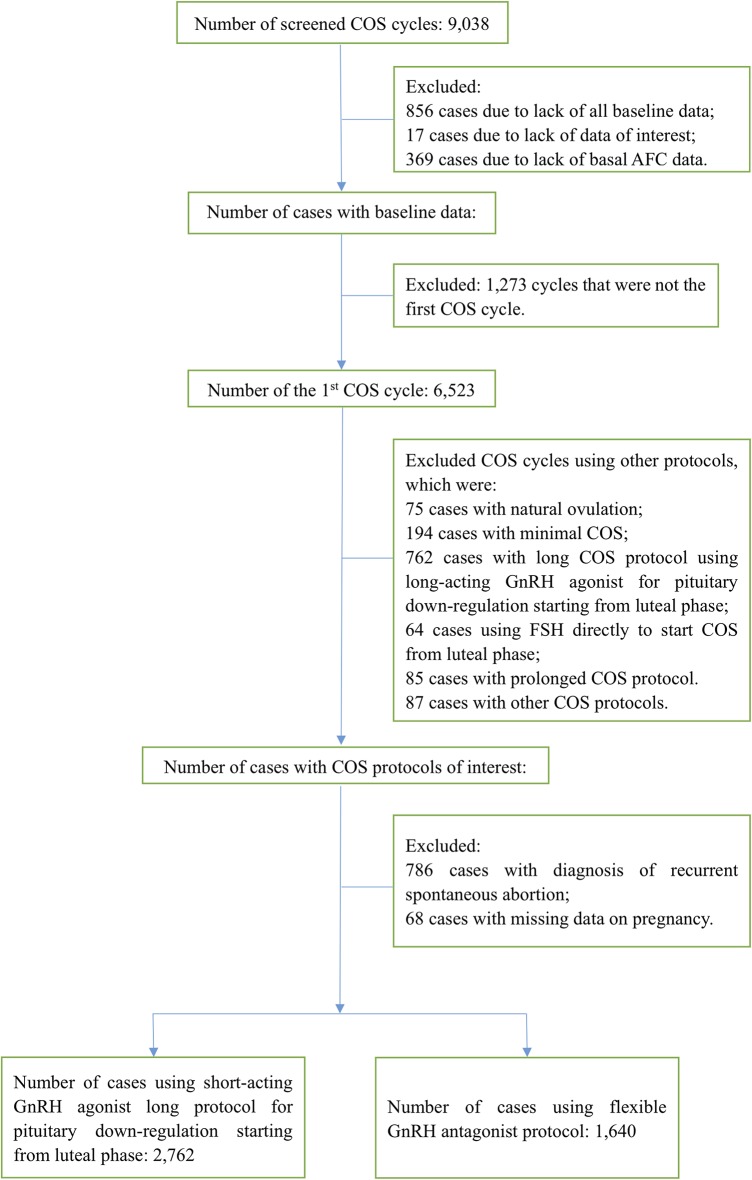
To compare the cumulative live birth rates (cLBRs) after the first assisted reproductive technology (ART) cycle using flexible gonadotropin releasing hormone (GnRH)-antagonist protocol vs. standard long GnRH agonist protocol for controlled ovarian stimulation (COS) in infertile women with different ages and ovarian reserve. Women who underwent ART treatment at our center between June 1st, 2015 and December 31st, 2018 were screened. Among them, only women who underwent their first COS cycle with flexible GnRH antagonist protocol or standard long GnRH agonist protocol were included in this study. The main outcome measurement was cLBR. A total of 4,402 patients were eligible for the analysis, of whom, 2,762 patients used the GnRH agonist protocol and 1,640 patients used the GnRH antagonist protocol. The cLBRs of women in the antagonist protocol group and long agonist protocol group were 45.3 and 50.0%, respectively. Subgroup multivariable regression analysis showed that, in patients with low ovarian reserve (AFC ≤ 7), the cLBR was significantly lower in the antagonist group than in the long agonist protocol group [OR (95% CI) 0.62 (0.41, 0.94)], which effect was more robust in younger patients (<30 y) [OR (95% CI) 0.29 (0.11, 0.74)]. The analysis also revealed remarkably lower cLBR in patients above 40 years regardless of their AFC, although the difference was not statistically significant. However, in patients with high ovarian reserve (AFC >24), the cLBR was higher in cycles with antagonist protocol than with the long agonist protocol [OR (95% CI) 1.43 (0.96, 2.12)], and the effect was of statistical significance in younger patients (< 30 y) [OR (95% CI) 1.78 (1.07, 2.96)]. The present study suggests that the flexible GnRH antagonist protocol might not be suitable for patients with low ovarian reserve (AFC ≤ 7) or patients aged over 40 years. However, flexible GnRH antagonist protocol might be strongly recommended for patients under 30 years old and with high ovarian reserve (AFC > 24). For the rest groups of patients in the present cohort, antagonist protocol was slightly favored because it had lower OHSS in general and in patients with poly-cystic ovarian syndrome (PCOS) according to previous publications.
比较不同年龄和卵巢储备的不孕妇女在接受辅助生殖技术(ART)后首次使用灵活的促性腺激素释放激素(GnRH)拮抗剂方案与标准长 GnRH 激动剂方案进行控制性卵巢刺激(COS)后的累积活产率(cLBR)。 筛选了 2015 年 6 月 1 日至 2018 年 12 月 31 日期间在我们中心接受 ART 治疗的妇女。其中,仅纳入首次接受灵活 GnRH 拮抗剂方案或标准长 GnRH 激动剂方案进行 COS 周期的妇女。主要结局测量指标为 cLBR。 共有 4402 名患者符合分析条件,其中 2762 名患者使用 GnRH 激动剂方案,1640 名患者使用 GnRH 拮抗剂方案。拮抗剂方案组和长激动剂方案组的 cLBR 分别为 45.3%和 50.0%。亚组多变量回归分析显示,在卵巢储备低(AFC≤7)的患者中,拮抗剂组的 cLBR 明显低于长激动剂方案组[OR(95%CI)0.62(0.41,0.94)],在年轻患者(<30 岁)中效果更显著[OR(95%CI)0.29(0.11,0.74)]。分析还显示,无论 AFC 如何,年龄超过 40 岁的患者的 cLBR 明显较低,尽管差异无统计学意义。然而,在卵巢储备高(AFC>24)的患者中,拮抗剂方案周期的 cLBR 高于长激动剂方案周期[OR(95%CI)1.43(0.96,2.12)],在年轻患者(<30 岁)中差异有统计学意义[OR(95%CI)1.78(1.07,2.96)]。 本研究表明,灵活 GnRH 拮抗剂方案可能不适合卵巢储备低(AFC≤7)或年龄超过 40 岁的患者。然而,对于年龄<30 岁且卵巢储备高(AFC>24)的患者,灵活 GnRH 拮抗剂方案可能是强烈推荐的。对于本队列中其余患者群体,由于根据之前的出版物拮抗剂方案总体上和多囊卵巢综合征(PCOS)患者中 OHSS 发生率较低,因此拮抗剂方案略有优势。