Thong Tasha, Wang Yutong, Brooks Michael D, Lee Christopher T, Scott Clayton, Balzano Laura, Wicha Max S, Colacino Justin A
Department of Environmental Health Sciences, School of Public Health, University of Michigan, Ann Arbor, MI, United States.
Department of Electrical Engineering and Computer Science, University of Michigan, Ann Arbor, MI, United States.
Front Cell Dev Biol. 2020 May 8;8:288. doi: 10.3389/fcell.2020.00288. eCollection 2020.
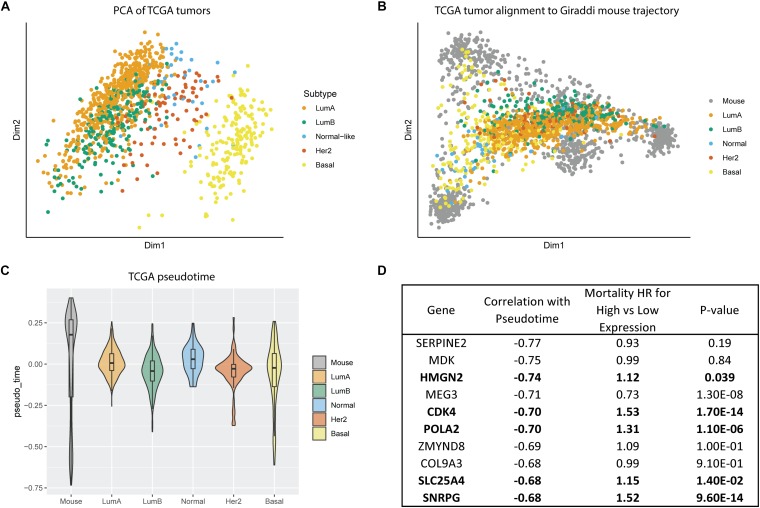
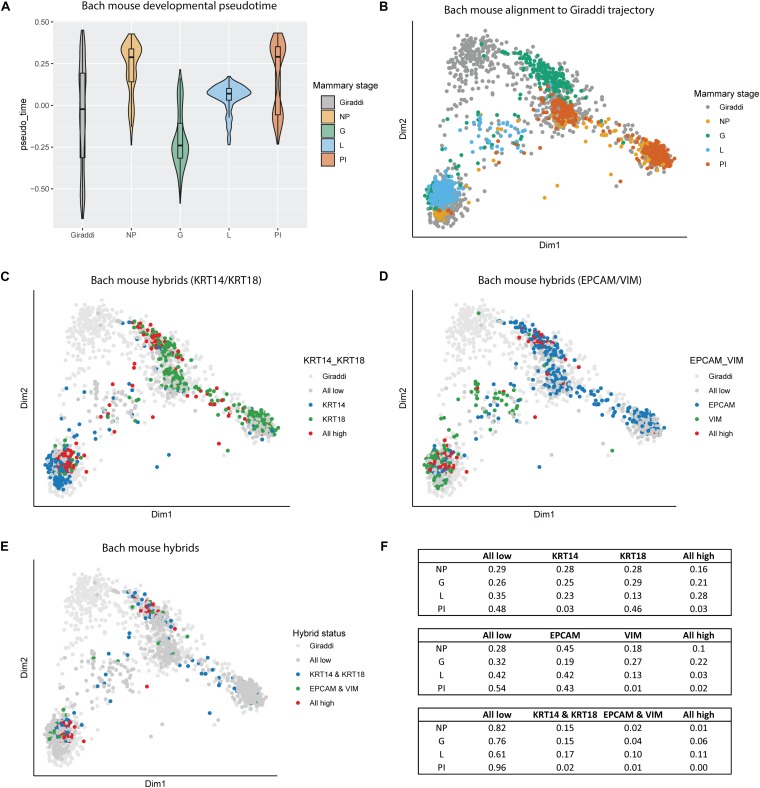
Similarities between stem cells and cancer cells have implicated mammary stem cells in breast carcinogenesis. Recent evidence suggests that normal breast stem cells exist in multiple phenotypic states: epithelial, mesenchymal, and hybrid epithelial/mesenchymal (E/M). Hybrid E/M cells in particular have been implicated in breast cancer metastasis and poor prognosis. Mounting evidence also suggests that stem cell phenotypes change throughout the life course, for example, through embryonic development and pregnancy. The goal of this study was to use single cell RNA-sequencing to quantify cell state distributions of the normal mammary (NM) gland throughout developmental stages and when perturbed into a stem-like state using conditional reprogramming (CR). Using machine learning based dataset alignment, we integrate multiple mammary gland single cell RNA-seq datasets from human and mouse, along with bulk RNA-seq data from breast tumors in the Cancer Genome Atlas (TCGA), to interrogate hybrid stem cell states in the normal mammary gland and cancer. CR of human mammary cells induces an expanded stem cell state, characterized by increased expression of embryonic stem cell associated genes. Alignment to a mouse single-cell transcriptome atlas spanning mammary gland development from to adulthood revealed that NM cells align to adult mouse cells and CR cells align across the pseudotime trajectory with a stem-like population aligning to the embryonic mouse cells. Three hybrid populations emerge after CR that are rare in NM: / (hybrid luminal/basal), (hybrid E/M), and a quadruple positive population, expressing all four markers. Pseudotime analysis and alignment to the mouse developmental trajectory revealed that E/M hybrids are the most developmentally immature. Analyses of single cell mouse mammary RNA-seq throughout pregnancy show that during gestation, there is an enrichment of hybrid E/M cells, suggesting that these cells play an important role in mammary morphogenesis during lactation. Finally, pseudotime analysis and alignment of TCGA breast cancer expression data revealed that breast cancer subtypes express distinct developmental signatures, with basal tumors representing the most "developmentally immature" phenotype. These results highlight phenotypic plasticity of normal mammary stem cells and provide insight into the relationship between hybrid cell populations, stemness, and cancer.
干细胞与癌细胞之间的相似性表明乳腺干细胞与乳腺癌发生有关。最近的证据表明,正常乳腺干细胞存在多种表型状态:上皮型、间充质型和混合上皮/间充质型(E/M)。特别是混合E/M细胞与乳腺癌转移和不良预后有关。越来越多的证据还表明,干细胞表型在整个生命过程中会发生变化,例如在胚胎发育和怀孕过程中。本研究的目的是使用单细胞RNA测序来量化正常乳腺(NM)在整个发育阶段以及使用条件重编程(CR)使其进入干细胞样状态时的细胞状态分布。通过基于机器学习的数据集比对,我们整合了来自人类和小鼠的多个乳腺单细胞RNA-seq数据集,以及癌症基因组图谱(TCGA)中乳腺肿瘤的批量RNA-seq数据,以研究正常乳腺和癌症中的混合干细胞状态。人类乳腺细胞的CR诱导了一种扩展的干细胞状态,其特征是胚胎干细胞相关基因的表达增加。与从小鼠胚胎期到成年期的乳腺发育单细胞转录组图谱比对发现,NM细胞与成年小鼠细胞比对,CR细胞在伪时间轨迹上与一个干细胞样群体比对,该群体与胚胎小鼠细胞比对。CR后出现了三个在NM中罕见的混合群体:/(混合管腔/基底)、(混合E/M)和一个四重阳性群体,表达所有四种标志物。伪时间分析和与小鼠发育轨迹的比对表明,E/M杂种在发育上最不成熟。对整个孕期小鼠乳腺单细胞RNA-seq的分析表明,在妊娠期,混合E/M细胞富集,表明这些细胞在泌乳期乳腺形态发生中起重要作用。最后,伪时间分析和TCGA乳腺癌表达数据的比对表明,乳腺癌亚型表达不同的发育特征,基底肿瘤代表最“发育不成熟”的表型。这些结果突出了正常乳腺干细胞的表型可塑性,并为混合细胞群体、干性和癌症之间的关系提供了见解。