Hinterding Stijn O M, Vonk Sander J W, van Harten Elleke J, Rabouw Freddy T
Soft Condensed Matter, Utrecht University, Princetonplein 1, 3584CC Utrecht, The Netherlands.
Inorganic Chemistry and Catalysis, Utrecht University, Universiteitsweg 99, 3584CG Utrecht, The Netherlands.
J Phys Chem Lett. 2020 Jun 18;11(12):4755-4761. doi: 10.1021/acs.jpclett.0c01250. Epub 2020 Jun 4.
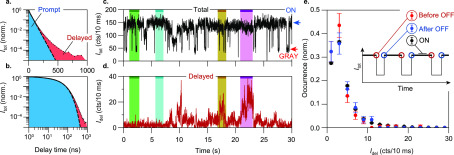
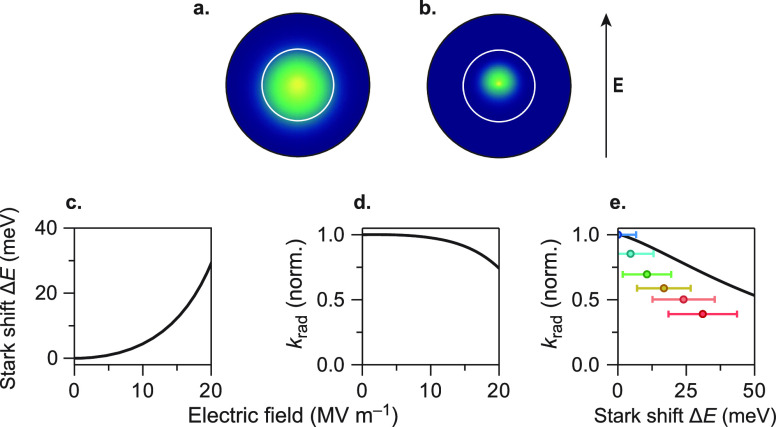
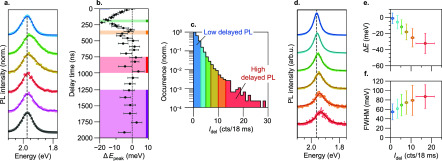
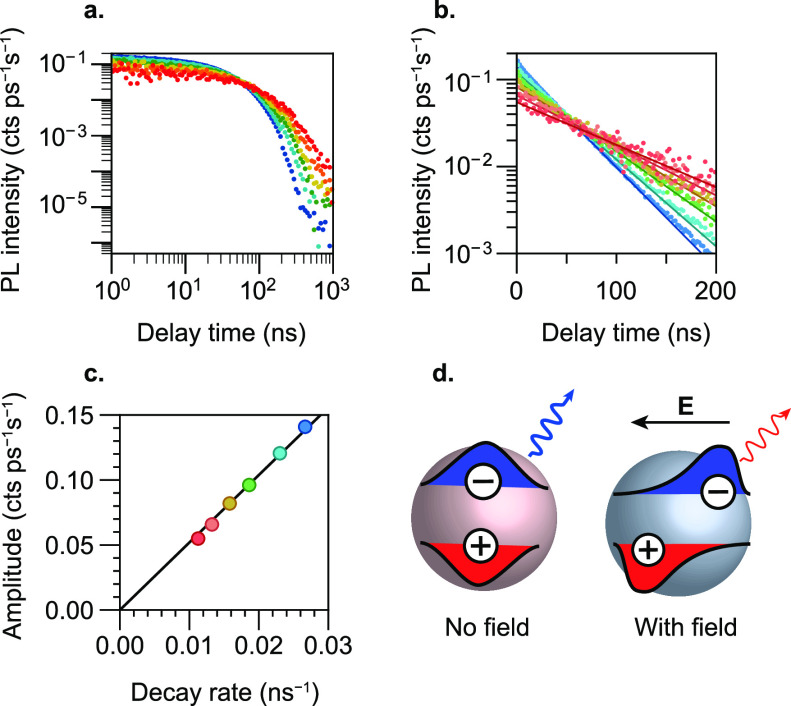
Bright and fast fluorescence makes semiconductor nanocrystals, or quantum dots (QDs), appealing for applications ranging from biomedical research to display screens. However, a few percent of their fluorescence intensity is surprisingly slow. Research into this "delayed emission" has been scarce, despite undesired consequences for some applications and potential opportunities for others. Here, we characterize the dynamics of delayed emission exhibited by individual CdSe/CdS core/shell QDs and correlate these with changes in the emission spectrum. The delayed-emission intensity from a single QD fluctuates strongly during an experiment of several minutes and is thus not always "on", implying that control over delayed emission may be possible. Periods of bright delayed emission correlate with red-shifted emission spectra. This behavior is consistent with exciton polarization by fluctuating electric fields due to diffusing surface charges, which have been known to cause spectral diffusion in QDs. Our findings thus provide a stepping stone for future efforts to control delayed emission.
明亮且快速的荧光使得半导体纳米晶体,即量子点(QDs),在从生物医学研究到显示屏等一系列应用中颇具吸引力。然而,它们荧光强度的百分之几却惊人地缓慢。尽管这种“延迟发射”对某些应用会产生不良后果,对其他应用则有潜在机遇,但对此的研究却很匮乏。在此,我们表征了单个CdSe/CdS核壳量子点所表现出的延迟发射动力学,并将这些与发射光谱的变化相关联。在几分钟的实验过程中,单个量子点的延迟发射强度会剧烈波动,因此并非总是“开启”的,这意味着对延迟发射的控制或许是可行的。明亮的延迟发射期与红移的发射光谱相关。这种行为与由于扩散的表面电荷产生的波动电场导致的激子极化相一致,已知表面电荷会在量子点中引起光谱扩散。因此,我们的研究结果为未来控制延迟发射的努力提供了一块垫脚石。