Hinterding Stijn O M, Salzmann Bastiaan B V, Vonk Sander J W, Vanmaekelbergh Daniel, Weckhuysen Bert M, Hutter Eline M, Rabouw Freddy T
Soft Condensed Matter, Debye Institute for Nanomaterials Science, Utrecht University, Princetonplein 1, 3584CC Utrecht, The Netherlands.
Inorganic Chemistry and Catalysis, Debye Institute for Nanomaterials Science, Utrecht University, Universiteitsweg 99, 3584CG Utrecht, The Netherlands.
ACS Nano. 2021 Apr 27;15(4):7216-7225. doi: 10.1021/acsnano.1c00481. Epub 2021 Mar 24.
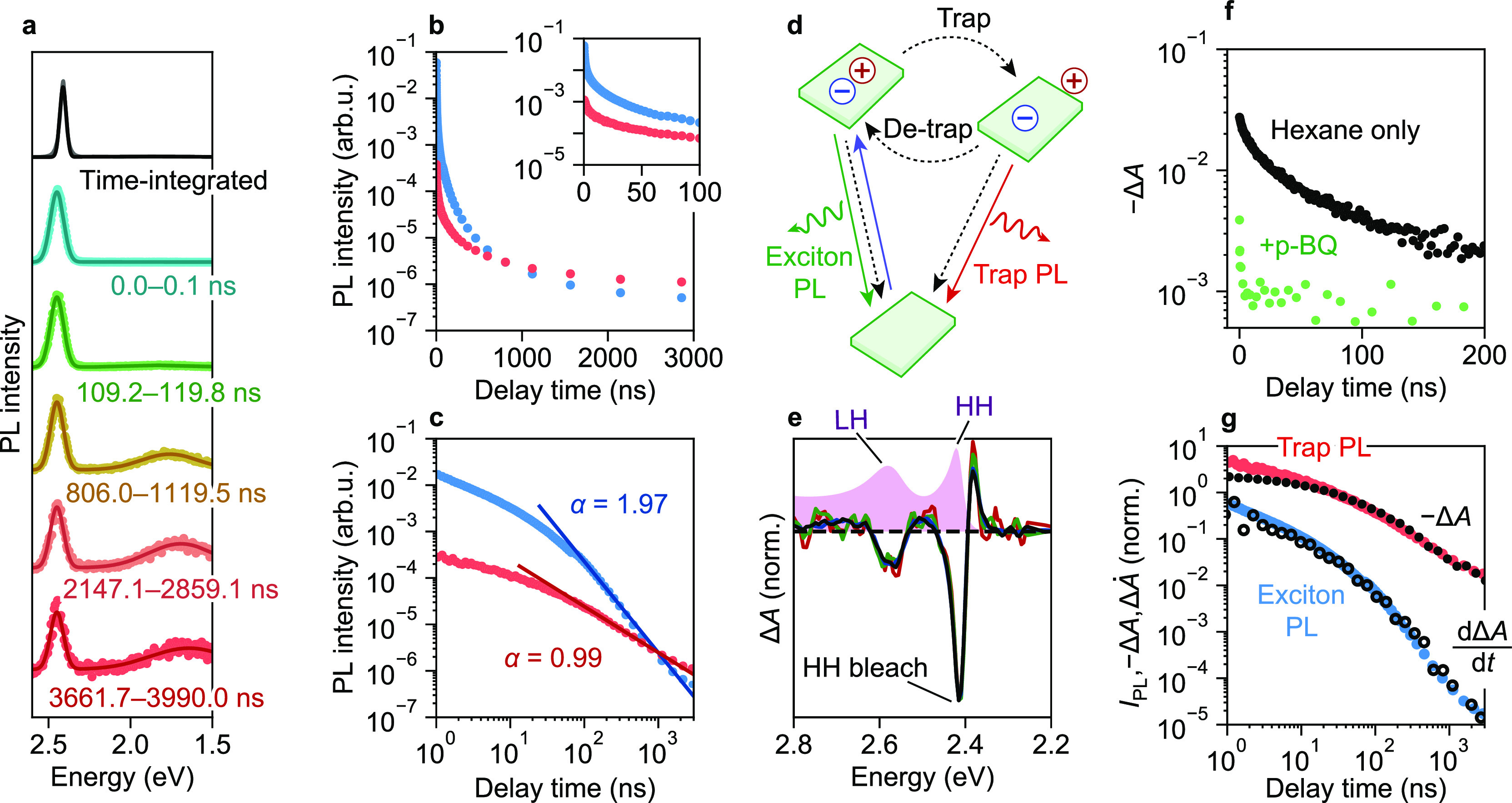
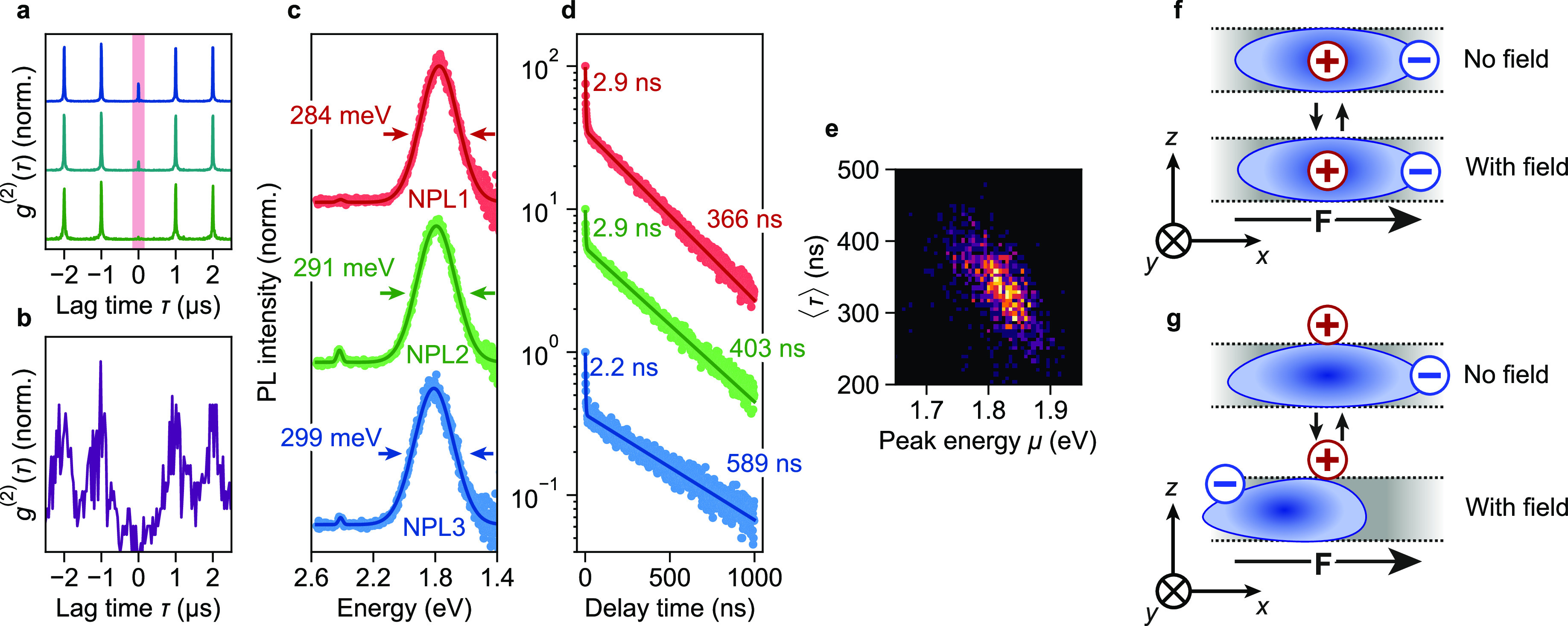
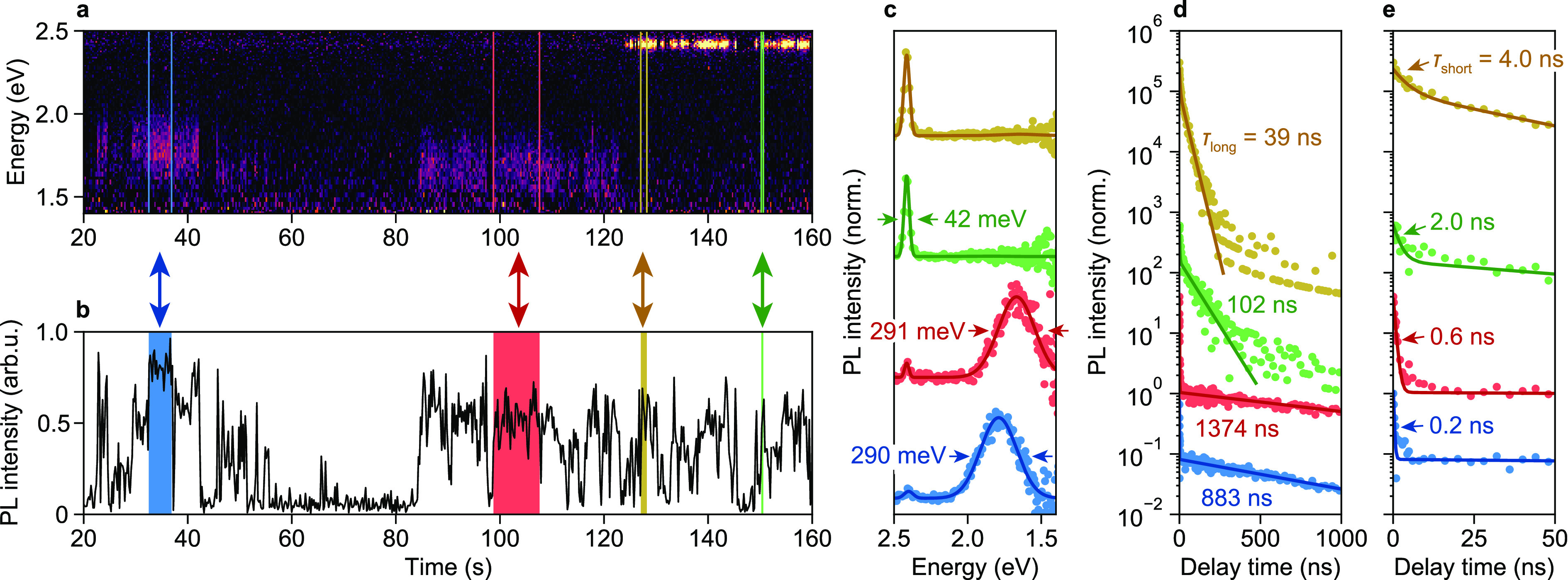
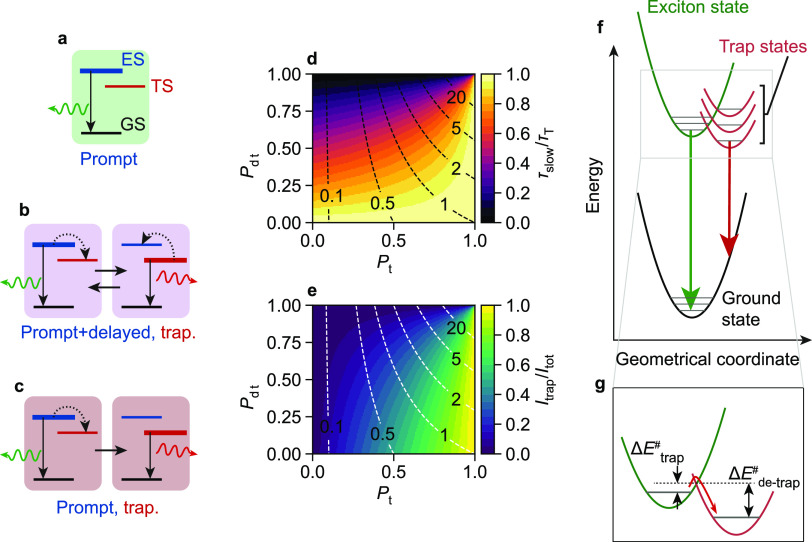
Trap states can strongly affect semiconductor nanocrystals, by quenching, delaying, and spectrally shifting the photoluminescence (PL). Trap states have proven elusive and difficult to study in detail at the ensemble level, let alone in the single-trap regime. CdSe nanoplatelets (NPLs) exhibit significant fractions of long-lived "delayed emission" and near-infrared "trap emission". We use these two spectroscopic handles to study trap states at the ensemble and the single-particle level. We find that reversible hole trapping leads to both delayed and trap PL, involving the same trap states. At the single-particle level, reversible trapping induces exponential delayed PL and trap PL, with lifetimes ranging from 40 to 1300 ns. In contrast with exciton PL, single-trap PL is broad and shows spectral diffusion and strictly single-photon emission. Our results highlight the large inhomogeneity of trap states, even at the single-particle level.
陷阱态可通过猝灭、延迟和光谱移动光致发光(PL)来强烈影响半导体纳米晶体。已证明陷阱态难以捉摸,在整体水平上难以详细研究,更不用说在单陷阱状态下了。CdSe纳米片(NPLs)表现出相当一部分长寿命的“延迟发射”和近红外“陷阱发射”。我们利用这两种光谱手段在整体和单粒子水平上研究陷阱态。我们发现可逆空穴俘获会导致延迟PL和陷阱PL,涉及相同的陷阱态。在单粒子水平上,可逆俘获会诱导指数形式的延迟PL和陷阱PL,其寿命范围为40至1300纳秒。与激子PL相比,单陷阱PL较宽,表现出光谱扩散和严格的单光子发射。我们的结果突出了陷阱态的巨大不均匀性,即使在单粒子水平也是如此。