From the Centers of Inflammation, Translational, and Clinical Lung Research (Y. Shao, Y. Sun, Y.L., F.S., C.D., C.J., K.X., X.J., X.Y.), Temple University, Lewis Katz School of Medicine, Philadelphia, PA.
Centers for Metabolic Disease Research, Cardiovascular Research and Thrombosis Research (J.S., W.Y.Y., X.J., H.W.), Temple University, Lewis Katz School of Medicine, Philadelphia, PA.
Arterioscler Thromb Vasc Biol. 2020 Jun;40(6):e138-e152. doi: 10.1161/ATVBAHA.120.314330. Epub 2020 May 27.
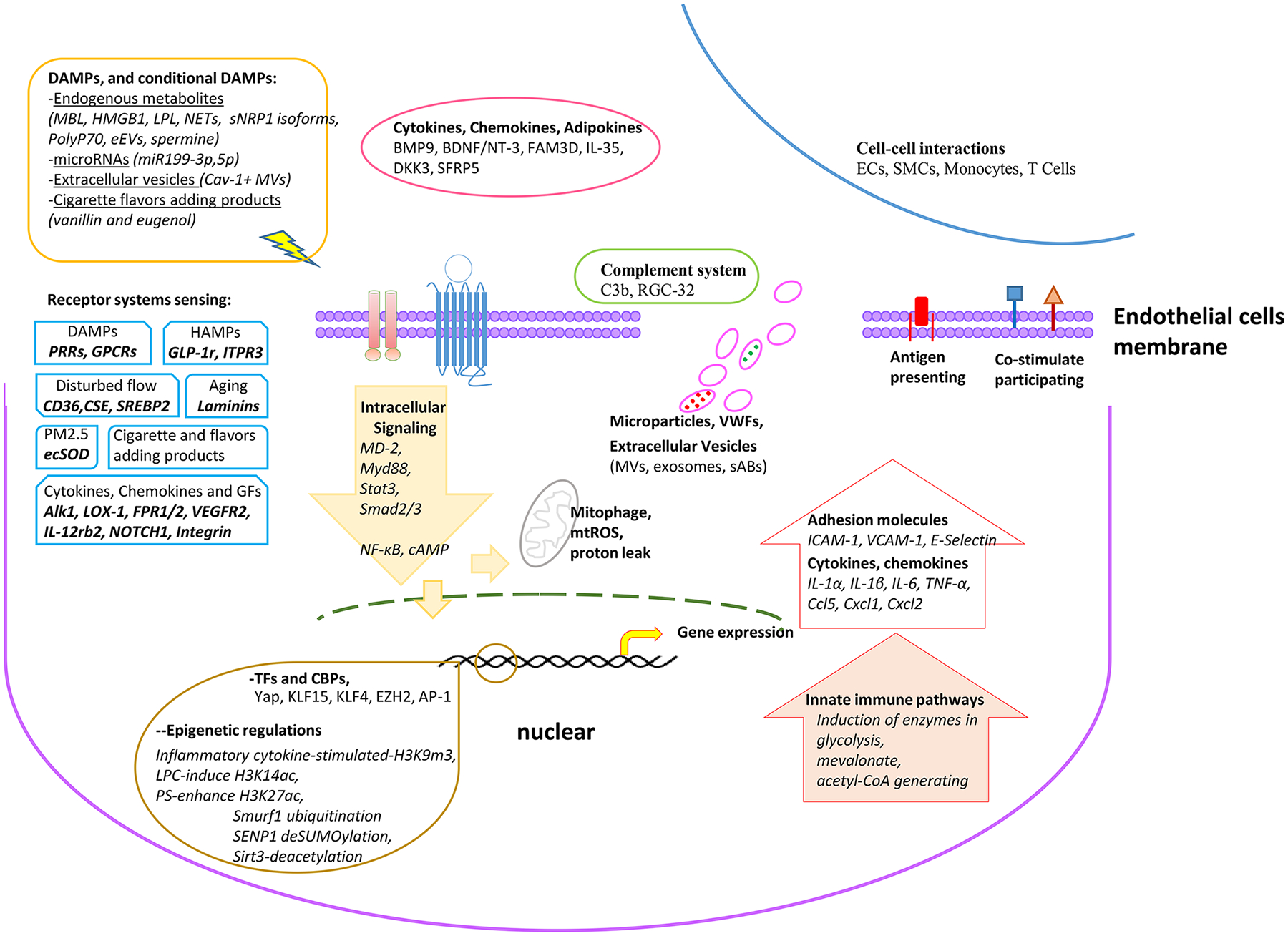
In addition to the roles of endothelial cells (ECs) in physiological processes, ECs actively participate in both innate and adaptive immune responses. We previously reported that, in comparison to macrophages, a prototypic innate immune cell type, ECs have many innate immune functions that macrophages carry out, including cytokine secretion, phagocytic function, antigen presentation, pathogen-associated molecular patterns-, and danger-associated molecular patterns-sensing, proinflammatory, immune-enhancing, anti-inflammatory, immunosuppression, migration, heterogeneity, and plasticity. In this highlight, we introduce recent advances published in both and many other journals: (1) several significant characters classify ECs as novel immune cells not only in infections and allograft transplantation but also in metabolic diseases; (2) several new receptor systems including conditional danger-associated molecular pattern receptors, nonpattern receptors, and homeostasis associated molecular patterns receptors contribute to innate immune functions of ECs; (3) immunometabolism and innate immune memory determine the innate immune functions of ECs; (4) a great induction of the immune checkpoint receptors in ECs during inflammations suggests the immune tolerogenic functions of ECs; and (5) association of immune checkpoint inhibitors with cardiovascular adverse events and cardio-oncology indicates the potential contributions of ECs as innate immune cells.
除了在生理过程中内皮细胞 (ECs) 的作用外,ECs 还积极参与先天和适应性免疫反应。我们之前曾报道过,与巨噬细胞等典型的先天免疫细胞类型相比,ECs 具有许多先天免疫功能,巨噬细胞执行这些功能,包括细胞因子分泌、吞噬作用、抗原呈递、病原体相关分子模式和危险相关分子模式感知、促炎、免疫增强、抗炎、免疫抑制、迁移、异质性和可塑性。在这一重点介绍中,我们介绍了 和许多其他期刊上发表的最新进展:(1) 几个重要的特征将 ECs 归类为新型免疫细胞,不仅在感染和同种异体移植中,而且在代谢疾病中也是如此;(2) 包括条件危险相关分子模式受体、非模式受体和与稳态相关的分子模式受体在内的几个新的受体系统有助于 ECs 的先天免疫功能;(3) 免疫代谢和先天免疫记忆决定了 ECs 的先天免疫功能;(4) 在炎症过程中 ECs 中大量诱导免疫检查点受体表明了 ECs 的免疫耐受功能;(5) 免疫检查点抑制剂与心血管不良事件和心脏肿瘤学的关联表明了 ECs 作为先天免疫细胞的潜在贡献。