Noom, Inc, New York, NY, United States.
Department of Medicine, Division of Endocrinology & Metabolism, Renaissance School of Medicine, Stony Brook University, Stony Brook, NY, United States.
JMIR Mhealth Uhealth. 2020 Jul 8;8(7):e17842. doi: 10.2196/17842.
The Centers for Disease Control and Prevention (CDC) diabetes prevention program (DPP) has formed the foundation for Type 2 Diabetes Mellitus (T2DM) prevention efforts and lifestyle change modifications in multiple care settings. To our knowledge, no randomized controlled trial has verified the efficacy of a fully mobile version of CDC's diabetes prevention program (DPP).
This study aimed to investigate the long-term weight loss and glycemic efficacy of a mobile-delivered DPP compared with a control group receiving usual medical care.
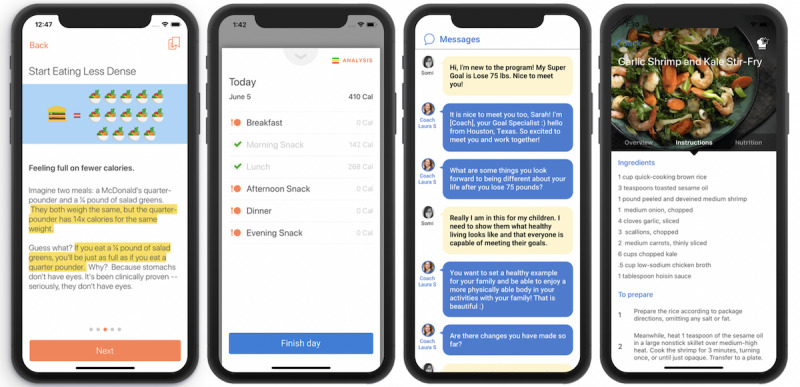
Adults with prediabetes (N=202) were recruited from a clinic and randomized to either a mobile-delivered, coach-guided DPP (Noom) or a control group that received regular medical care including a paper-based DPP curriculum and no formal intervention. The intervention group learned how to use the Noom program, how to interact with their coach, and the importance of maintaining motivation. They had access to an interactive coach-to-participant interface and group messaging, daily challenges for behavior change, DPP-based education articles, food logging, and automated feedback. Primary outcomes included changes in weight and hemoglobin A (HbA) levels at 6 and 12 months, respectively. Exploratory secondary outcomes included program engagement as a predictor of changes in weight and HbA levels.
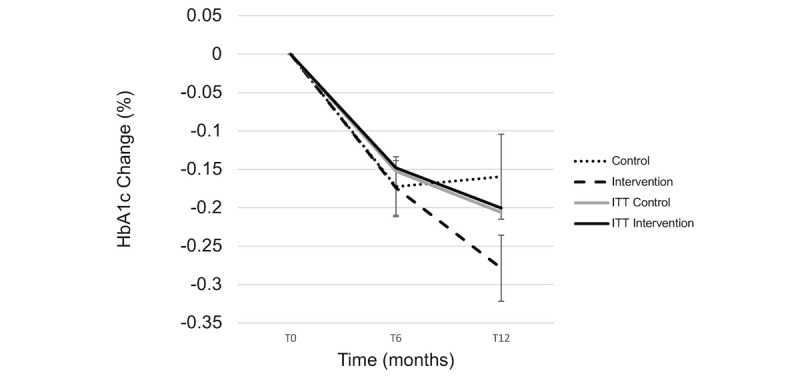
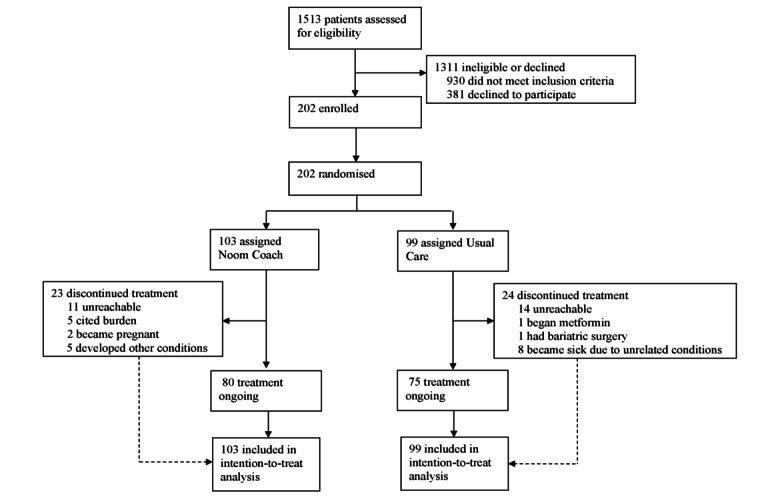
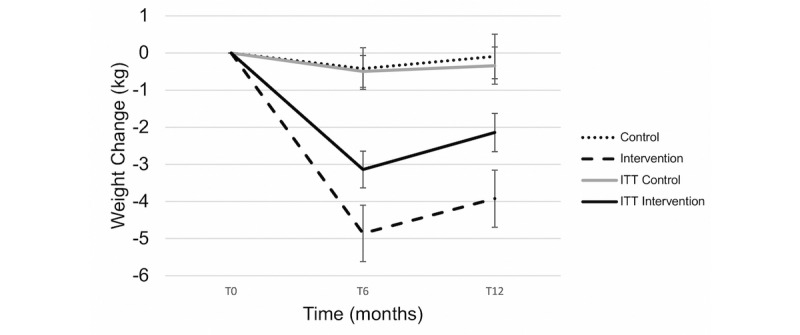
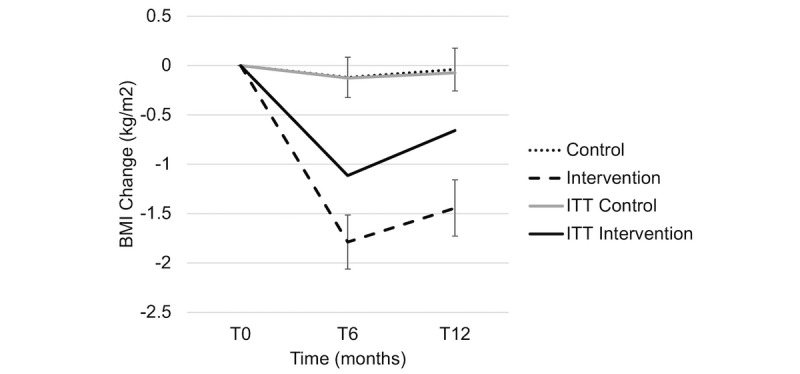
A total of 202 participants were recruited and randomized into the intervention (n=101) or control group (n=99). In the intention-to-treat (ITT) analyses, changes in the participants' weight and BMI were significantly different at 6 months between the intervention and control groups, but there was no difference in HbA levels (mean difference 0.004%, SE 0.05; P=.94). Weight and BMI were lower in the intervention group by -2.64 kg (SE 0.71; P<.001) and -0.99 kg/m2 (SE 0.29; P=.001), respectively. These differences persisted at 12 months. However, in the analyses that did not involve ITT, program completers achieved a significant weight loss of 5.6% (SE 0.81; P<.001) at 6 months, maintaining 4.7% (SE 0.88; P<.001) of their weight loss at 12 months. The control group lost -0.15% at 6 months (SE 0.64; P=.85) and gained 0.33% (SE 0.70; P=.63) at 12 months. Those randomized to the intervention group who did not start the program had no meaningful weight or HbA level change, similar to the control group. At 1 year, the intervention group showed a 0.23% reduction in HbA levels; those who completed the intervention showed a 0.28% reduction. Those assigned to the control group had a 0.16% reduction in HbA levels.
This novel mobile-delivered DPP achieved significant weight loss reductions for up to 1 year compared with usual care. This type of intervention reduces the risk of overt diabetes without the added barriers of in-person interventions.
ClinicalTrials.gov NCT03865342; https://clinicaltrials.gov/ct2/show/NCT03865342.
疾病控制与预防中心 (CDC) 的糖尿病预防计划 (DPP) 为 2 型糖尿病 (T2DM) 的预防工作和生活方式改变奠定了基础,已在多个护理环境中实施。据我们所知,尚无随机对照试验验证 CDC 完全移动版本的糖尿病预防计划 (DPP) 的疗效。
本研究旨在调查通过移动设备提供的 DPP 与接受常规医疗护理的对照组相比在长期减重和血糖效果方面的差异。
将 202 名患有前驱糖尿病的成年人从诊所招募并随机分为移动提供、教练指导的 DPP(Noom)组或接受常规医疗护理的对照组,包括纸质 DPP 课程和没有正式干预。干预组学习如何使用 Noom 程序、与教练互动以及保持动力的重要性。他们可以使用互动式教练与参与者界面和群组消息、日常行为改变挑战、基于 DPP 的教育文章、食物记录和自动反馈。主要结局包括分别在 6 个月和 12 个月时体重和血红蛋白 A(HbA)水平的变化。探索性次要结局包括作为体重和 HbA 水平变化预测因素的计划参与度。
共招募了 202 名参与者并随机分为干预组(n=101)或对照组(n=99)。在意向治疗(ITT)分析中,干预组和对照组在 6 个月时的参与者体重和 BMI 变化存在显著差异,但 HbA 水平没有差异(平均差异 0.004%,SE 0.05;P=.94)。干预组的体重和 BMI 分别降低了 -2.64kg(SE 0.71;P<.001)和 -0.99kg/m2(SE 0.29;P=.001)。这些差异在 12 个月时仍然存在。然而,在不涉及 ITT 的分析中,完成计划的参与者在 6 个月时体重显著减轻了 5.6%(SE 0.81;P<.001),在 12 个月时保持了 4.7%(SE 0.88;P<.001)的体重减轻。对照组在 6 个月时减轻了 -0.15%(SE 0.64;P=.85),在 12 个月时增加了 0.33%(SE 0.70;P=.63)。随机分配到干预组但未开始该计划的参与者体重或 HbA 水平没有明显变化,与对照组相似。在 1 年时,干预组的 HbA 水平降低了 0.23%;完成干预的患者 HbA 水平降低了 0.28%。分配到对照组的患者 HbA 水平降低了 0.16%。
与常规护理相比,这种新型移动提供的 DPP 在长达 1 年的时间内实现了显著的体重减轻。这种干预方式降低了发生显性糖尿病的风险,而没有增加面对面干预的额外障碍。
ClinicalTrials.gov NCT03865342;https://clinicaltrials.gov/ct2/show/NCT03865342。