Department of Health Research Methodology, McMaster University, 1280 Main St W, Hamilton, Ontario, L8S 4L8, Canada.
Biosymetric Inc, 180 John St, Toronto, Ontario, M5T 1X5, Canada.
Global Health. 2019 Feb 1;15(1):10. doi: 10.1186/s12992-019-0451-4.
The increasing prevalence of type 2 diabetes mellitus (T2DM) can have a substantial impact in low- and middle-income countries (LMICs). Community-based programs addressing diet, physical activity, and health behaviors have shown significant benefits on the prevention and management of T2DM, mainly in high-income countries. However, their effects on preventing T2DM in the at-risk population of LMICs have not been thoroughly evaluated.
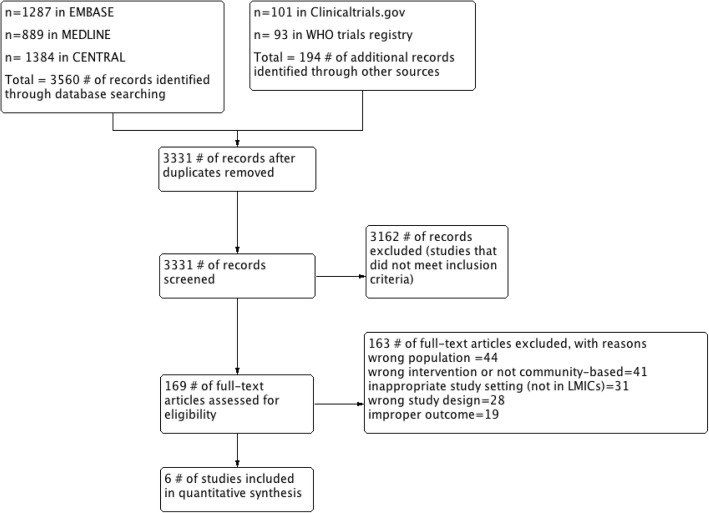
The Cochrane Library (CENTRAL), MEDLINE, EMBASE and two clinical trial registries were searched to identify eligible studies. We applied a 10 years limit (from 01 Jan 2008 to 06 Mar 2018) on English language literature. We included randomized controlled trials (RCTs) with programs focused on lifestyle changes such as weight loss and/or physical activity increase, without pharmacological treatments, which aimed to alter incidence of diabetes or one of the T2DM risk factors, of at least 6 months duration based on follow-up, conducted in LMICs.
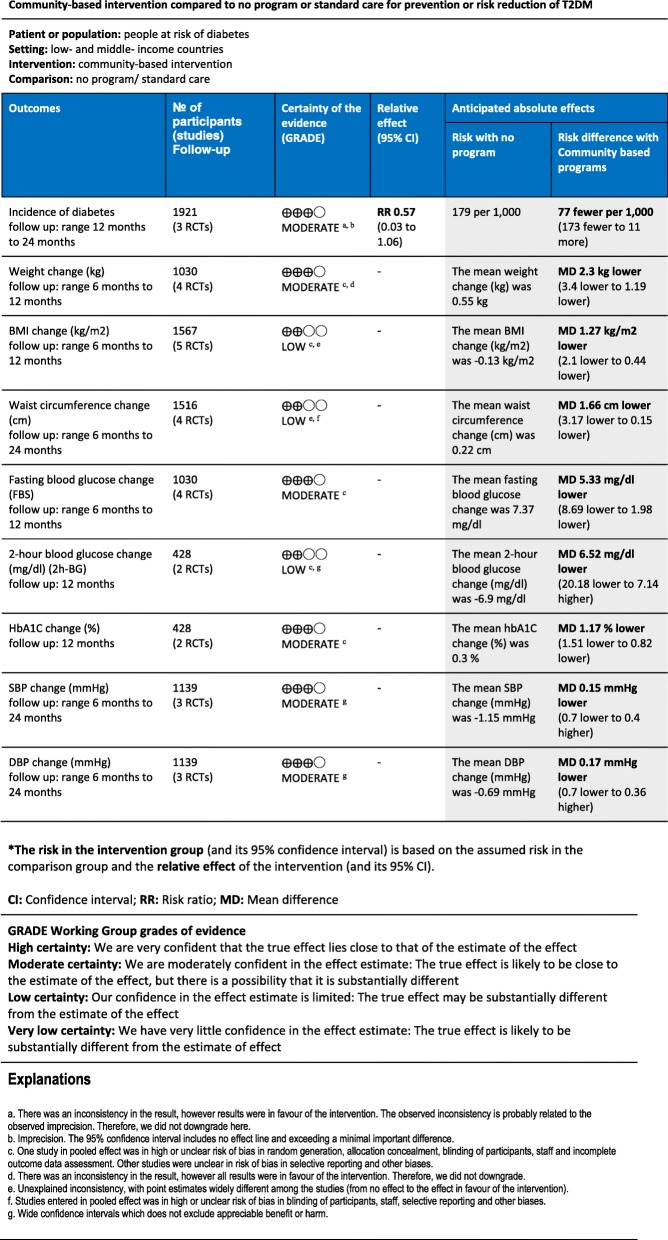
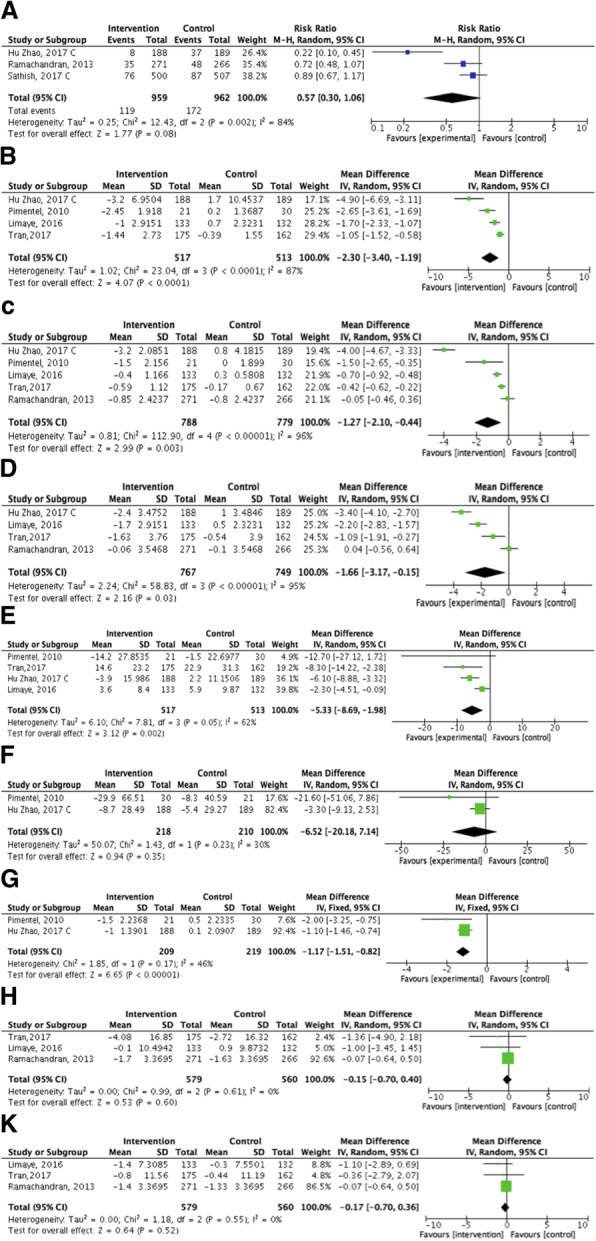
Six RCTs randomizing 2574 people were included. The risk of developing diabetes in the intervention groups reduced more than 40%, RR (0.57 [0.30, 1.06]), for 1921 participants (moderate quality evidence), though it was not statistically significant. Significant differences were observed in weight, body mass index, and waist circumference change in favor of community-based programs from baseline, (MD [95% CI]; - 2.30 [- 3.40, - 1.19], p < 0.01, I2 = 87%), (MD [95% CI]; - 1.27 [- 2.10, - 0.44], p < 0.01, I2 = 96%), and (MD [95% CI]; - 1.66 [- 3.17, - 0.15], p = 0.03, I2 = 95%), respectively. The pooled effect showed a significant reduction in fasting blood glucose and HbA1C measurements in favor of the intervention (MD [95% CI]; - 4.94 [- 8.33, - 1.55], p < 0.01, I2 = 62%), (MD [95% CI]; - 1.17 [- 1.51, - 0.82], p < 0.01, I2 = 46%), respectively. No significant difference was observed in 2-h blood glucose values, systolic or diastolic blood pressure change between the two groups.
Based on available literature, evidence suggests that community-based interventions may reduce the incidence rate of T2DM and may positively affect anthropometric indices and HbA1C. Due to the heterogeneity observed between trials we recommend more well-designed RCTs with longer follow-up durations be executed, to confirm whether community-based interventions lead to reduced T2DM events in the at-risk population of LMIC settings.
2 型糖尿病(T2DM)患病率的上升在中低收入国家(LMICs)会产生重大影响。以饮食、身体活动和健康行为为重点的社区项目对 T2DM 的预防和管理产生了显著的益处,主要是在高收入国家。然而,它们在预防 LMIC 高危人群中 T2DM 方面的效果尚未得到充分评估。
对 Cochrane 图书馆(CENTRAL)、MEDLINE、EMBASE 和两个临床试验登记处进行检索,以确定合格的研究。我们对英语文献设定了 10 年的时间限制(从 2008 年 1 月 1 日至 2018 年 3 月 6 日)。我们纳入了重点关注生活方式改变(如体重减轻和/或体力活动增加)的随机对照试验(RCTs),无药物治疗,旨在改变糖尿病发病率或 T2DM 风险因素之一,基于随访时间至少为 6 个月,在 LMIC 中进行。
纳入了 6 项随机分配 2574 人的 RCT。干预组发生糖尿病的风险降低了 40%以上,RR(0.57 [0.30,1.06]),有 1921 名参与者(中等质量证据),但无统计学意义。从基线开始,社区为基础的项目在体重、体重指数和腰围变化方面显示出显著的优势,(MD [95%CI];-2.30 [-3.40,-1.19],p<0.01,I2=87%),(MD [95%CI];-1.27 [-2.10,-0.44],p<0.01,I2=96%),(MD [95%CI];-1.66 [-3.17,-0.15],p=0.03,I2=95%),分别。汇总效应显示,干预组空腹血糖和 HbA1C 测量值显著降低(MD [95%CI];-4.94 [-8.33,-1.55],p<0.01,I2=62%),(MD [95%CI];-1.17 [-1.51,-0.82],p<0.01,I2=46%),分别。两组间 2 小时血糖值、收缩压或舒张压变化无显著差异。
根据现有文献,证据表明,以社区为基础的干预措施可能降低 T2DM 的发病率,并可能对人体测量指标和 HbA1C 产生积极影响。由于观察到试验之间存在异质性,我们建议进行更多设计良好的 RCT,并延长随访时间,以确认社区为基础的干预措施是否会降低 LMIC 高危人群中 T2DM 的发生。