College of Health Sciences, Debre Markos University, Debre Markos, Ethiopia.
College of Health Sciences, Assosa University, Assosa, Ethiopia.
BMC Public Health. 2020 May 27;20(1):794. doi: 10.1186/s12889-020-08889-x.
Personal protective equipment (PPE) is a material, device, equipment, or clothing used or worn by workers to reduce their chance of exposure or contact with any harmful material or energy that causes injury, disease, or even death. The use of PPE is a universal legal requirement to reduce occupational injuries and illnesses in the workplace. Therefore, this study was conducted to assess PPE utilization and its associated factors among building construction workers in Addis Ababa, Ethiopia, 2019.
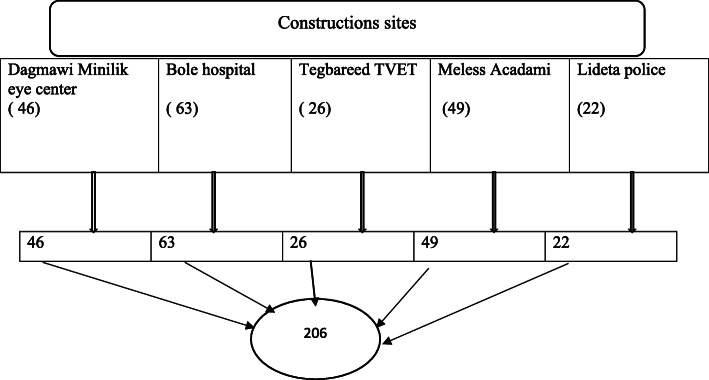
Institution based quantitative cross-sectional study was conducted on the selected construction sites of Addis Ababa city from April 1 to May 18, 2019. Data were collected among all (206) building construction workers via interviewer-administered questionnaires. Data were entered into Epi info version 7.1 and exported to SPSS version 25 statistical software for analysis. Variables with a p-value of less than 0.20 in bivariate analysis were included in multivariate logistic regression. Finally, variables with a p-value of less than 0.05 in multivariate analysis were considered as significantly associated.
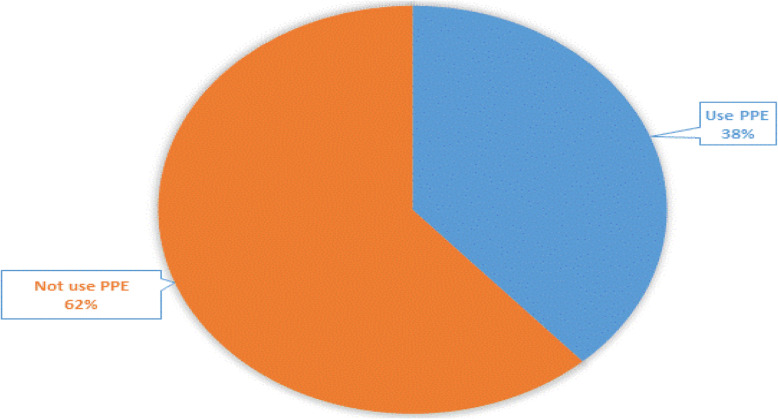
The utilization of at least one PPE among building construction workers in Addis Ababa was found to be 38%. The majority (41.1%) of the participants' reason for not using PPE were the unavailability of PPE followed by absence of orientation on using PPE (21.3%). The majority (35.3%) and (32.2%) of participants knew abrasion as a type of injury and suffered from abrasion respectively. Factors associated with utilization of PPE were the presence of training on PPE use (AOR = 4.8; 95% CI: 2.3, 10.3), presence of safety training (AOR = 2,8; 95% CI:1.5, 5.2), safety orientation before commencing work (AOR = 4.0; 95% CI:1.9, 9.0) and presence of supervision (AOR = 5.0; 95% CI:1.9,13).
PPE utilization among building construction workers in Addis Ababa was low. The main reasons for non-utilization of PPE were unavailability of the materials and the absence of orientation on using PPE. The presence of PPE use training, presence of safety training, safety orientation, and governmental supervision were factors associated with PPE utilization. There should be continuous supervision of construction sites to assure all workers get material and training on how to use it.
个人防护设备(PPE)是指工人使用或穿戴的材料、装置、设备或服装,以降低其接触或暴露于任何有害材料或能量的机会,这些材料或能量可能导致伤害、疾病甚至死亡。在工作场所使用 PPE 是减少职业伤害和疾病的普遍法律要求。因此,本研究旨在评估埃塞俄比亚亚的斯亚贝巴建筑工人的 PPE 使用情况及其相关因素,研究时间为 2019 年 4 月 1 日至 5 月 18 日。
这是一项基于机构的定量横断面研究,研究对象为亚的斯亚贝巴市选定的建筑工地。通过访谈者管理的问卷,于 2019 年 4 月 1 日至 5 月 18 日期间,对所有(206)名建筑工人进行了数据收集。将数据录入 Epi info 版本 7.1 并导出到 SPSS 版本 25 统计软件进行分析。在单变量分析中 p 值小于 0.20 的变量将被纳入多变量逻辑回归。最后,在多变量分析中 p 值小于 0.05 的变量被认为与 PPE 使用显著相关。
亚的斯亚贝巴建筑工人至少使用一种 PPE 的比例为 38%。大多数(41.1%)参与者不使用 PPE 的原因是没有 PPE,其次是没有接受过使用 PPE 的培训(21.3%)。大多数(35.3%)和(32.2%)参与者知道磨损是一种伤害类型,分别遭受过磨损。与 PPE 使用相关的因素包括 PPE 使用培训(AOR=4.8;95%CI:2.3,10.3)、安全培训(AOR=2.8;95%CI:1.5,5.2)、工作前安全指导(AOR=4.0;95%CI:1.9,9.0)和监督(AOR=5.0;95%CI:1.9,13)的存在。
亚的斯亚贝巴建筑工人 PPE 的使用率较低。不使用 PPE 的主要原因是没有材料和没有接受过使用 PPE 的培训。PPE 使用培训、安全培训、安全指导和政府监督的存在与 PPE 使用相关。应该对建筑工地进行持续监督,以确保所有工人都能获得材料和使用培训。