Faculty of Health Sciences, Department of Physiotherapy, Oslo Metropolitan University, P.O. Box 4, St Olavs Plass, Oslo, Norway.
Research and Communication Unit, Oslo University Hospital, Oslo, Norway.
BMC Musculoskelet Disord. 2020 May 27;21(1):328. doi: 10.1186/s12891-020-03289-z.
The Quick Disabilities of the Arm, Shoulder and Hand questionnaire (QuickDASH) and the Patient-Specific Functional Scale (PSFS) are commonly used outcome instruments for measuring self-reported disability in patients with shoulder pain. To date, few studies have evaluated the responsiveness and estimated their minimal important change (MIC). Further assessment will expand the current knowledge and improve the interpretability of these instruments in clinical and research practice. The purpose of this prospective cohort study with 3 months follow-up was to evaluate the responsiveness of the QuickDASH and PSFS in patients with shoulder pain, and to estimate their MICs by using two different anchor-based methods.
Patients with shoulder pain recruited at a multidisciplinary hospital outpatient clinic completed the QuickDASH and PSFS at baseline and at 3 months follow-up. The responsiveness was evaluated by using a criterion approach with the area under the receiver operating characteristic curve (AUC) and a construct approach by testing 9 a-priori hypotheses. The MIC was assessed using two anchor-based MIC methods.
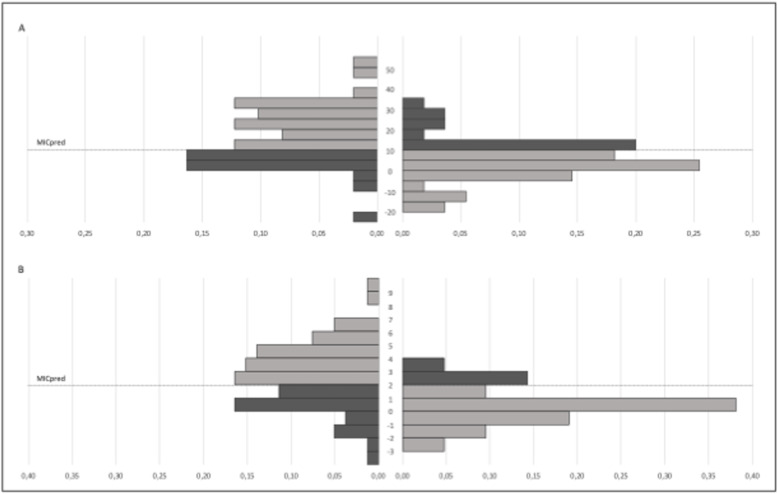
134 patients participated at baseline and 117 (87.3%) at 3 months follow-up. The AUC was acceptable for both QuickDASH (0.75) and PSFS (0.75). QuickDASH met 7 (77.8%) and PSFS 8 (88.9%) of the hypotheses. None of the instruments showed signs of floor and ceiling effects. The MIC estimates ranged from 10.8 to 13.6 for QuickDASH and from 1.9 to 2.0 for PSFS, depending on the method used.
This study demonstrates that both the QuickDASH and PSFS are responsive measures of disability in patients with shoulder pain. The estimated MIC values were presented.
Quick Disabilities of the Arm, Shoulder and Hand 问卷(QuickDASH)和患者特定功能量表(PSFS)是常用于测量肩部疼痛患者自我报告残疾的结果工具。迄今为止,很少有研究评估其反应性并估计其最小重要变化(MIC)。进一步的评估将扩大这些工具在临床和研究实践中的现有知识并提高其可解释性。本前瞻性队列研究随访时间为 3 个月,旨在评估肩部疼痛患者的 QuickDASH 和 PSFS 的反应性,并使用两种不同的基于锚定的方法估计其 MIC。
在多学科医院门诊招募肩部疼痛患者,在基线和 3 个月随访时完成 QuickDASH 和 PSFS。使用基于标准的曲线下面积(AUC)和 9 个先验假设的构建方法评估反应性。使用两种基于锚定的 MIC 方法评估 MIC。
134 例患者在基线时参加,117 例(87.3%)在 3 个月随访时参加。QuickDASH 的 AUC 为 0.75,PSFS 的 AUC 为 0.75,均为可接受。QuickDASH 满足 7 个(77.8%)和 PSFS 满足 8 个(88.9%)假设。两种仪器均未显示出地板和天花板效应的迹象。基于所使用的方法,QuickDASH 的 MIC 估计值范围为 10.8 至 13.6,PSFS 的 MIC 估计值范围为 1.9 至 2.0。
本研究表明,QuickDASH 和 PSFS 均是肩部疼痛患者残疾的敏感测量工具。提出了估计的 MIC 值。