Department of Radiation Oncology, The Affiliated Changzhou No. 2 People's Hospital of Nanjing Medical University, Changzhou, 213003, Jiangsu, China.
Department of Nuclear Medicine, The Third Affiliated Hospital of Soochow University, Changzhou, 213003, Jiangsu, China.
BMC Endocr Disord. 2020 May 27;20(1):75. doi: 10.1186/s12902-020-00556-x.
Nonalcoholic fatty liver disease (NAFLD) is a multisystem disease that affects the liver and a variety of extra-hepatic organ systems. This study aimed to investigate the relationship between hepatic steatosis and glucose metabolism in liver and extra-hepatic tissues and organs.
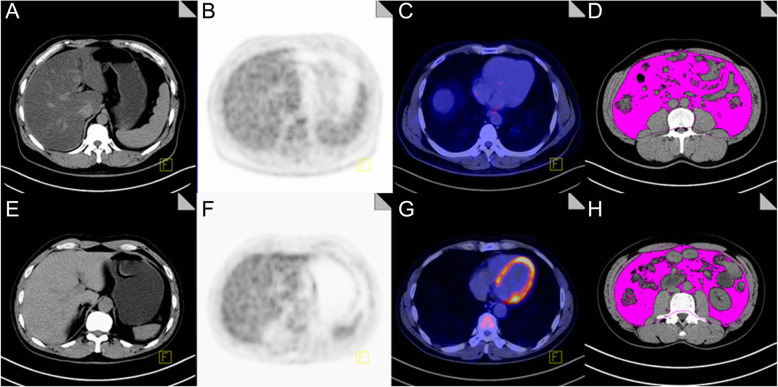
The whole body F-fluorodeoxyglucose (FDG) positron emission tomography (PET)/computed tomography (CT) images of 191 asymptomatic tumor screening patients were retrospectively analyzed. Patients with the ratio of spleen/liver CT densities > 1.1 were defined to have NAFLD, and their clinical symptoms, laboratory markers, FDG uptake in a variety of tissues and organs including heart, mediastinal blood pool, liver, spleen, pancreas, and skeletal muscle, as well as abdominal adipose tissue volumes including visceral adipose tissue (VAT) volume and subcutaneous adipose tissue (SAT) volume were compared with those of the non-NAFLD patients and used to analyze the independent correlation factors of NAFLD.
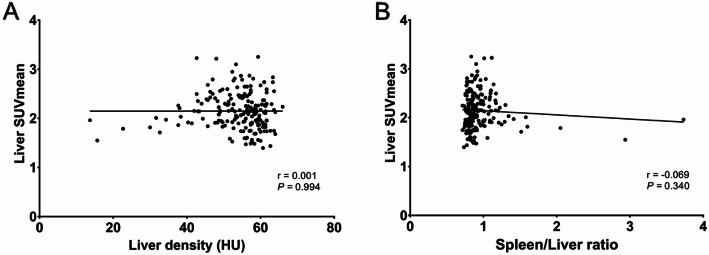
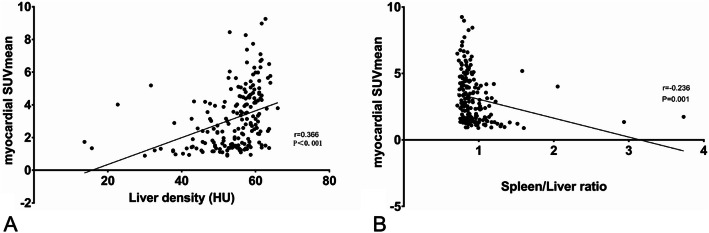
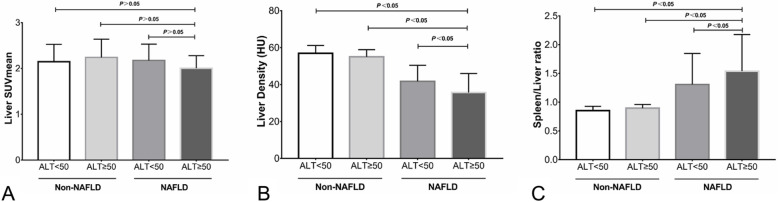
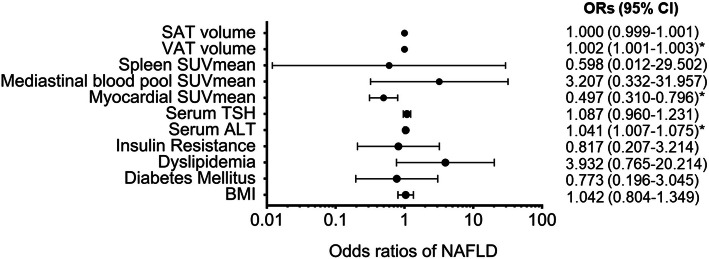
Among the 191 patients, 33 (17.3%) were NAFLD, and 158 (82.7%) were non-NAFLD. There was no significant correlation between the mean standardized uptake value (SUVmean) and CT density of liver as well as the ratio of spleen/liver CT densities. Hepatic steatosis, but not FDG intake, was more significant in NAFLD patients with abnormal liver function than those with normal liver function. Compared with the non-NAFLD patients, NAFLD patients had significantly reduced myocardial glucose metabolism, but significantly increased mediastinal blood pool, spleen SUVmean and abdominal adipose tissue volumes (including VAT and SAT volumes) (P < 0.05). Multivariate regression analysis showed that elevated serum ALT, increased abdominal VAT volume, and decreased myocardial FDG uptake were independent correlation factors for NAFLD. Further studies showed that hepatic steatosis and myocardial FDG uptake were mildly linearly correlated (r = 0.366 with hepatic CT density and - 0.236 with the ratio of spleen/liver CT densities, P < 0.05).
NAFLD is a systemic disease that can lead to the change of glucose metabolism in some extra-hepatic tissues and organs, especially the myocardium.
非酒精性脂肪性肝病(NAFLD)是一种影响肝脏和多种肝外器官系统的多系统疾病。本研究旨在探讨肝脏脂肪变性与肝内和肝外组织器官葡萄糖代谢之间的关系。
回顾性分析了 191 例无症状肿瘤筛查患者的全身 F-氟脱氧葡萄糖(FDG)正电子发射断层扫描(PET)/计算机断层扫描(CT)图像。根据脾脏/肝脏 CT 密度比值>1.1 定义为 NAFLD,比较其临床症状、实验室标志物、心脏、纵隔血池、肝脏、脾脏、胰腺和骨骼肌等多种组织器官的 FDG 摄取以及包括内脏脂肪组织(VAT)体积和皮下脂肪组织(SAT)体积在内的腹部脂肪组织体积,并分析 NAFLD 的独立相关因素。
在 191 例患者中,33 例(17.3%)为 NAFLD,158 例(82.7%)为非 NAFLD。肝脏 SUVmean 与 CT 密度比值以及脾脏/肝脏 CT 密度比值之间无显著相关性。与肝功能正常的 NAFLD 患者相比,肝功能异常的 NAFLD 患者肝脏脂肪变性更为明显,但 FDG 摄取量无明显差异。与非 NAFLD 患者相比,NAFLD 患者心肌葡萄糖代谢明显降低,但纵隔血池、脾脏 SUVmean 和腹部脂肪组织体积(包括 VAT 和 SAT 体积)明显增加(P<0.05)。多变量回归分析显示,血清 ALT 升高、腹部 VAT 体积增加和心肌 FDG 摄取减少是 NAFLD 的独立相关因素。进一步研究表明,肝脏脂肪变性和心肌 FDG 摄取呈轻度线性相关(与肝脏 CT 密度呈正相关 r=0.366,与脾脏/肝脏 CT 密度比值呈负相关 r=-0.236,P<0.05)。
NAFLD 是一种全身性疾病,可导致一些肝外组织器官葡萄糖代谢发生变化,特别是心肌。