Radiotherapy and Imaging, The Institute of Cancer Research, London, UK
Radiotherapy and Imaging, The Royal Marsden Hospital NHS Trust, London, UK.
BMJ Open. 2020 May 26;10(5):e037134. doi: 10.1136/bmjopen-2020-037134.
Patients with muscle invasive bladder cancer (MIBC) who are unfit and unsuitable for standard radical treatment with cystectomy or daily radiotherapy present a large unmet clinical need. Untreated, they suffer high cancer specific mortality and risk significant disease-related local symptoms. Hypofractionated radiotherapy (delivering higher doses in fewer fractions/visits) is a potential treatment solution but could be compromised by the mobile nature of the bladder, resulting in target misses in a significant proportion of fractions. Adaptive 'plan of the day' image-guided radiotherapy delivery may improve the precision and accuracy of treatment. We aim to demonstrate within a randomised multicentre phase II trial feasibility of plan of the day hypofractionated bladder radiotherapy delivery with acceptable rates of toxicity.
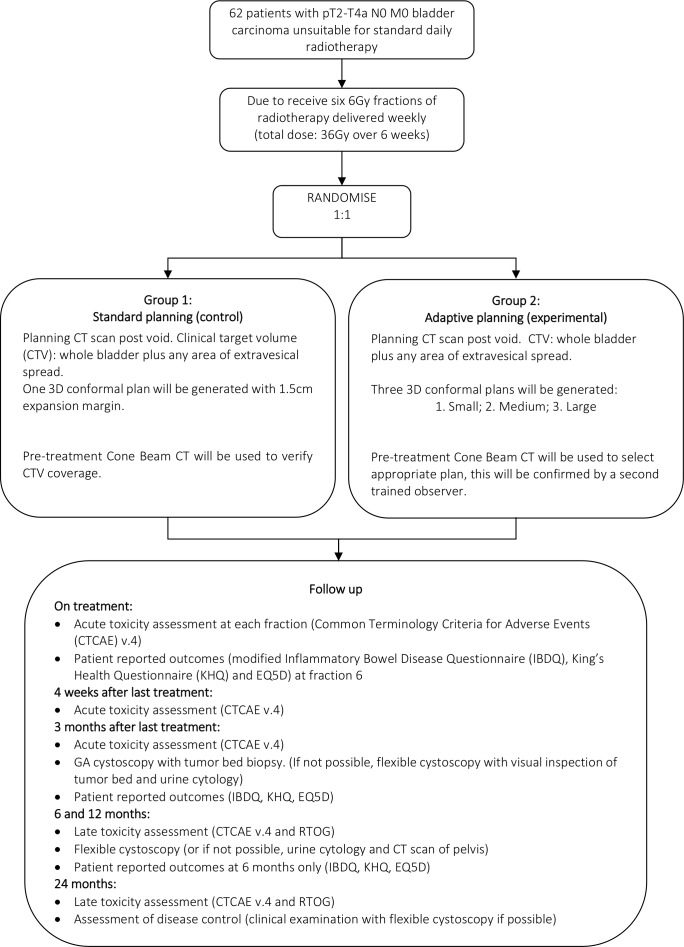
Patients with T2-T4aN0M0 MIBC receiving 36 Gy in 6-weekly fractions are randomised (1:1) between treatment delivered using a single-standard plan or adaptive radiotherapy using a library of three plans (small, medium and large). A cone beam CT taken prior to each treatment is used to visualise the anatomy and select the most appropriate plan depending on the bladder shape and size. A comprehensive radiotherapy quality assurance programme has been instituted to ensure standardisation of radiotherapy planning and delivery. The primary endpoint is to exclude 30% acute grade 3 non-genitourinary toxicity at 3 months for adaptive radiotherapy in patients who received 1 fraction (p0=0.7, p1=0.9, α=0.05, β=0.2). Secondary endpoints include local disease control, symptom control, late toxicity, overall survival, patient-reported outcomes and proportion of fractions benefiting from adaptive planning. Target recruitment is 62 patients.
The trial is approved by the London-Surrey Borders Research Ethics Committee (13/LO/1350). The results will be disseminated via peer-reviewed scientific journals, conference presentations and submission to regulatory authorities.
NCT01810757.
不适合接受根治性膀胱切除术或每日放疗的肌层浸润性膀胱癌(MIBC)患者存在巨大的未满足的临床需求。如果不治疗,他们会有较高的癌症特异性死亡率,并面临严重的疾病相关局部症状风险。少分次放疗(在较少的次数/访问中给予更高的剂量)是一种潜在的治疗方法,但由于膀胱的移动性,可能会导致靶区在很大一部分分次中丢失。适应性“每日计划”图像引导放疗可能会提高治疗的精确性和准确性。我们旨在在一项随机多中心 II 期试验中证明,采用自适应“每日计划”少分次膀胱放疗的方法具有可行性,并且毒性反应可接受。
接受 36Gy 分 6 周给予的 T2-T4aN0M0 MIBC 患者,按照治疗方案分为使用单一标准计划或自适应放疗(使用小、中、大三种计划库)的 1:1 随机分组。每次治疗前进行锥形束 CT 以可视化解剖结构,并根据膀胱形状和大小选择最合适的计划。已经制定了全面的放疗质量保证计划,以确保放疗计划和实施的标准化。主要终点是排除接受 1 次治疗的患者中,自适应放疗在 3 个月时急性 3 级非泌尿系统毒性发生率为 30%(p0=0.7,p1=0.9,α=0.05,β=0.2)。次要终点包括局部疾病控制、症状控制、迟发性毒性、总生存率、患者报告的结局和受益于自适应计划的分次比例。目标入组 62 例患者。
该试验已获得伦敦-萨里边境研究伦理委员会(13/LO/1350)批准。结果将通过同行评议的科学期刊、会议报告和向监管机构提交的方式进行传播。
NCT01810757。