
硫酸锌通过精子蛋白质组分析改善肥胖大鼠生育能力的机制。
The Mechanism of Zinc Sulfate in Improving Fertility in Obese Rats Analyzed by Sperm Proteomic Analysis.
机构信息
NHC Key Laboratory of Family Planning and Healthy, Hebei Key Laboratory of Reproductive Medicine, Hebei Research Institute for Family Planning Science and Technology, Shijiazhuang 050071, China.
Graduate School of Hebei Medical University, Shijiazhuang 050017, China.
出版信息
Biomed Res Int. 2020 May 4;2020:9876363. doi: 10.1155/2020/9876363. eCollection 2020.
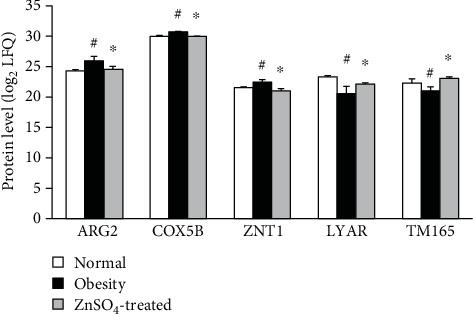
This study investigates the mechanism underlying the improving effect of zinc on fertility in obese rats using proteomics. The effects of three different doses of ZnSO on spermatogenesis and hormone levels were studied. Testicular spermatogenesis was observed by HE staining. Serum estrogen and testosterone levels were measured by chemiluminescent microparticle immunoassay. Sperm proteomic analysis was performed by liquid chromatography-mass spectrometry. The DAVID database was used to perform the GO enrichment analysis and KEGG pathway analysis of the differentially expressed genes, and the STRING online database was used to construct a PPI network. The sperm count, sperm motility, and testosterone hormones of the ZnSO-treated rats group were increased. ZnSO improved testicular structure and spermatogenesis abnormalities caused by obesity. Proteomic analysis showed that there were 401 differentially expressed proteins in a total of 6 sperm samples from the ZnSO-treated group and the obesity groups. Differential proteins were input into the DAVID website. The 341 identified proteins were then classified according to their biological functions. The KEGG analysis showed that the enriched signal pathways included glycolysis/gluconeogenesis, carbon metabolism, citrate cycle, fatty acid metabolism, and pyruvate metabolism. Some proteins were shown to be associated with valine, leucine, and isoleucine degradation pathways. STRING analysis obtained 36 node proteins. Cytoscape analysis showed that these proteins mainly participated in nine networks including metabolic process, oxidation-reduction, aerobic respiration, RNA splicing, and glutathione conjugation. ZnSO may improve the fertility of obese male rats by regulating protein expression related to metabolism, inflammation, and sperm maturation.
本研究采用蛋白质组学技术探讨锌改善肥胖大鼠生育能力的作用机制。研究了三种不同剂量的 ZnSO4 对精子发生和激素水平的影响。通过 HE 染色观察睾丸精子发生情况。采用化学发光微粒子免疫分析法测定血清雌激素和睾酮水平。采用液相色谱-质谱法进行精子蛋白质组分析。使用 DAVID 数据库对差异表达基因进行 GO 富集分析和 KEGG 通路分析,使用 STRING 在线数据库构建 PPI 网络。ZnSO4 处理组大鼠的精子计数、精子活力和睾酮激素水平增加。ZnSO4 改善了肥胖引起的睾丸结构和精子发生异常。蛋白质组学分析显示,ZnSO4 处理组和肥胖组共 6 个精子样本中有 401 个差异表达蛋白。将差异蛋白输入 DAVID 网站,将 341 个鉴定蛋白按其生物学功能进行分类。KEGG 分析显示,富集的信号通路包括糖酵解/糖异生、碳代谢、柠檬酸循环、脂肪酸代谢和丙酮酸代谢。一些蛋白质与缬氨酸、亮氨酸和异亮氨酸降解途径有关。STRING 分析得到 36 个节点蛋白。Cytoscape 分析表明,这些蛋白主要参与包括代谢过程、氧化还原、有氧呼吸、RNA 剪接和谷胱甘肽结合在内的 9 个网络。ZnSO4 可能通过调节与代谢、炎症和精子成熟相关的蛋白质表达来改善肥胖雄性大鼠的生育能力。


 Zotero 插件