Petelczyc Monika, Gierałtowski Jan Jakub, Żogała-Siudem Barbara, Siudem Grzegorz
Faculty of Physics, Warsaw University of Technology, Koszykowa 75, PL-00-662, Warsaw, Poland.
Systems Research Institute, Polish Academy of Sciences, ul. Newelska 6, PL-01-447, Poland.
Heliyon. 2020 May 19;6(5):e03984. doi: 10.1016/j.heliyon.2020.e03984. eCollection 2020 May.
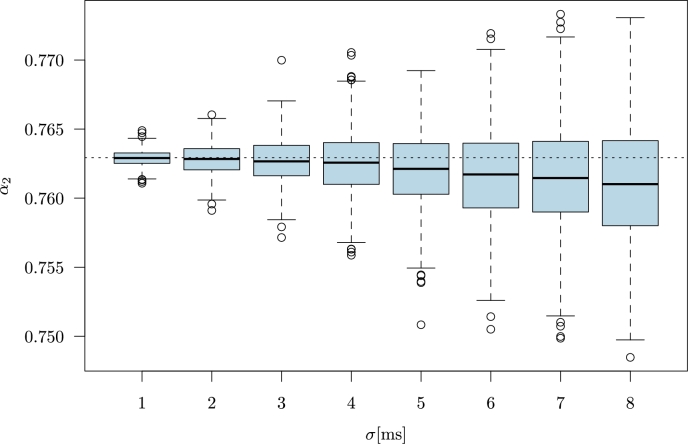
An observational error of heart rate variability (HRV) may arise from many factors, such as a limited sampling frequency, QRS complexes detection process, preprocessing procedures and others. In our study, we focused on the first two origins of measurement error. We introduced a model of observational error and suggested universal descriptors for the assessment of its resultant magnitude in terms of time, frequency as well as nonlinear parameters. For this purpose, we applied Monte Carlo simulations which showed that the most sensitive to observational error are: pNN50 (the proportion of pairs of successive RR intervals that differ by more than 50 ms) and markers obtained from frequency analysis. On the other hand, the most resistant are other time domain parameters as well as the short and long-term slopes of Detrended Fluctuation Analysis (DFA). We postulate that the observational error should be considered in population studies, when different recorders are used in the research centres. Additionally, in the case of patients with similar etiology of disease but with different heart rhythms abnormalities the scatter of HRV parameters will also be observed due to the subject's the time series variability.
心率变异性(HRV)的观测误差可能源于多种因素,如采样频率有限、QRS波群检测过程、预处理程序等。在我们的研究中,我们关注测量误差的前两个来源。我们引入了一个观测误差模型,并提出了通用描述符,用于从时间、频率以及非线性参数方面评估其产生的大小。为此,我们应用了蒙特卡罗模拟,结果表明对观测误差最敏感的是:pNN50(连续RR间期差值超过50毫秒的比例)以及从频率分析中获得的指标。另一方面,最具抗性的是其他时域参数以及去趋势波动分析(DFA)的短期和长期斜率。我们假设,在人群研究中,当研究中心使用不同的记录仪时,应考虑观测误差。此外,对于病因相似但心律异常不同的患者,由于受试者时间序列的变异性,也会观察到HRV参数的离散情况。