Internal Medicine II, Ulm University Medical Center, Ulm, Germany.
Medical School of Southeast University, Nanjing, China.
Int J Cardiovasc Imaging. 2020 Oct;36(10):1985-1996. doi: 10.1007/s10554-020-01895-5. Epub 2020 May 27.
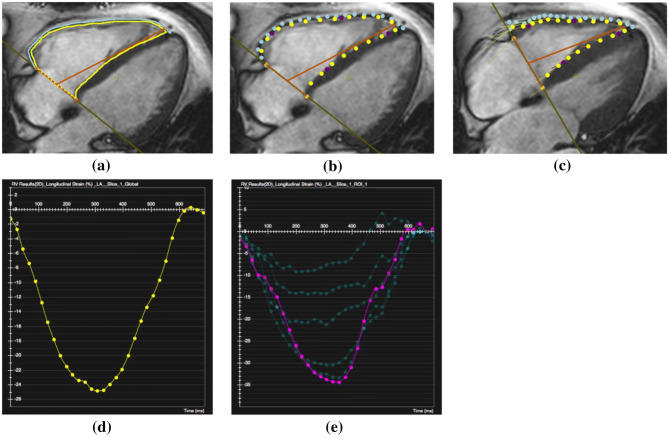
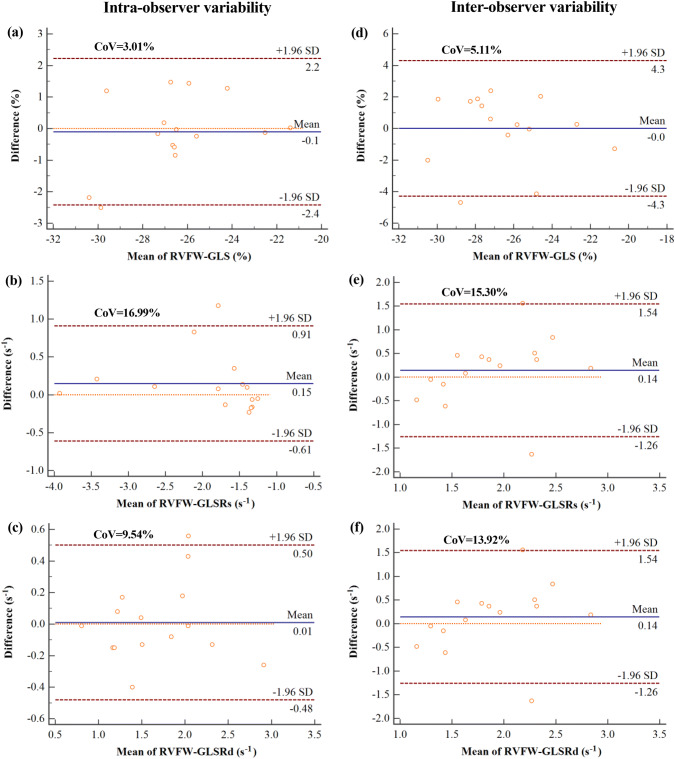
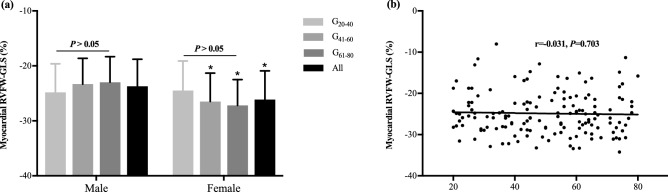
Cardiovascular magnetic resonance based tissue tracking (CMR-TT) was reported to provide detailed insight into left ventricular mechanical features. However, inadequate knowledge of the right ventricle (RV) mechanical deformation has been acquired by this advanced technique so far. It was the aim of this study to establish reference values of RV free wall (RVFW) global, regional and segmental longitudinal peak strain and strain rate (LS and LSR), and to investigate the gender- and age-related difference as well as the base-to-apex gradient of RVFW-LS and LSR with CMR-TT. 150 healthy volunteers (75 males/females) were retrospectively and continuously recruited and subdivided into three age groups (G, G and G). RVFW global, regional (basal, middle-cavity and apical) and segmental LS (GLS, RLS, SLS) along with systolic and diastolic LSR were generated by post-hoc CMR-TT analysis of standard steady-state free precession long-axis four-chamber view cine images acquired at 1.5T field strength. The reference value of myocardial RVFW-GLS was - 24.9 ± 5.2%. We found that females showed more negative GLS than males except in the youngest group, and no age-related difference of GLS was observed in both gender groups. RLS and SLS presented with the same age-related tendency as GLS. The basal and middle-cavity LS were similar between each other and significantly larger than apical LS. RVFW-GLSR resulted as - 1.73 ± 0.58 s and 1.69 ± 0.65 s during systolic and diastolic phases, respectively. The diastolic GLSR of males tended to decline with the ageing and was significantly lower than that of females in G group. Regional and segmental LSR showed significant gender-related differences in certain basal and apical region/segments without any age-related effects. CMR-TT overcomes the difficulty in measuring RV global and segmental deformation. The establishment of the vendor-, gender- and segment-specific reference values of RVFW-LS and LSR is essential for the rapid and efficient utilization of CMR-TT modality in the clinical routine.
基于心血管磁共振的组织追踪(CMR-TT)技术可以提供有关左心室机械特征的详细信息。然而,迄今为止,该先进技术对右心室(RV)机械变形的了解还不够充分。本研究旨在建立 RV 游离壁(RVFW)整体、节段性纵向峰值应变和应变率(LS 和 LSR)的参考值,并探讨 CMR-TT 技术中 RVFW-LS 和 LSR 的性别和年龄相关差异以及基底到心尖梯度。回顾性连续招募了 150 名健康志愿者(75 名男性/女性),并将其分为三个年龄组(G 组、G 组和 G 组)。通过 1.5T 场强下标准稳态自由进动长轴四腔视图电影图像的后处理 CMR-TT 分析,生成 RVFW 整体、节段性(基底、中腔和心尖)和节段性 LS(GLS、RLS、SLS)以及收缩期和舒张期 LSR。心肌 RVFW-GLS 的参考值为-24.9±5.2%。我们发现,女性的 GLS 比男性更负,除了最年轻的组外,在两性组中都没有观察到 GLS 的年龄相关差异。RLS 和 SLS 与 GLS 呈现出相同的年龄相关趋势。基底和中腔 LS 彼此相似,明显大于心尖 LS。RVFW-GLSR 分别为收缩期和舒张期的-1.73±0.58 s 和-1.69±0.65 s。男性的舒张期 GLSR 随着年龄的增长而下降,在 G 组中明显低于女性。在某些基底和心尖区域/节段,节段性和节段性 LSR 存在明显的性别相关差异,而没有任何年龄相关的影响。CMR-TT 克服了测量 RV 整体和节段变形的困难。建立 RVFW-LS 和 LSR 的供应商、性别和节段特异性参考值对于在临床常规中快速有效地利用 CMR-TT 模式至关重要。