Department of Medical Genetics, Graduate School of Medicine, Ajou University, Suwon 16499, Korea.
Department of Biomedical Sciences, Graduate School of Medicine, Ajou University, Suwon 16499, Korea.
Molecules. 2020 May 25;25(10):2453. doi: 10.3390/molecules25102453.
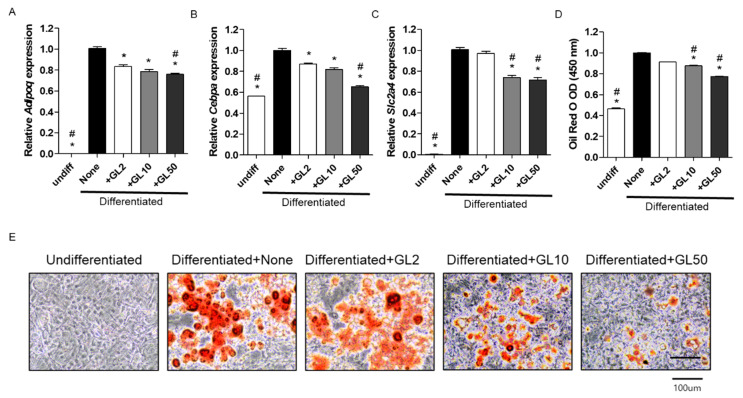
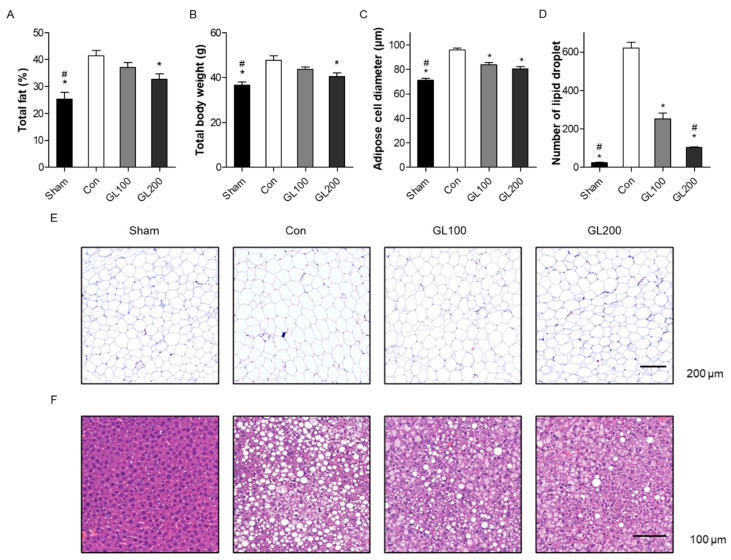
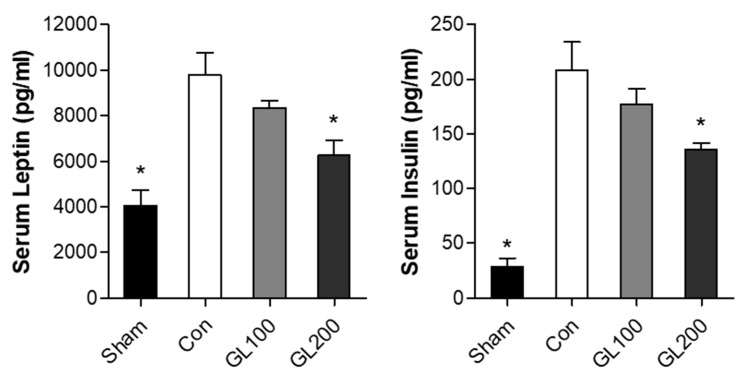
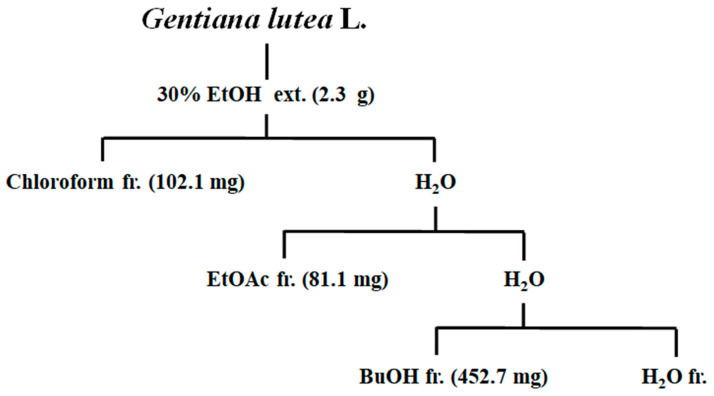
Obesity is one of the most common metabolic diseases resulting in metabolic syndrome. In this study, we investigated the antiobesity effect of L. (GL) extract on 3T3-L1 preadipocytes and a high-fat-diet (HFD)-induced mouse model. For the induction of preadipocytes into adipocytes, 3T3-L1 cells were induced by treatment with 0.5 mM 3-isobutyl-1-methylxanthine, 1 mM dexamethasone, and 1 μg/mL insulin. Adipogenesis was assessed based on the messenger ribonucleic acid expression of adipogenic-inducing genes (adiponectin (), CCAAT/enhancer-binding protein alpha (), and glucose transporter type 4 ()) and lipid accumulation in the differentiated adipocytes was visualized by Oil Red O staining. In vivo, obese mice were induced with HFD and coadministered with 100 or 200 mg/kg/day of GL extract for 12 weeks. GL extract treatment inhibited adipocyte differentiation by downregulating the expression of adipogenic-related genes in 3T3-L1 cells. In the obese mouse model, GL extract prevented HFD-induced weight gain, fatty hepatocyte deposition, and adipocyte size by decreasing the secretion of leptin and insulin. In conclusion, GL extract shows antiobesity effects in vitro and in vivo, suggesting that this extract can be beneficial in the prevention of obesity.
肥胖症是导致代谢综合征的最常见代谢性疾病之一。在本研究中,我们研究了 L.(GL)提取物对 3T3-L1 前脂肪细胞和高脂肪饮食(HFD)诱导的小鼠模型的抗肥胖作用。为了诱导前脂肪细胞分化为脂肪细胞,用 0.5 mM 3-异丁基-1-甲基黄嘌呤、1 mM 地塞米松和 1 μg/mL 胰岛素处理 3T3-L1 细胞。根据脂肪生成诱导基因(脂联素()、CCAAT/增强子结合蛋白-α()和葡萄糖转运蛋白 4())的信使核糖核酸表达和分化脂肪细胞中脂质积累来评估脂肪生成。在体内,用 HFD 诱导肥胖小鼠,并同时给予 100 或 200 mg/kg/天的 GL 提取物,持续 12 周。GL 提取物通过下调 3T3-L1 细胞中脂肪生成相关基因的表达来抑制脂肪细胞分化。在肥胖小鼠模型中,GL 提取物通过减少瘦素和胰岛素的分泌来预防 HFD 诱导的体重增加、脂肪肝细胞沉积和脂肪细胞大小增加。总之,GL 提取物在体外和体内均显示出抗肥胖作用,表明该提取物可有益于预防肥胖。