Dalakouras Athanasios, Papadopoulou Kalliope K
Department of Biochemistry & Biotechnology, University of Thessaly, 41500 Larissa, Greece.
Institute of Plant Breeding and Genetic Resources ELGO-DEMETER, 57001 Thessaloniki, Greece.
Plants (Basel). 2020 May 26;9(6):673. doi: 10.3390/plants9060673.
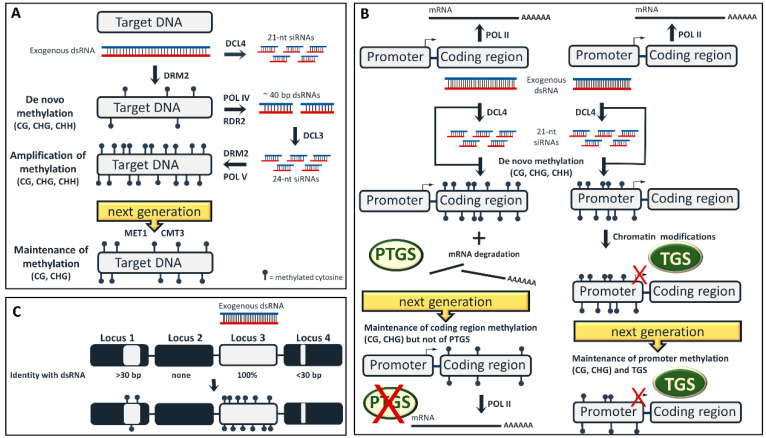
Exogenous RNA interference (exo-RNAi) is a powerful transgene-free tool in modern crop improvement and protection platforms. In exo-RNAi approaches, double-stranded RNAs (dsRNAs) or short-interfering RNAs (siRNAs) are externally applied in plants in order to selectively trigger degradation of target mRNAs. Yet, the applied dsRNAs may also trigger unintended epigenetic alterations and result in epigenetically modified plants, an issue that has not been sufficiently addressed and which merits more careful consideration.
外源RNA干扰(exo-RNAi)是现代作物改良和保护平台中一种强大的无转基因工具。在外源RNA干扰方法中,双链RNA(dsRNA)或小干扰RNA(siRNA)被外部应用于植物中,以便选择性地触发靶标mRNA的降解。然而,所应用的dsRNA也可能触发意外的表观遗传改变,并导致表观遗传修饰的植物,这一问题尚未得到充分解决,值得更仔细的考虑。