Kiselev Konstantin V, Suprun Andrey R, Aleynova Olga A, Ogneva Zlata V, Kostetsky Eduard Y, Dubrovina Alexandra S
Laboratory of Biotechnology, Federal Scientific Center of the East Asia Terrestrial Biodiversity, Far Eastern Branch of the Russian Academy of Sciences, 690022 Vladivostok, Russia.
Department of Biochemistry, Microbiology and Biotechnology, Far Eastern Federal University, 690090 Vladivostok, Russia.
Plants (Basel). 2022 Mar 8;11(6):715. doi: 10.3390/plants11060715.
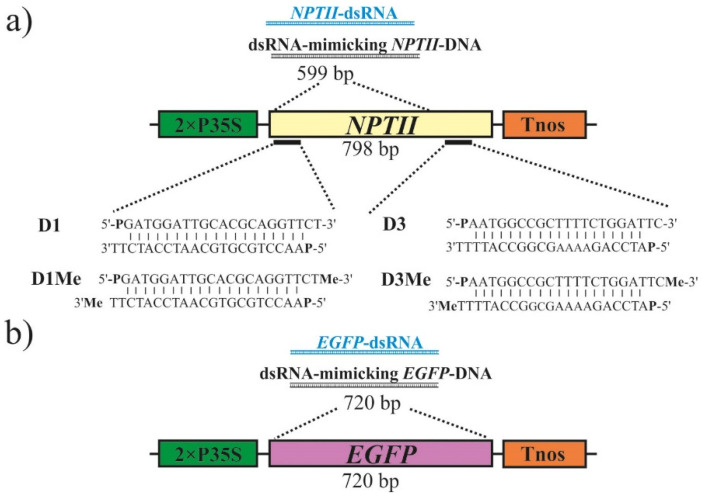
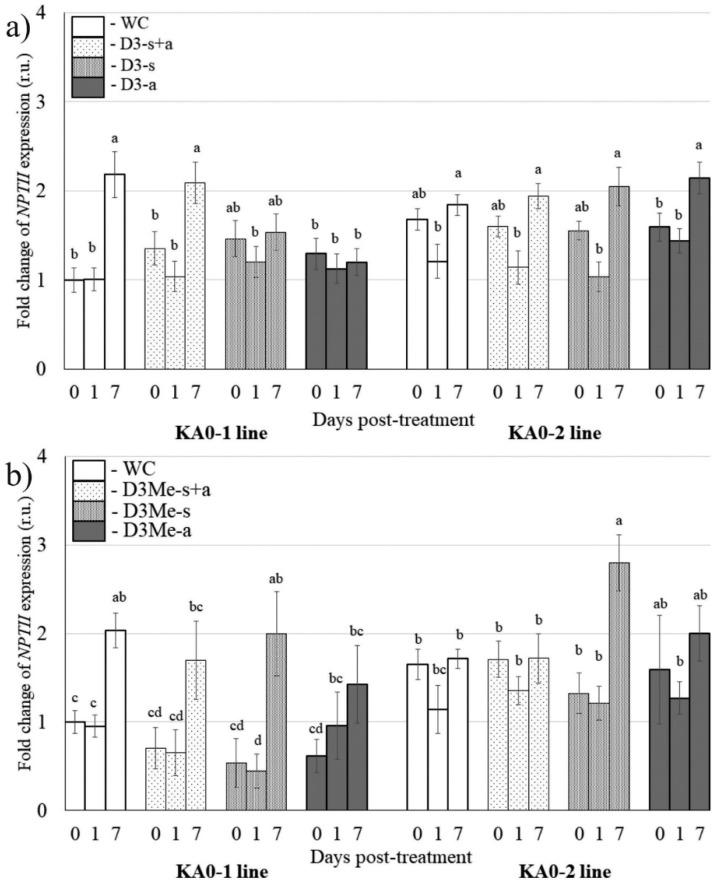
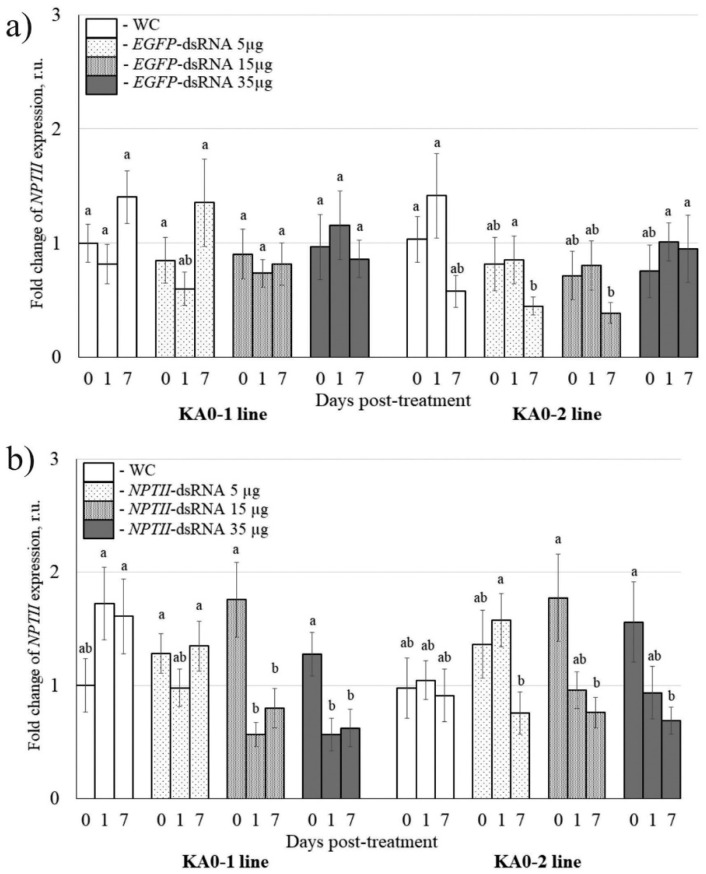
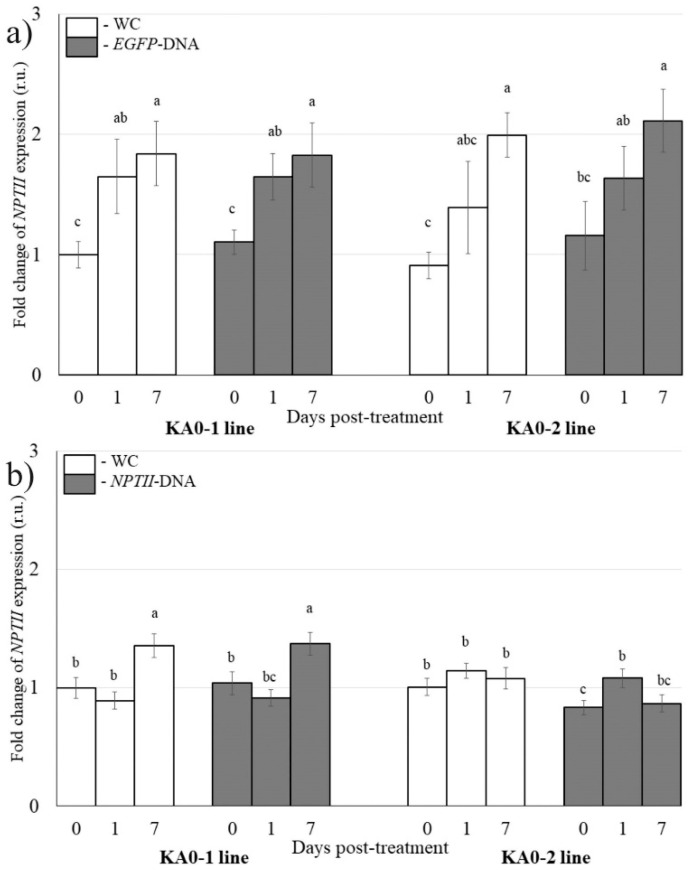
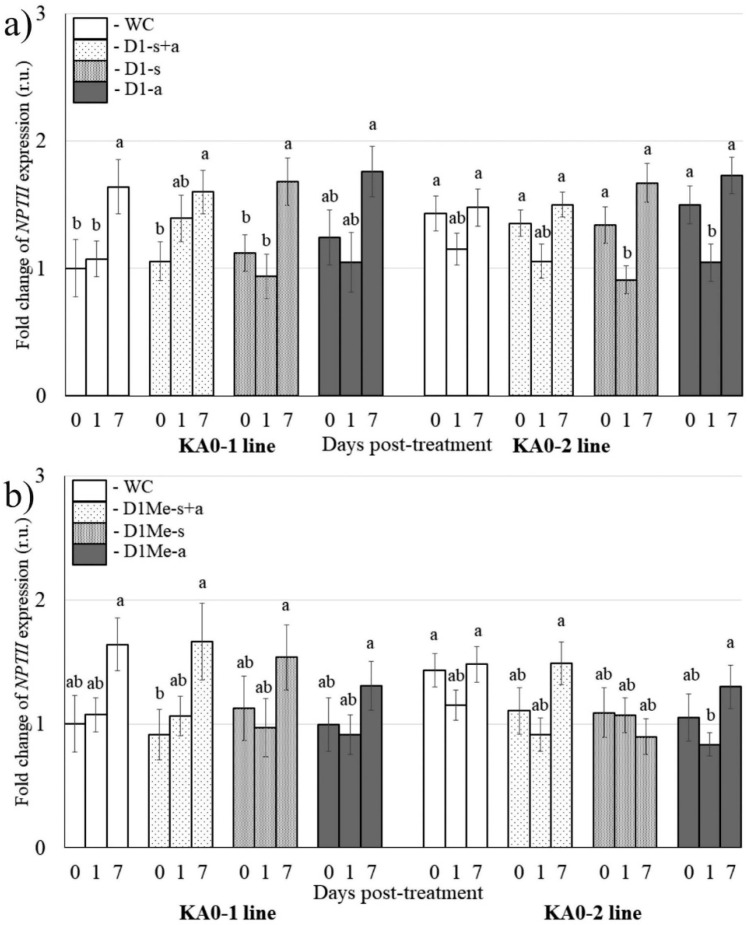
The phenomenon of RNA interference (RNAi) is widely used to develop new approaches for crop improvement and plant protection. Recent investigations show that it is possible to downregulate plant transgenes, as more prone sequences to silencing than endogenous genes, by exogenous application of double-stranded RNAs (dsRNAs) and small interfering RNAs (siRNAs). However, there are scarce data on the specificity of exogenous RNAs. In this study, we explored whether plant transgene suppression is sequence-specific to exogenous dsRNAs and whether similar effects can be caused by exogenous DNAs that are known to be perceived by plants and induce certain epigenetic and biochemical changes. We treated transgenic plants of bearing the neomycin phosphotransferase II () transgene with specific synthetic -dsRNAs and non-specific dsRNAs, encoding enhanced green fluorescent protein (), as well as with DNA molecules mimicking the applied RNAs. None of the -dsRNA doses resulted in a significant decrease in transgene expression in the -transgenic plants, while the specific -dsRNA significantly reduced expression in a dose-dependent manner. Long DNAs mimicking dsRNAs and short DNA oligonucleotides mimicking siRNAs did not exhibit a significant effect on transgene expression. Thus, exogenous -dsRNAs induced a sequence-specific and RNA-specific transgene-suppressing effect, supporting external application of dsRNAs as a promising strategy for plant gene regulation.
RNA干扰(RNAi)现象被广泛用于开发作物改良和植物保护的新方法。最近的研究表明,通过外源应用双链RNA(dsRNA)和小干扰RNA(siRNA),有可能下调植物转基因,因为转基因比内源基因更容易被沉默。然而,关于外源RNA特异性的数据很少。在本研究中,我们探讨了植物转基因抑制对外源dsRNA是否具有序列特异性,以及已知能被植物感知并诱导某些表观遗传和生化变化的外源DNA是否能产生类似的效果。我们用编码增强型绿色荧光蛋白(EGFP)的特异性合成nptII -dsRNA和非特异性dsRNA以及模拟所应用RNA的DNA分子处理携带新霉素磷酸转移酶II(nptII)转基因的转基因植物。在nptII转基因植物中,没有一个nptII -dsRNA剂量导致nptII转基因表达显著降低,而特异性egfp -dsRNA以剂量依赖的方式显著降低了egfp表达。模拟dsRNA的长DNA和模拟siRNA的短DNA寡核苷酸对nptII转基因表达没有显著影响。因此,外源nptII -dsRNA诱导了序列特异性和RNA特异性的转基因抑制效应,支持将dsRNA的外源应用作为一种有前景的植物基因调控策略。