Jin Hana, Rugira Trojan, Ko Young Shin, Park Sang Won, Yun Seung Pil, Kim Hye Jung
Department of Pharmacology, College of Medicine, Institute of Health Sciences, Gyeongsang National University, Jinju 52727, Korea.
Department of Convergence Medical Science (BK21 Plus), Gyeongsang National University, Jinju 52727, Korea.
Cancers (Basel). 2020 May 26;12(6):1363. doi: 10.3390/cancers12061363.
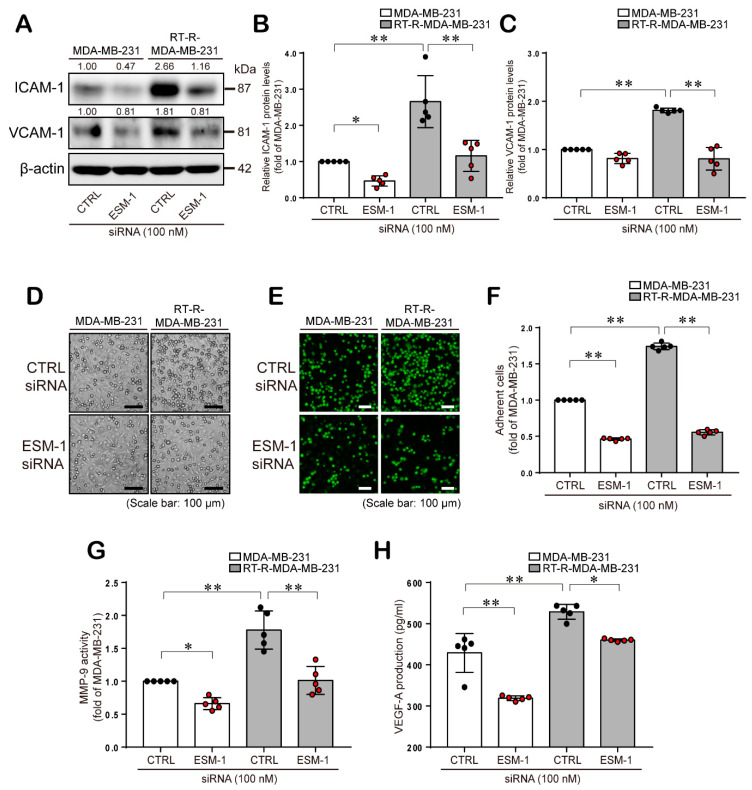
The key barrier to the effectiveness of radiotherapy remains the radioresistance of breast cancer cells, resulting in increased tumor recurrence and metastasis. Thus, in this study, we aimed to clarify the difference between radiotherapy-resistant (RT-R) breast cancer (BC) and BC, and accordingly, analyzed gene expression levels between radiotherapy-resistant (RT-R) MDA-MB-231 cells and MDA-MB-231 cells. Gene expression array showed that ESM-1 was the most upregulated in RT-R-MDA-MB-231 cells compared to MDA-MB-231 cells. Then, we aimed to investigate the role of ESM-1 in the increased tumorigenesis of RT-R-BC cells. RT-R-MDA-MB-231, which showed an increased expression level of ESM1, exhibited significantly enhanced proliferation, colony forming ability, migration, and invasion compared to MDA-MB-231 cells, and ESM-1 knockdown effectively reversed these effects. In addition, compared to MDA-MB-231 cells, RT-R-MDA-MB-231 cells displayed improved adhesion to endothelial cells (ECs) due to the induction of adhesion molecules and increased MMP-9 activity and VEGF-A production, which were decreased by ESM-1 knockdown. Moreover, the expression of HIF-1α and activation of NF-κB and STAT-3 were increased in RT-R-MDA-MB-231 cells compared to MDA-MB-231 cells, and these effects were abolished by the knockdown of ESM-1. Finally, we confirmed the role of ESM-1 in tumorigenesis in an in vivo mouse model. Tumor volume, lung metastasis, and tumorigenic molecules (VEGF-A, HIF-1α, MMP-9, ICAM-1, VCAM-1, and phospho-NF-κB and phospho-STAT-3) were significantly induced in mice injected with ESM-1-overexpressing 4T1 cells and greatly enhanced in those injected with ESM-1-overexpressing RT-R-4T1 cells. Taken together, these results suggest for the first time that ESM-1 plays a critical role in tumorigenesis of breast cancer cells, especially RT-R-breast cancer cells, through the induction of cell proliferation and invasion.
放射治疗有效性的关键障碍仍然是乳腺癌细胞的放射抗性,这导致肿瘤复发和转移增加。因此,在本研究中,我们旨在阐明放射抗性(RT-R)乳腺癌(BC)与乳腺癌之间的差异,并据此分析了放射抗性(RT-R)MDA-MB-231细胞与MDA-MB-231细胞之间的基因表达水平。基因表达阵列显示,与MDA-MB-231细胞相比,ESM-1在RT-R-MDA-MB-231细胞中上调最为明显。然后,我们旨在研究ESM-1在RT-R-BC细胞肿瘤发生增加中的作用。与MDA-MB-231细胞相比,显示ESM1表达水平增加的RT-R-MDA-MB-231细胞表现出显著增强的增殖、集落形成能力、迁移和侵袭能力,而ESM-1敲低有效地逆转了这些作用。此外,与MDA-MB-231细胞相比,RT-R-MDA-MB-231细胞由于黏附分子的诱导、MMP-9活性增加和VEGF-A产生而表现出对内皮细胞(ECs)的黏附改善,而这些在ESM-1敲低后降低。此外,与MDA-MB-231细胞相比,RT-R-MDA-MB-231细胞中HIF-1α的表达以及NF-κB和STAT-3的激活增加,而这些作用在ESM-1敲低后被消除。最后,我们在体内小鼠模型中证实了ESM-1在肿瘤发生中的作用。在注射过表达ESM-1的4T1细胞的小鼠中,肿瘤体积、肺转移以及致瘤分子(VEGF-A、HIF-1α、MMP-9、ICAM-1、VCAM-1以及磷酸化-NF-κB和磷酸化-STAT-3)显著诱导,而在注射过表达ESM-1的RT-R-4T1细胞的小鼠中大大增强。综上所述,这些结果首次表明ESM-1通过诱导细胞增殖和侵袭在乳腺癌细胞尤其是RT-R-乳腺癌细胞的肿瘤发生中起关键作用。