Premnath Sangeetha, Alalshaikh Ghadah, Alfotawi Randa, Philip Manju
Department of Oral and Maxillofacial Surgery, College of Dentistry, King Saud University, Riyadh, SAU.
Cureus. 2020 Apr 24;12(4):e7820. doi: 10.7759/cureus.7820.
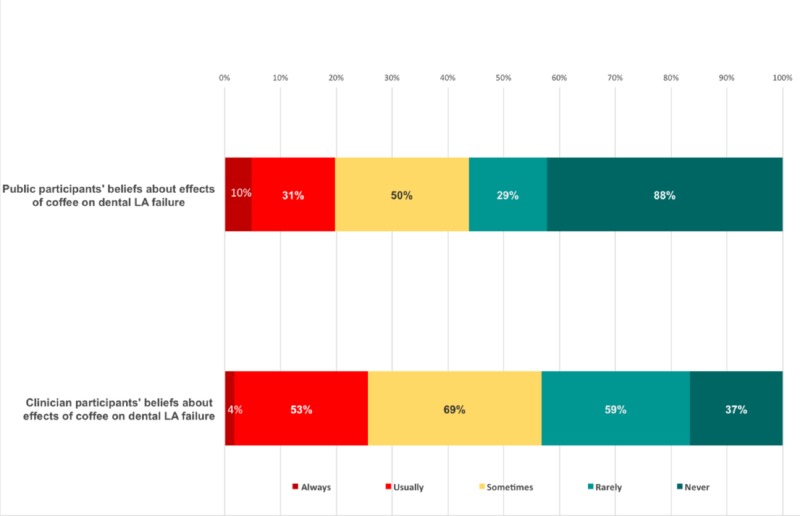
Introduction In our clinical practice, we have encountered patients who reported the failure of local anesthesia due to excessive coffee consumption and required higher-than-normal doses of local anesthesia. Therefore, our study aimed to assess the awareness and knowledge of coffee consumption, its effect on local anesthesia, and the available scientific evidence among the public, patients, and clinicians in dental practice. Material and Methods A cross-sectional survey with two sets of questionnaires was designed based on the Likert scale. A 5-point scale was used to assess agreement and frequency. Yes/no and open-ended questions were used for the assessment. Questionnaires were distributed among the clinicians, patients, and the public. Data were analyzed with descriptive linear statistics. Results Of the 430 responses provided by patients and the general public, more than 40% believed that the local anesthetic failure was caused by excessive coffee consumption. Among the 235 responses provided by the clinicians, 65% of the clinicians reported encountering patients with local anesthesia failure and believed it could be due to excessive coffee consumption. However, only 9% of the clinicians were aware of scientific evidence regarding the effect of coffee consumption on local anesthesia failure. Conclusion Surprisingly, the majority of clinicians believed that caffeine had an effect on the reduction of local anesthesia; however, only a few of them had scientific knowledge. The available scientific evidence relates that caffeine can influence cognitive performance by increasing alertness, as well as sleep deprivation causing stress and anxiety, which partially explains the local anesthetic failure among coffee consumers. Therefore, a stress reduction protocol should be a routine daily practice for a dentist to reduce the failure rate of local anesthesia.
引言 在我们的临床实践中,我们遇到过一些患者,他们报告称由于过量饮用咖啡导致局部麻醉失败,需要高于正常剂量的局部麻醉药。因此,我们的研究旨在评估公众、患者以及牙科临床医生对咖啡饮用的认知和了解、其对局部麻醉的影响以及现有的科学证据。
材料与方法 基于李克特量表设计了包含两套问卷的横断面调查。采用5分制量表来评估同意程度和频率。使用是/否及开放式问题进行评估。问卷分发给临床医生、患者和公众。数据采用描述性线性统计进行分析。
结果 在患者和公众提供的430份回复中,超过40%的人认为局部麻醉失败是由过量饮用咖啡引起的。在临床医生提供的235份回复中,65%的临床医生报告遇到过局部麻醉失败的患者,并认为这可能是由于过量饮用咖啡所致。然而,只有9%的临床医生知晓关于咖啡饮用对局部麻醉失败影响的科学证据。
结论 令人惊讶的是,大多数临床医生认为咖啡因会对局部麻醉效果产生影响;然而,他们中只有少数人具备科学知识。现有的科学证据表明,咖啡因可通过提高警觉性来影响认知表现,以及睡眠剥夺会导致压力和焦虑,这部分解释了咖啡饮用者中局部麻醉失败的原因。因此,减轻压力方案应成为牙医日常的常规操作,以降低局部麻醉的失败率。