Department of Communication and Cognition, Tilburg School of Humanities and Digital Sciences, Tilburg University, Tilburg, The Netherlands.
PLoS One. 2020 May 29;15(5):e0233592. doi: 10.1371/journal.pone.0233592. eCollection 2020.
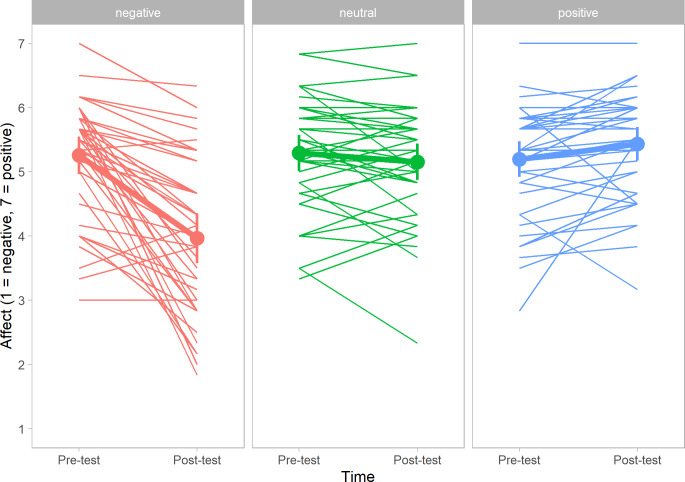
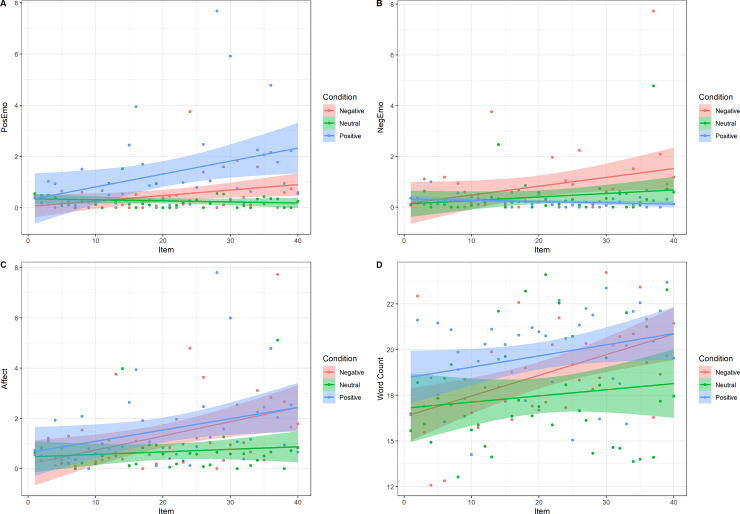
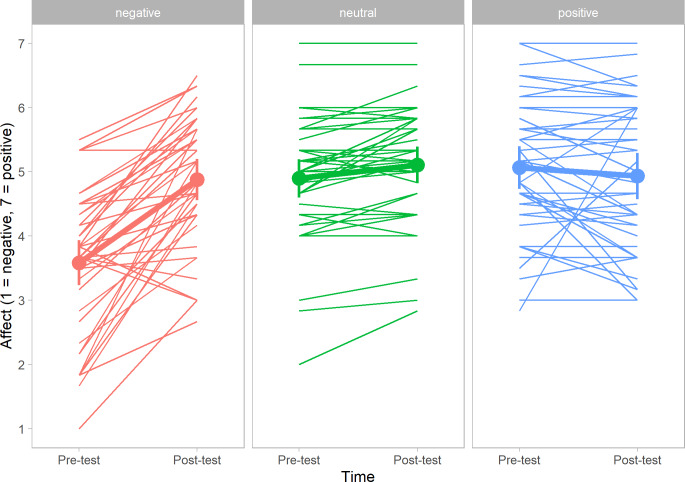
In this paper, we study the effect of verbalizing affective pictures on affective state and language production. Individuals describe (Study I: Spoken Descriptions of Pictures) or passively view (Study II: Passively Viewing Pictures) 40 pictures for the International Affective Picture System (IAPS) that gradually increase from neutral to either positive or negative content. We expected that both methods would result in successful affect induction, and that the effect would be stronger for verbally describing pictures than for passively viewing them. Results indicate that speakers indeed felt more negative after describing negative pictures, but that describing positive (compared to neutral) pictures did not result in a more positive state. Contrary to our hypothesis, no differences were found between describing and passively viewing the pictures. Furthermore, we analysed the verbal picture descriptions produced by participants on various dimensions. Results indicate that positive and negative pictures were indeed described with increasingly more affective language in the expected directions. In addition to informing our understanding of the relationship between (spoken) language production and affect, these results also potentially pave the way for a new method of affect induction that uses free expression.
在本文中,我们研究了言语化情感图片对情感状态和语言产生的影响。个体描述(研究 I:图片的口头描述)或被动观看(研究 II:被动观看图片)国际情感图片系统(IAPS)中的 40 张图片,这些图片的内容逐渐从中性变为积极或消极。我们预计这两种方法都会成功地引起情感,并且言语描述图片的效果会强于被动观看图片。结果表明,描述消极图片后,说话者确实感到更消极,但描述积极(与中性相比)图片并不会导致更积极的状态。与我们的假设相反,描述和被动观看图片之间没有发现差异。此外,我们还分析了参与者在各种维度上产生的口头图片描述。结果表明,积极和消极的图片确实以预期的方式用越来越多的情感语言来描述。除了加深我们对(口语)语言产生和情感之间关系的理解外,这些结果还为使用自由表达的新情感诱导方法铺平了道路。